




AI Governance Framework: A Practical Guide for Enterprises (2026)

 Updated on Sep 04, 2026
Your board wants a straight answer: are the AI systems your teams have rolled out safe, legal, and aligned with the business? If you cannot answer with confidence, you are not alone.
An AI governance framework is the structured set of policies, roles, and controls that guides how your organization builds, deploys, and monitors AI systems so they stay compliant, ethical, and aligned with your business goals. Get it right, and AI becomes a durable source of value. Get it wrong, and you expose the business to regulatory penalties, reputational damage, and operational failures.
The stakes are real. The EU AI Act (2024) carries penalties under Article 99 of up to 35 million euros or 7% of global annual turnover for the most serious violations. In the US, the Colorado AI Act (SB24-205) and New York City Local Law 144 on automated employment decisions are already in force.
This guide walks you through what good governance looks like, how the major reference frameworks compare, and how to actually put one into practice.
Key Takeaways
- An AI governance framework combines policy, roles, tooling, and monitoring. It is a working system, not a document you write once.
- The four dominant reference points in 2026 are NIST AI RMF, ISO/IEC 42001, the EU AI Act, and OECD AI Principles. Each plays a different role, and most mature programs combine more than one.
- For the most serious violations, EU AI Act penalties can reach 35 million euros or 7% of global annual turnover. Enforcement is phased across 2026 to 2028, not switched on all at once.
- In the US, sector regulators including the FDA, CFPB, and FTC, plus state laws in Colorado, California, Illinois, and New York, all shape how enterprises govern AI.
- Implementation is iterative. Most enterprises loop through inventory, risk assessment, and framework selection rather than running the steps once in strict order.
- Agentic and generative AI introduce governance requirements you cannot ignore in 2026, from permission boundaries to output monitoring at scale.
What Is an AI Governance Framework?
An AI governance framework is a structured set of policies, roles, processes, and technical controls that guides how your organization designs, deploys, and monitors AI systems across their full lifecycle. It covers everything from data selection and model training through deployment, ongoing monitoring, and eventual decommissioning. The point is to produce trustworthy AI systems that meet your legal, ethical, and business requirements while staying accountable to the people they affect.
Here is where most companies get confused. A governance framework is not an AI ethics statement, and it is not just a compliance checklist. Ethics statements describe values but rarely change how engineering teams work. Compliance checklists cover a specific regulation but miss the reality of running models in production. Governance brings both together and adds the operational layer: who approves what, how AI inventory is tracked, what happens when a model drifts, and how audit trails stay ready for a regulator. That last part matters most.
A simple mental model: think of governance as three overlapping layers.
| Layer | What it does | Who owns it |
| Strategic | Sets values, principles, and risk appetite | Board, executive team, ethics reviewers |
| Operational | Defines policies, roles, and processes | Governance officer, legal, compliance, risk |
| Technical | Embeds controls in the ML pipeline | Engineering, MLOps, security |
Most enterprises are strong in one or two layers and weak in the third. The technical layer is the most common gap, because policy teams can write governance documents faster than engineering teams can implement the controls.
These three layers work together across the AI lifecycle. The seven capabilities below are the practical building blocks that connect them.
Why Enterprises Need an AI Governance Framework
Three forces are pushing this to the top of the CTO agenda in 2026.
- Regulatory pressure is stacking up. The EU AI Act, NIST AI RMF, the Colorado AI Act, and enforcement activity from the FTC, FDA, CFPB, and EEOC all shape how enterprises deploy AI in the US. Each carries different obligations, which we cover in the framework comparison below.
- Reputational risk now lands in board packs. A single mishandled AI system can trigger customer churn, regulatory scrutiny, and lasting reputational damage.
- Operational risks compound quietly between reviews. Model drift, hallucinations, and biased outcomes can gradually erode the value of AI investments in the gaps between formal reviews. Silence is not safety.
Core Components of an AI Governance Framework
Seven capability areas recur across mature governance programs of every size. Rather than build all seven at once, most successful programs stage them over 12 to 18 months and iterate.
Policy, Principles, and Acceptable Use
Every program needs a written foundation. This includes AI policies and standards, acceptable use policies for employees and vendors, and a short set of principles that connect back to your company values. Keep the policies short enough that engineers will actually read them. If a policy runs longer than five pages, it will sit unread in a compliance folder and change nothing about how teams build systems. Short beats comprehensive.
Risk Classification and Tiering
You cannot govern every AI use case the same way. Build a method for placing each system in a risk tier such as minimal, limited, high, or unacceptable. That tier then decides what controls apply. A chatbot that answers internal HR questions needs a different level of review than a credit-scoring model that affects lending decisions. Tier first, control second.
Roles and Accountability
Clear lines of responsibility beat elaborate committee structures every time. Name a governance officer or Chief AI Officer, appoint AI risk officers, designate ethics reviewers, and clarify who has authority for approving, overriding, or escalating decisions. Document responsibilities at every level, so when something goes wrong there is no confusion about who owns the fix. Names, not committees.
Model Lifecycle Controls
Governance has to be embedded in every stage of the ML lifecycle, from secure data pipelines and documented validation through staged deployment and monitoring. This is the technical layer, and it is where engineering teams plug in most often. Data provenance controls matter especially here, because training-data manipulation is a recognized adversarial attack against enterprise AI systems. Provenance is the defense.
Compliance and Regulatory Alignment
Map each AI system to the regulations that apply. A US fintech serving EU customers has to consider PCI-DSS, GDPR, KYC/AML rules, CFPB guidance on AI in credit decisions, and the applicable phase of the EU AI Act at the same time. Without this mapping, you cannot tell whether a control gap is a paperwork problem or a legal exposure.
Documentation and Transparency
Model cards, data sheets, decision explanations, and traceable records are what let you defend a decision when a regulator, auditor, or customer asks how it was made. Black box models without documentation cannot be defended, and an undocumented decision is far harder to justify under review. Write it down as you go.
Continuous Monitoring and Incident Response
Governance is only credible when there are mechanisms to audit outcomes after a system is live, not just before it is deployed. That means MLOps pipelines with monitoring dashboards, real-time drift detection, bias testing, incident logs, and threat detection tuned for AI-specific risks. In our engagements we typically build these controls on stacks that include MLflow, Kubeflow, and cloud-native monitoring tools, wrapped in ISO 27001-aligned security controls. None of this is optional.
Comparing the Major AI Governance Frameworks
The four most cited reference frameworks in 2026 look similar on the surface, but they do genuinely different jobs. Reading them as competing products leads to bad decisions. Reading them by primary role makes it clear why most enterprises use more than one at the same time. The question is not “which one” but “which combination.”
| Framework | Publisher | Primary Role | Type | Best fit for |
| NIST AI RMF 1.0 | US NIST | AI governance and risk management; under active revision as of 2026 | Voluntary framework | US enterprises, federal contractors, risk-focused programs |
| ISO/IEC 42001:2023 | ISO/IEC | Establishing and improving an AI Management System | Certifiable management-system standard | Global enterprises seeking third-party certification |
| EU AI Act | European Union | Legal compliance; binding regulation, phased applicability 2026 to 2028 | Legally binding regulation | Any company placing AI on the market or serving users in the EU |
| OECD AI Principles | OECD | High-level policy direction and responsible AI; updated 2024 | Voluntary principles, not an implementation framework | Board and C-suite alignment on values |
1. NIST AI RMF 1.0
NIST AI RMF 1.0 is one of the most widely adopted voluntary AI risk management frameworks in the US. It provides a structured approach to identifying, assessing, and managing AI risks throughout the system lifecycle. The framework also pairs well with the NIST Cybersecurity Framework (CSF) 2.0, making it a practical choice for organizations that already have a mature cybersecurity program. For most teams, this is the pragmatic default.
Best for: US enterprises, organizations with significant regulatory exposure, and teams building risk-based programs.
Note: NIST is actively evolving its AI risk management guidance. Treat it as a living standard and review your controls periodically as the guidance develops.
2. ISO/IEC 42001:2023
ISO/IEC 42001:2023 is the first international management-system standard designed specifically for AI. It defines requirements for establishing, implementing, maintaining, and continually improving an AI Management System (AIMS).
Its key differentiator is the path toward third-party certification. That matters when customers, partners, or procurement teams require independent evidence that your governance processes meet an established standard. Procurement teams increasingly ask.
Best for: Global enterprises, organizations answering procurement requirements, and companies seeking formal certification.
3. The EU AI Act
The EU AI Act differs from NIST AI RMF and ISO/IEC 42001 because it is a binding regulation, not a voluntary framework or management standard. It takes a risk-based approach and establishes specific requirements for different categories of AI system, including additional obligations for high-risk systems.
The regulation is being implemented in phases, with major obligations taking effect on different dates. Organizations that place covered AI systems on the EU market may be subject to it even if they are headquartered outside the European Union. Geography is no shield.
Best for: Organizations developing, deploying, importing, distributing, or providing covered AI systems in the EU market.
4. OECD AI Principles
The OECD AI Principles provide high-level, values-based guidance covering human rights, fairness, transparency, robustness, security, and accountability. Unlike NIST AI RMF or ISO/IEC 42001, they are not designed to function as a detailed implementation framework. They are more useful for establishing an ethical and strategic baseline.
Use the principles to align executives and boards around responsible AI, then translate them into operational and technical controls using NIST AI RMF, ISO/IEC 42001, and the regulations that apply to you. Principles alone govern nothing.
Best for: Executive teams, boards, policymakers, and organizations establishing responsible AI principles.
Which framework should you adopt?
Consider three common scenarios.
- A US fintech serving EU customers does not choose between NIST and the EU AI Act. It uses NIST AI RMF to structure its internal risk program, must comply with the EU AI Act as a legal requirement for its EU-facing product, and may pursue ISO/IEC 42001 certification later as third-party proof that its management system holds up.
- A US healthcare provider running AI in clinical or operational settings layers HIPAA and, for medical devices, FDA guidance on AI/ML software as a medical device on top of any framework choice.
- A board that wants a values statement in its annual report leans on OECD AI Principles for the high-level language while the CTO and compliance leaders build the operational plumbing underneath.
How to Implement an AI Governance Framework: A 7-Step Roadmap
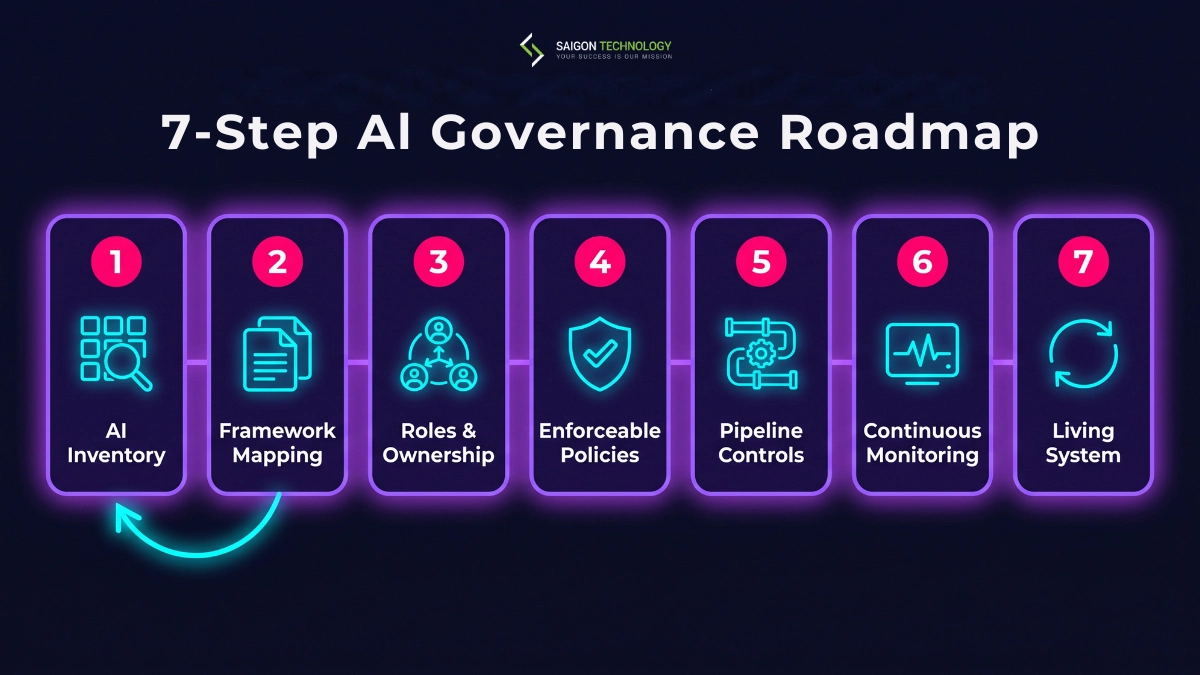
Implementation is rarely a straight line. Steps 1 and 2 loop rather than run once, because inventory changes how you assess risk and which frameworks apply. The seven steps below are the durable sequence most programs converge on, but expect to iterate.
1. Start with an honest AI inventory
You cannot govern what you cannot see. Build a central register of every model, third-party AI service, shadow AI use case, and embedded AI feature in your SaaS stack. Classify each by risk tier using the categories your chosen frameworks recognize. Expect the first pass to surface more AI in production than your governance team knew about. That surprise is the point.
2. Map your regulatory and framework obligations
Work out which frameworks and regulations apply to each use case. That usually means some combination of NIST AI RMF, ISO/IEC 42001, the EU AI Act, sector rules like HIPAA or CFPB guidance, and state laws like the Colorado AI Act. Expect to repeat steps 1 and 2 together in the first six months, because each pass reveals gaps in the other. Expect two passes.
3. Assign governance responsibilities and roles
Name a governance officer or Chief AI Officer, appoint AI risk officers, and designate ethics reviewers. Clarify who has authority for approving, overriding, escalating, or vetoing decisions. Document these responsibilities so there is no confusion about ownership when something goes wrong. Mid-sized companies without a dedicated Chief AI Officer can assign the role to an existing leader with cross-functional influence.
4. Write policies people will actually use
Draft policies covering acceptable use, model development, third-party AI, data handling, and human oversight. Then test them with the engineers and business users who have to live with them. Policy-driven workflows should be enforceable at the tool layer, not just described in a PDF. If your acceptable use policy cannot be enforced in your identity provider or AI platform admin console, it will not survive contact with reality.
5. Move controls into your ML pipeline
Shift controls left into data, training, validation, deployment, and monitoring, rather than treating governance as a final gate before launch. Documented validation, automated bias testing, and secure data pipelines with clear provenance make governance operational.
“Most governance programs fail at the pipeline, not the policy. If bias tests and drift checks are not gated in CI, they become a quarterly reminder, and a reminder never blocks a bad model from reaching production.”
– Phong Le, Tech Lead (AI, Python) at Saigon Technology

Our Loan City project applied this approach by combining automated loan matching with compliance and audit management, centralized monitoring, and traceable processes.
6. Monitor continuously, not quarterly
Deploy MLOps pipelines with real-time drift detection, compliance dashboards, incident logs, and threat detection for AI-specific attacks like prompt injection. Aim for real-time monitoring on high-risk systems and daily or weekly reviews on lower-risk ones. Quarterly reviews are not enough for anything customer-facing. Weekly is the floor.
7. Treat the framework as a living system
Plan for reviews every six months, ongoing training for engineers and business users, and structured updates as regulations and models evolve. Governance that is not maintained decays into shelfware within a year. Budget for upkeep from the start.
Steps 5 and 6 are where most enterprises bring in an external partner, because controls have to be built into pipelines rather than described in policy. Our AI development services and custom software development teams work with US clients on exactly that layer.
Common AI Governance Challenges (and How to Solve Them)
Even well-designed programs run into predictable problems. Here are the five we see most often.
Shadow AI
- Problem: Employees adopt consumer AI tools faster than IT can approve them, creating security, privacy, and compliance exposure.
- Solution: Publish a clear acceptable use policy, maintain a governed AI inventory that includes third-party subscriptions, and offer sanctioned enterprise alternatives.
Model drift and monitoring blind spots
- Problem: Models that perform well at launch can degrade as data, user behavior, or business conditions change. Without clear monitoring and ownership, these changes may go undetected.
- Solution: Implement drift and performance monitoring, scheduled model validation, and clearly assigned ownership for escalation and remediation.
Third-party model risk
- Problem: Foundation models and vendor APIs introduce unknown training data, hidden weaknesses, and unannounced changes.
- Solution: Run vendor due diligence, add contractual protections around model updates, and test independently before production use.
Talent gap in AI risk and compliance
- Problem: Governance officers, AI ethicists, and AI risk officers are scarce, and hiring is slow.
- Solution: Combine internal upskilling with external expertise, and lean on established frameworks rather than inventing controls from scratch.
Governance versus speed tension
- Problem: Product teams see governance as a slow gate that blocks releases.
- Solution: Shift controls into the pipeline, automate what you can, and reserve human review for genuinely high-risk decisions.
We saw this pattern play out on the healthcare EHR engagement documented in our HealthTech case study, where audit trails and access controls were built into the delivery pipeline from the first sprint rather than retrofitted before launch. Regulated data leaves no room for retroactive controls.
AI Governance for Agentic and Generative AI in 2026
Agentic and generative AI are where governance has to evolve fastest in 2026. Static policies written for classical ML models do not cover systems that autonomously choose tools, generate content at scale, or hand tasks to other agents. If your 2025 program did not explicitly address these categories, you have work to do.
Agentic AI
Autonomous agents introduce a new class of risk. They take actions, hold memory, and often coordinate with other agents, so controls have to move beyond model-level review into agent-level authorization and logging.
| Risk | Control |
| Unauthorized actions | Permission boundaries |
| Excessive autonomy | Human approval gates |
| Agent identity | Scoped access and credential rotation |
| Multi-agent failures | Logging and circuit breakers |
| Memory accumulation | Retention and audit controls |
Generative AI
Generative AI systems produce content at volumes that break traditional review models. Sampling-based review is no longer enough for anything customer-facing, so controls have to run automatically in line with generation. Sampling will not scale.
| Risk | Control |
| Hallucination | Grounding and output validation |
| Prompt injection | Input validation and untrusted-input handling |
| Data leakage | Data classification and output filtering |
| Copyright | Content provenance tracking |
| Unsafe output | Automated output monitoring |
Governance for these systems has to be engineered into the platform, not bolted on afterward. If you are running foundation models or agentic workflows in production without these controls today, that is where your program should focus next.
FAQs
What are the pillars of an AI governance framework?
Most mature programs cover seven capability areas: policy and principles, risk classification, roles and accountability, model lifecycle controls, compliance mapping, documentation and transparency, and continuous monitoring. Not every framework mandates the same components, but this is the set enterprise programs converge on in practice.
Is AI governance the same as AI ethics?
No. AI ethics defines the values a system should uphold, such as fairness, human rights, and transparency. AI governance is the operational system that turns those values into policies, roles, controls, and monitoring. An ethics board without governance produces principles that never change engineering behavior.
How is AI governance different from data governance?
Data governance manages the data assets your organization holds, including quality, access controls, and provenance. AI governance covers the full AI system, which includes data but also models, deployment, monitoring, and human oversight. Strong AI governance depends on strong data governance, but it adds a model-lifecycle layer on top.
Do small companies need an AI governance framework?
Yes, but proportional to your AI risk exposure. A small company using off-the-shelf AI for internal productivity needs a lightweight acceptable use policy and vendor review process. A small company building AI products for regulated US industries needs a full program from day one, because regulators do not scale their expectations to company size.
What does it cost to implement?
Costs depend on scope, existing maturity, and industry. Enterprises typically invest in AI risk officers, tooling for inventory and monitoring, external audit or consulting support, and engineering effort to embed controls into pipelines. Working with an experienced engineering partner at published rates of $22-$46 per hour keeps the pipeline-level work predictable, and a phased approach lets your team show measurable impact before broader rollout.
Where to Start
Good governance turns AI principles into a practical operating system. In 2026 that means building an AI inventory, mapping applicable frameworks and regulations, and embedding controls into the AI lifecycle. NIST AI RMF, ISO/IEC 42001, the EU AI Act, and OECD AI Principles provide useful reference points, but the goal is to combine them into a program that fits your own risk profile. Pick one and start.
Where to focus first depends on where you are today. If you are early in the journey, start with the inventory and role definition. If you have policies in place but limited operational depth, the technical layer is where most programs get stuck next. Start there.
Saigon Technology is an AI-native software engineering partner, founded in 2012, with 400+ engineers and 100+ AI projects delivered across healthcare, fintech, and logistics. If operationalizing governance is on your roadmap, our AI engineering team is happy to talk through what that looks like in practice.


Related articles
The Decision-Maker’s Guide to Outsourcing AI and Machine Learning Projects
 Thanh (Bruce) Pham - CEO of Saigon Technology
  18 Mar 2026
AI in Fintech: A 2026 Builder’s Guide to Use Cases, Architecture and Regional Rules
04 May 2026 
Vibe Coding Security: Risks of AI Code
22 Jun 2026 
LLM Security Risks: What Every CTO Must Know Before Shipping AI Features
25 Jun 2026 
AI Code Review: Best Tools, Features, Pricing & Comparison Guide (2026)
03 Jul 2026 
AI-Augmented Software Development: A Practical Guide for Engineering Leaders (2026)
08 Jul 2026 
AI Readiness Assessment: Scoring Whether You Can Actually Build
20 Aug 2026 
10 AI Implementation Challenges Derailing Projects in 2026
31 Aug 2026