


LMS Development Cost in 2027: Complete Pricing Breakdown

 Updated on Nov 26, 2026
LMS development cost ranges from $20,000 for an MVP to $500,000+ for an enterprise platform, determined by feature scope, compliance needs, and team rates. Saigon Technology builds custom learning management systems at $22 to $46 per hour, helping organizations cut per-user licensing fees and own their training infrastructure long-term. This guide breaks down pricing by tier, phase, and industry so you can set an accurate budget before development starts.
Key Takeaways
- Basic LMS: $20,000 to $45,000 (1 to 3 months).
- MVP / Pilot LMS: $45,000 to $90,000 (3 to 5 months).
- Mid-market LMS: $90,000 to $180,000 (4 to 8 months).
- Enterprise LMS: $180,000 to $350,000+ (9 to 18+ months).
- SaaS LMS pricing: typically $5 to $25 per user per month.
- Additional costs: integrations, API fees, hosting, security, compliance, and maintenance (typically 15% to 20% of initial development costs annually).
How Much Does It Cost to Build an LMS?
Building a learning management system typically costs between $20,000 and $350,000+, depending on project scope, feature complexity, integration requirements, and expected user volume. Most projects fall into four categories: Basic, MVP / Pilot, Mid-Market, and Enterprise.
The table below outlines the estimated development costs, timelines, and core capabilities for each project type.
| Scope Tier | Cost Range | Timeline | Key Features |
| Basic LMS | $20,000 to $45,000 | 1 to 3 months | User registration, role management, course and lesson creation, video/document delivery, basic quizzes, and learner progress tracking |
| MVP / Pilot | $45,000 to $90,000 | 3 to 5 months | User management, course management, assessments, progress tracking, certificate generation, and basic admin dashboards |
| Mid-Market LMS | $90,000 to $180,000 | 4 to 8 months | Advanced dashboards, mobile learning, SSO and HRIS integrations, analytics, gamification, and automated learning workflows |
| Enterprise LMS | $180,000 to $350,000+ | 9 to 18+ months | Multi-tenant architecture, custom workflows, advanced analytics, complex integrations, AI-powered learning features, and enterprise compliance requirements |
These estimates reflect different levels of development scope and complexity. Actual costs depend on the features required, technical architecture, integration requirements, team composition, and scalability needs.
At Saigon Technology, our software development rates range from $22 to $46 per hour. Our Vietnam-based engineering teams work with technologies including React, Angular, .NET, Node.js, and Python to build scalable learning management platforms for businesses and education providers.
LMS Development Cost Breakdown by Feature
Each LMS feature carries its own development cost based on technical complexity, number of integrations, and security requirements. The table below shows what to expect per module when building a learning management system.
| LMS Feature | Estimated Cost | What’s Included |
| User Management & Authentication | $3,000 to $8,000 | User registration, login, role-based access control (RBAC), learner and instructor profiles, permission management |
| Course & Content Management | $8,000 to $20,000 | Course creation, content uploads, lesson organization, learning paths, multimedia delivery, course administration |
| Assessment & Certification | $5,000 to $15,000 | Quizzes, question banks, automated grading, assignment submissions, certificate generation |
| Progress Tracking & Reporting | $5,000 to $15,000 | Learner progress dashboards, course completion tracking, performance reports, analytics |
| Communication & Collaboration | $4,000 to $12,000 | Discussion forums, announcements, messaging, notifications, instructor-learner interactions |
| Payment & Subscription Management | $3,000 to $8,000 | Course payments, subscription plans, payment gateway integration, transaction records |
| Third-Party Integrations | $5,000 to $20,000+ | HRIS, CRM, ERP, SSO providers, video conferencing, external content providers (SCORM, xAPI) |
| Advanced Analytics & AI Features | $10,000 to $35,000+ | Personalized learning recommendations, AI-assisted content generation, predictive analytics, automated learning insights |
Most organizations start with the first four core modules ($21,000 to $58,000) and add communication, payment, integrations, and AI features in later development sprints.
The cost per feature scales with customization depth. A standard quiz engine with multiple-choice questions costs less than an adaptive assessment system that adjusts question difficulty based on learner performance. Similarly, basic progress tracking with completion percentages is significantly cheaper than an analytics dashboard with custom KPIs, cohort comparisons, and exportable reports.
LMS Development Cost Breakdown by Phase
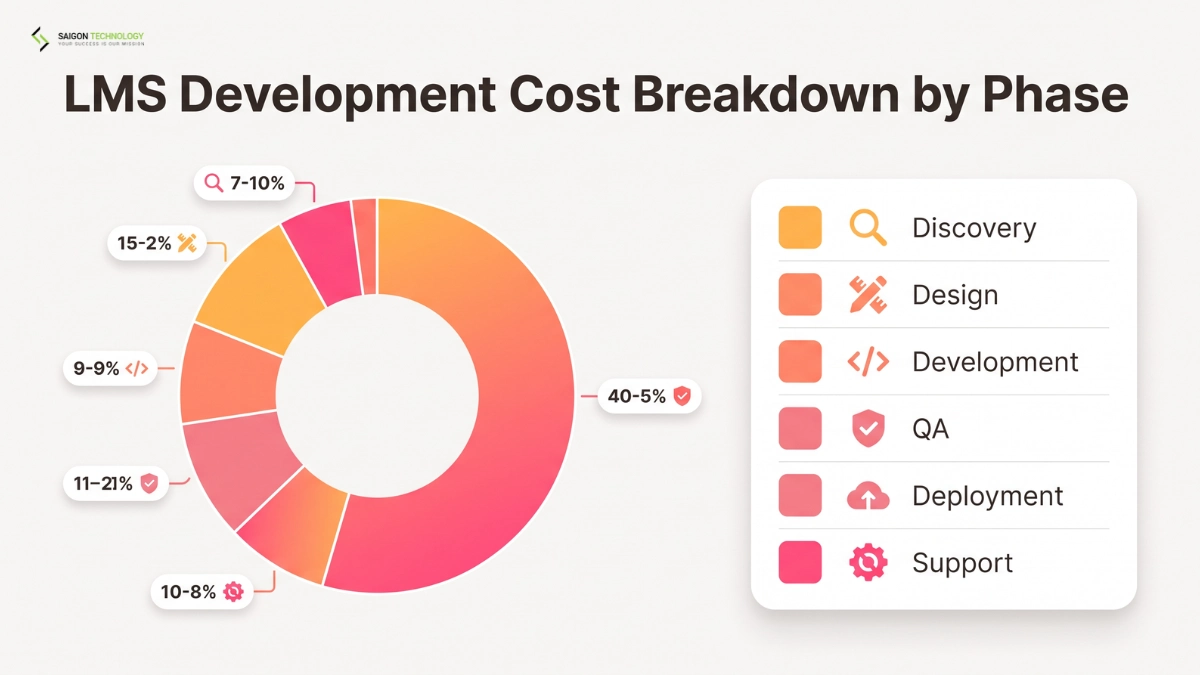
Understanding where your budget goes helps you make smarter decisions about scope and sequencing. Here is how a typical LMS development budget breaks down across six phases.
| Phase | Estimated Cost | Budget Allocation | What’s Included |
| Discovery & Planning | $2,000 to $10,000 | 5 to 8% | Requirements analysis, stakeholder interviews, wireframes, technical feasibility, system architecture, and project roadmap |
| UI/UX Design | $4,000 to $15,000 | 8 to 12% | User research, interface design, interactive prototypes, responsive layouts, and accessibility considerations |
| Core Development | $20,000 to $300,000+ | 50 to 60% | Frontend and backend development, database architecture, user management, course management, assessments, reporting, and third-party integrations |
| QA Testing & Security | $5,000 to $50,000 | 12 to 18% | Functional testing, integration testing, performance testing, security validation, and user acceptance testing |
| Deployment | $2,000 to $10,000 | 3 to 7% | Cloud environment setup, CI/CD configuration, database migration, SSL configuration, and production deployment |
| Post-Launch Support | 15 to 20% of initial development cost per year | Ongoing | Bug fixes, security patches, performance monitoring, infrastructure maintenance, and feature enhancements |
Core development is the largest cost bucket. It accounts for 50 to 60% of the total budget and covers frontend interfaces, backend logic, database design, and API layers. The tech stack affects this cost directly. A React frontend with a Node.js backend and PostgreSQL database will have different cost implications than a .NET and Angular stack with Azure SQL.
Skipping discovery is the number-one cause of budget overruns. A proper requirements analysis phase typically saves 15 to 25% of the total project budget by preventing scope creep and rework during development.
7 Key Factors That Affect LMS Development Cost
Not every LMS project falls neatly into the three tiers above. These seven factors move the price up or down.
- Feature scope and complexity. Basic features such as user management and course creation cost less than advanced capabilities. AI-powered adaptive learning may add $15,000 to $40,000, while custom real-time video conferencing can add $20,000 to $50,000.
- Platform type. A web-only LMS generally costs less to develop than a web and mobile solution. Multi-tenant architecture may add $20,000 to $60,000 compared with a single-tenant platform.
- Custom UX/UI design. Template-based design typically costs $5,000 to $10,000, while fully customized interfaces with user research, prototyping, and WCAG 2.1 accessibility considerations can reach $25,000 to $30,000+.
- Complex integrations. Integrating HR/ERP systems, payment gateways, video conferencing, SCORM, or xAPI can cost $5,000 to $20,000 per integration, depending on API complexity and data synchronization requirements. For e-learning platforms that must support SCORM, xAPI, and LTI simultaneously, integration costs can reach the higher end of this range.
- Compliance and security. HIPAA-related safeguards, FERPA privacy controls, and SOC 2 security requirements increase development, testing, and documentation costs. Expenses depend on the applicable requirements and existing infrastructure; there is no fixed compliance fee.
- Developer rates and team location. Saigon Technology publishes software development rates of $22 to $46/hour and AI development rates of $26 to $46/hour. US senior engineering vendor rates can range from $100 to $200/hour, depending on expertise and engagement model.
- Scalability architecture. Monolithic architecture can reduce initial complexity, while microservices require additional investment in deployment, monitoring, and infrastructure. Costs depend on expected concurrent users, data volume, and scaling requirements.
Our 400+ engineers have delivered LMS and SaaS platforms on React, Angular, .NET, Node.js, and Python, each with different cost implications for your project.
Custom LMS vs. Off-the-Shelf: Total Cost of Ownership
Most learning management system pricing guides focus on the initial development price. However, the more important question for growing organizations is how building your own LMS compares with SaaS licensing over three to five years.
Consider an organization with 1,000 users. The following comparison uses a SaaS subscription of $10 per user per month and an LMS build budget of $120,000.
| Cost Factor | SaaS LMS (1,000 Users) | Custom-Built LMS |
| Initial Development | No upfront build cost | $120,000 |
| Year 1 Total | $120,000 | $143,000 to $149,000 |
| Year 3 Total | $360,000 | $189,000 to $207,000 |
| Year 5 Total | $600,000 | $235,000 to $265,000 |
| Per-user fees | $10/user/month | No fixed per-user license fee |
| Customization | Limited to vendor capabilities | Full control over features and workflows |
| Data ownership | Subject to vendor terms | Greater control over infrastructure and data |
| Ongoing costs | Recurring subscription fees | Maintenance and hosting |
Assumptions: Custom LMS development costs $120,000, annual maintenance is 15 to 20% of initial development cost, and hosting costs $5,000/year. SaaS pricing remains fixed at $10/user/month. Figures exclude taxes, third-party licenses, and major feature expansions.
For organizations with 1,000 users, SaaS licensing can accumulate to $600,000 over five years at $10 per user per month. A custom LMS with the same initial $120,000 development budget has an estimated five-year TCO of $235,000 to $265,000 under these assumptions.
SaaS offers lower upfront investment, vendor-managed updates, and faster deployment. Building a custom platform requires more initial capital but provides greater control over functionality, integrations, data, and long-term platform direction. The more users and specialized workflows an organization supports, the more important it becomes to evaluate total ownership costs rather than subscription fees alone.
Hidden and Ongoing LMS Maintenance Costs
The initial LMS development budget does not cover every expense. After launch, organizations need to account for ongoing maintenance, infrastructure, software licenses, and technical support to keep the platform secure and reliable.
| Cost Category | Estimated Cost | What It Covers |
| Maintenance and Updates | 15 to 20% of initial development cost/year | Bug fixes, security patches, framework updates, and performance improvements |
| Cloud Hosting and Infrastructure | $500 to $3,000+/month | Cloud servers, databases, file storage, backups, and content delivery |
| Third-Party Licenses and APIs | $100 to $1,000+/month | Video conferencing, email services, payment gateways, analytics, and other external tools |
| Technical Support and Monitoring | $1,000 to $5,000+/month | System monitoring, incident response, troubleshooting, and user support |
Actual costs depend on the number of active users, data storage requirements, traffic volume, service-level agreements, and third-party providers. These figures are planning estimates, not fixed vendor prices. Some support and infrastructure costs may also overlap depending on the service agreement.
Budget for LMS maintenance from the beginning. A platform serving 500 users has different infrastructure and support requirements from one serving 50,000 users. Estimating these recurring expenses before development helps organizations plan the total cost of ownership (TCO), rather than focusing only on the initial build price.
How to Reduce LMS Development Costs
Reducing LMS project costs starts with controlling scope, choosing the right technology, and planning for future requirements. These six practices help organizations manage budgets without compromising essential functionality.
Start with an MVP and Iterate
The most effective way to control LMS development cost is to launch with only the features your learners need on day one. That means user management, course management, assessments, and progress tracking.
Saigon Technology’s LMS development pricing starts at $45,000 to $90,000 for an MVP or pilot at this scope. From there, add advanced features in later releases based on user feedback and business priorities, not assumptions about what learners might need.
Use Pre-Built Integrations and Open-Source Components
Beyond scope control, the next biggest savings come from reusing what already exists. Established libraries for authentication, notifications, and content management eliminate weeks of development time.
Before building custom integrations, evaluate SCORM and xAPI-compatible tools that are already available as tested open-source packages. This approach can reduce implementation effort by 20 to 30%, depending on project requirements.
Choose an Architecture That Supports Future Growth
While controlling scope and reusing components save money upfront, architecture decisions affect long-term costs. Consider expected user volume, content delivery needs, integrations, and reporting requirements before selecting an architecture.
A well-planned architecture reduces the need for major refactoring as the platform grows. That said, microservices are not necessary for every LMS project. A modular monolithic architecture may be more cost-effective for an initial release, with the option to extract services later as traffic and complexity increase.
Work with a Dedicated Development Team
Even with the right scope and architecture, team cost remains the single largest budget variable. An offshore dedicated development team provides access to experienced engineers without the overhead of building an entire in-house department.
Saigon Technology’s software development rates range from $22 to $46 per hour, depending on project requirements and team composition. This single decision can reduce total project cost by 50 to 70% compared to US-based teams at equivalent skill level.
Prioritize Features Using the MoSCoW Method
Alongside team selection, feature prioritization determines how far your budget goes. Classify requirements as Must-have, Should-have, Could-have, or Won’t-have for the initial release.
This framework helps teams focus spending on essential LMS capabilities while deferring features that are not immediately necessary. Organizations that apply MoSCoW prioritization typically cut 15 to 25% from initial scope without sacrificing what matters most.
Invest in Project Discovery and Requirements Planning
Finally, all the cost-saving strategies above depend on clear requirements. Define user roles, learning workflows, integrations, security requirements, and acceptance criteria before development begins.
Clear requirements reduce scope changes, avoid unnecessary rework, and establish a more realistic project budget. A structured discovery phase typically saves 15 to 25% of the total project budget by preventing scope creep and rework during development.
FAQs
1. How much does it cost to build a custom LMS?
Custom LMS development cost typically ranges from $20,000 to $350,000+, depending on platform complexity, features, integrations, and scalability requirements. A basic LMS costs $20,000 to $45,000, an MVP or pilot LMS costs $45,000 to $90,000, a mid-market platform costs $90,000 to $180,000, and an enterprise LMS starts at $180,000 and can exceed $350,000.
2. How long does it take to develop an LMS?
LMS development typically takes 1 to 3 months for a basic platform, 3 to 5 months for an MVP or pilot, 4 to 8 months for a mid-market LMS, and 9 to 18+ months for an enterprise solution. Timelines depend on feature complexity, integrations, security requirements, data migration, and team size. Extensive customization or compliance requirements may extend the schedule.
3. How much does it cost to add AI features to an LMS?
Adding AI features to an LMS typically costs $10,000 to $60,000+, depending on functionality, data requirements, and integration complexity. AI course recommendations may cost $10,000 to $20,000, adaptive learning paths $15,000 to $25,000, and custom machine learning models $25,000 to $60,000+. These are indicative estimates, not fixed development prices.
4. Can an LMS be customized for a specific industry?
Yes. A custom LMS can be tailored to industry-specific training workflows, user roles, reporting needs, and compliance requirements. For example, healthcare LMS platforms may require HIPAA-related safeguards, while financial services LMS platforms may include KYC/AML training and compliance reporting. Education platforms may need SCORM, xAPI, LTI, and student information system integrations.
5. Can an LMS integrate with existing HR or ERP systems?
Yes. A custom LMS can integrate with HR systems, ERP platforms, CRM software, payroll tools, and identity providers through APIs or pre-built connectors. These integrations can synchronize employee records, automate user enrollment, track training completion, and connect learning data with existing business workflows. Integration costs depend on API availability, data complexity, and the number of systems involved.
Why Choose Saigon Technology for Your LMS Project?
Saigon Technology helps organizations plan and build LMS platforms tailored to their training objectives, user needs, and technical requirements. Here is what we bring to your LMS project:
- LMS development services built around your learning workflows, from employee onboarding to learner performance tracking.
- 400+ engineers working with React, Angular, .NET, Node.js, and Python for frontend, backend, APIs, and third-party integrations.
- Education platform experience: Lumina (e-learning with course delivery, video lessons, quizzes, certificates) and Scholar OS (LMS + CRM for education management).
- Scalable dedicated teams to build, extend, or maintain your LMS as your user base grows.
- Transparent pricing at $22 to $46 per hour, depending on project requirements and team composition.
Saigon Technology is a Microsoft Gold Partner with ISO 9001 and ISO 27001 certification. Our engineering teams have delivered 850+ projects across healthcare, fintech, and education over 14+ years.
Ready to scope your LMS project? Share your requirements with our team for a free project estimate within 48 hours.


Related articles

Custom Application Development: What Decision-Makers Need to Know Before They Build
 Thanh (Bruce) Pham - CEO of Saigon Technology
 17 Dec 2024
Custom Software vs Off-the-Shelf Solutions: A Side-by-Side Evaluation Framework
26 Mar 2026 
Staff Augmentation vs Outsourcing: A CTO’s Decision Framework
09 Jun 2026 
AI Code Review: Best Tools, Features, Pricing & Comparison Guide (2026)
03 Jul 2026 
Student Information System: A 2026 Guide for Schools
09 Oct 2026