




10 AI Implementation Challenges Derailing Projects in 2026

 Updated on Sep 03, 2026
According to RAND Corporation, some estimates suggest that more than 80% of AI projects fail, roughly twice the failure rate of non-AI IT projects. Gartner found that by the end of 2025, at least 50% of generative AI projects had been abandoned after proof of concept. The problem is rarely the technology. It is the AI implementation challenges enterprises underestimate.
AI implementation challenges are the technical, organizational, and governance obstacles that stop enterprises moving AI from proof of concept into scaled production. They fall into 10 recurring failure modes across five categories: data, talent, technology, strategy, and governance. This guide breaks down each one, shows how they shift by industry, and gives you a six-step framework for fixing them before they sink your next initiative.
Key Takeaways
- 80%+ of enterprise AI projects fail in production, and data quality sits at the root of most of them.
- The 10 biggest obstacles span data, talent, organizational change, legacy integration, scalability, strategy, cost/ROI, security, ethics, and expectations.
- 2026 adds four failure modes: agentic AI operationalization, EU AI Act enforcement, NIST AI RMF compliance, and model drift at production scale.
- A repeatable six-step framework turns those obstacles into shippable systems: assess readiness, define narrow use cases, build the data foundation, staff the team, deploy with MLOps, measure ROI.
- Treating AI as an engineering discipline rather than a research experiment is the strongest predictor of production success.
Why Enterprise AI Projects Fail: The 2026 Data
The failure rate is not anecdotal. Four independent studies from RAND, Gartner, McKinsey, and BCG reach the same conclusion: moving AI from experiment to scaled production is far harder than building the model, and the obstacles that stop it sit around the model rather than inside it.
- RAND (2024): some estimates suggest more than 80% of AI projects fail, roughly twice the rate of non-AI IT projects.
- Gartner (2025): by the end of 2025, at least 50% of generative AI projects had been abandoned after proof of concept, driven by poor data quality, inadequate risk controls, rising costs, or unclear business value.
- McKinsey (2024): only 11% of companies had adopted generative AI at scale, and just 15% reported a meaningful impact on EBIT.
- BCG (2024): top-performing companies were twice as likely to have the data pipelines and data management practices needed to source and store data for AI.
These findings converge on one point. AI projects rarely fail because of the model. The real challenges of AI implementation live in everything around it. Across 100+ AI projects, Saigon Technology’s engineering teams have seen the same 10 enterprise AI implementation challenges repeat across industries.
What Are AI Implementation Challenges?
AI implementation challenges are the specific technical, organizational, governance, and cultural obstacles that stop an enterprise taking an AI system from prototype into reliable production use. They sit downstream of AI adoption decisions. Adoption is a strategic choice; implementation is the engineering work that follows it.
The distinction matters because most reporting on “AI failure” conflates the two. A CEO deciding to pursue AI is not the same problem as an engineering team making a model production-ready on fragmented legacy data. This article is about the second: the execution layer.
AI adoption vs. AI implementation
| Dimension | AI Adoption | AI Implementation |
| Question answered | Should we use AI? | How do we ship AI reliably? |
| Owner | CEO, CIO, Board | CTO, VP Engineering, Head of Data |
| Success measure | Strategy approved | System in production with measurable business impact |
| Typical failure | Wrong problem chosen | Right problem, wrong execution |
Why 2026 is different: foundation model access is commoditized, so the challenges of AI implementation have moved upstream and downstream. Upstream sits data readiness and governance. Downstream sits model observability, agentic AI operationalization, and regulatory compliance under the EU AI Act and NIST AI RMF. The AI implementation challenges 2026 introduces are different in kind, not just in degree.
The 10 Biggest Challenges Enterprises Face in 2026
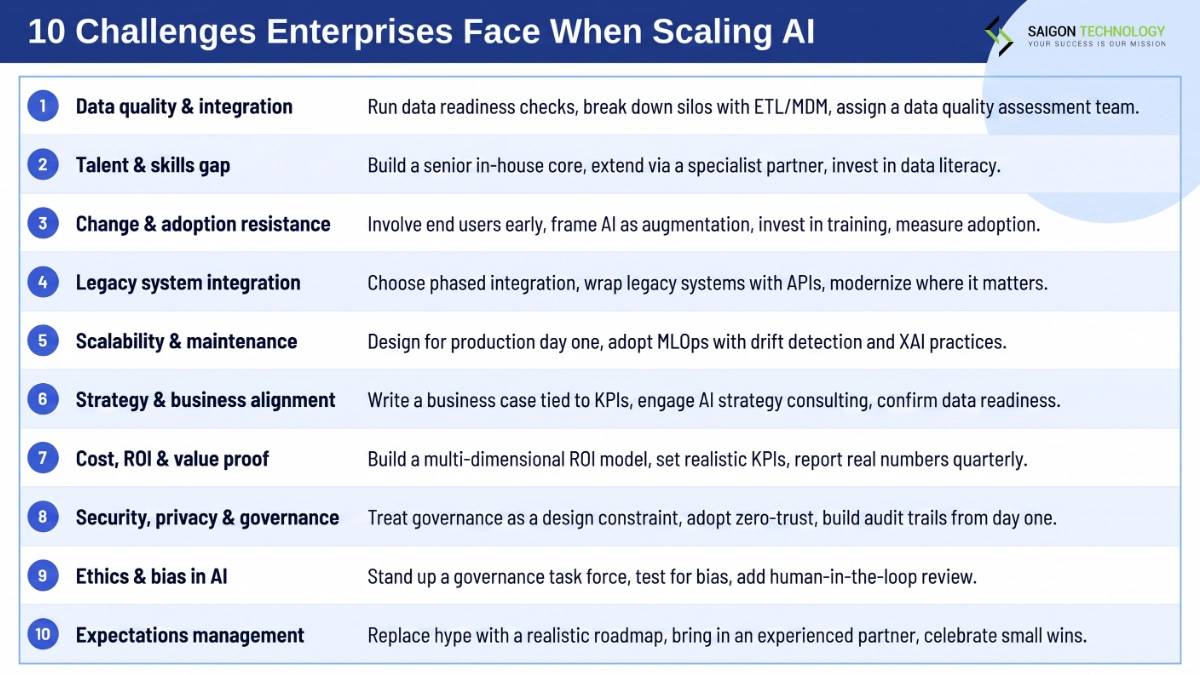
AI creates real business value, but getting it into production is rarely simple. Enterprises typically hit data, people, technology, cost, security, and adoption problems at once, in roughly this order of frequency. The 10 below are what our senior engineering teams meet most often.
1. Data quality and integration
Poor data quality is the single most cited cause of AI implementation failure. Models learn from data, and when it is inaccurate, incomplete, or trapped in silos, they amplify the problem at scale.
Enterprise records typically live across dozens of source systems: CRM, ERP, warehouses, SaaS tools, and departmental spreadsheets. Making them usable requires cleansing, validation, consistent formatting, and a working data governance framework. Most enterprises discover mid-project that their infrastructure is not ready.
Example: a retailer holds customer records in its website, CRM, and sales system. When those records disagree, the model builds the wrong customer profile.
How to solve it
- Run a data readiness check before any model work begins.
- Break down silos with ETL and integration tooling, centralized platforms, and master data management (MDM) tools.
- Assign a cross-functional team to a formal data quality assessment.
- Treat data readiness as the first deliverable, not an afterthought.
2. Talent and skills gap
The shortage of experienced AI talent is a structural constraint. Data scientists, machine learning engineers, MLOps specialists, and data engineers are all scarce, and enterprises competing with hyperscalers usually lose.
The gap goes beyond hiring. Successful delivery needs engineering discipline, lifecycle management, analytics literacy, and real collaboration between engineers, analysts, and domain experts. Data literacy across the wider organization matters as much as senior headcount.
How to solve it
- Build a small in-house core of senior AI engineering and MLOps leads, then extend capacity through a specialist partner.
- Invest in data literacy and reverse mentoring so business teams and engineers share a vocabulary.
- Saigon Technology’s Forward-Deployed AI Engineer model embeds senior AI engineers into your team while your in-house core ramps.
3. Organizational change and adoption resistance
A technically flawless system still fails if the people meant to use it resist it. Large-scale transformations consistently fall short on the people side, and AI is harder because it raises job security concerns directly.
Employee resistance is rational. Workers who fear replacement will not champion tools that automate their tasks. Change of this scope needs a formal strategy, cultural adoption planning, workforce readiness assessment, and sustained training. Without those it becomes the invisible bottleneck.
Example: a tool drafts reports in seconds, but staff keep working manually because they neither trust nor understand it.
How to solve it
- Involve end users in design from day one.
- Frame AI as augmentation rather than replacement, backed by concrete process examples.
- Invest in training as heavily as in the model. Measure adoption, not just accuracy.
4. Integration with legacy systems
Most enterprises run on infrastructure that predates modern AI. Mainframes, monolithic ERPs, on-premise systems, and fragmented pipelines are the reality, and integrating with them is where many pilots die.
The work involves middleware, integration platforms (iPaaS), modular architectures, and often a partial move to cloud. Fragmented records across on-premise and cloud environments create readiness gaps that surface only when the model consumes live production data.
“Teams assume the model is the hard part. In practice the blocker is usually the last mile: exposing clean, current data from a mainframe or monolithic ERP through an API the model can actually call in production.”
– Linh Pham, Senior Solution Architect, Saigon Technology
Example: a chatbot answers customer questions well but cannot help if it cannot reach order details in the company’s older system.
How to solve it
- Choose phased integration over a big-bang rewrite. Wrap legacy systems with APIs and expose data through middleware.
- Where the system warrants it, plan a targeted legacy application modernization effort alongside the rollout so integration is not a last-mile blocker.
5. Scalability and model maintenance
Getting a model working in a demo is easy. Keeping it accurate, fast, and secure in production for years is hard. Most AI projects never escape the gap between proof of concept and production, a stall pattern widely known as pilot purgatory.
Scalable architecture in 2026 usually combines cloud computing, hybrid infrastructure, and, where latency matters, edge computing. Scale is only half the problem. Model drift is real, retraining cycles are non-negotiable, and continuous monitoring, model security, version control, and healthy data pipelines are what separate a research artifact from a production system.
How to solve it
- Design for production on day one.
- Adopt MLOps with automated retraining, drift detection, and explainable AI (XAI) practices so stakeholders can audit model behavior.
- Build governance into the pipeline rather than around it.
6. Strategy and business alignment
Many AI initiatives start without a clear business case. A team gets excited about a technology, spins up a pilot, then asks what problem it solves. That sequence almost guarantees failure.
Successful delivery starts with defined business goals, measurable success metrics, and stakeholder alignment. It needs a compliance review, security policies matched to the data flows, and executive backing that survives several quarters. A pilot without those foundations is theatre.
How to solve it
- Start with a written business case tied to specific KPIs.
- Engage AI strategy consulting early to translate business goals into a technical roadmap.
- Confirm the data and operational foundations exist before committing engineering budget.
7. Cost, ROI, and value justification
AI is expensive to build and expensive to run. Infrastructure, integration work, specialized teams, pilots, and ongoing maintenance all compound. Boards want returns in quarters while realistic timelines run to years, and that gap kills momentum.
Impact is also harder to capture than in traditional software. Beyond efficiency gains, value shows up as cost avoidance, risk reduction, and quality improvements that resist mapping to a single KPI. XAI practices help finance leaders trust projected numbers, which unlocks the upfront investment production requires.
How to solve it
- Build a multi-dimensional ROI model covering efficiency, cost avoidance, risk reduction, and revenue enablement.
- Set realistic KPIs for each phase.
- Report quarterly with real numbers, not projections. Making returns visible early keeps executive support longer.
8. Security, privacy, and governance
These systems process sensitive data and make consequential decisions, which makes them a first-class security concern. In 2026 the risks include adversarial attacks, model exfiltration, prompt injection, and AI-specific incident response scenarios that existing playbooks do not cover.
A governance framework has to cover privacy regulation by jurisdiction (GDPR, HIPAA, PDPA and others), risk assessments tuned to AI workloads, zero-trust architectures, audit trails, and threat detection. Cross-functional teams spanning security, legal, and engineering are no longer optional in regulated industries.
How to solve it
- Treat governance as a design constraint, not a compliance afterthought.
- Build audit trails from day one and segment training data by sensitivity.
- Adopt zero-trust and secrets management (AWS KMS, Azure Key Vault, HashiCorp Vault) across the pipeline.
- Saigon Technology’s engineering teams work under ISO 27001, ISO 9001, and NDA-first engagement to meet the security bar enterprise buyers require.
9. Ethics and bias in AI
Bias creates business risk, regulatory risk, and reputational risk in equal measure. A hiring model that discriminates, a lending model that redlines, or a service model that answers differently by demographic can trigger enforcement action and brand damage.
Responsible delivery requires an ethics framework, formal governance, bias analysis at both data and output layers, and mitigation such as reweighting, adversarial debiasing, or human-in-the-loop review. Interpretability, validation, and transparency are not just ethical preferences. Under the EU AI Act they are legal requirements for high-risk systems.
Example: if past loan decisions were unfair to certain customers, a model trained on them will learn that pattern and reproduce it.
How to solve it
- Stand up a cross-functional governance task force spanning legal, compliance, engineering, and business.
- Test for bias across protected attributes before and after deployment.
- Build human-in-the-loop review for high-stakes decisions.
- Document data provenance and model logic to satisfy transparency obligations.
10. Expectations management
Unrealistic expectations are the quiet killer. Vendor hype and consumer demos set boardroom expectations well above what production systems deliver in year one. When results fall short, projects lose support before they can mature.
Managing expectations is both a leadership skill and an engineering discipline. It needs goals matched to current maturity, pragmatic roadmaps with incremental milestones, realistic budgeting, and continuous stakeholder communication. Executive support depends on trust, and trust depends on honesty about both opportunities and limits.
Example: a chatbot performs well in a demo but needs months more work to connect properly with the CRM, customer data, and business workflows.
How to solve it
- Replace “AI transformation” narratives with a written roadmap naming specific use cases, timelines, and outcomes.
- Bring in an experienced AI transformation partner early to calibrate what is realistic.
- Celebrate small production wins publicly. They build credibility that carries the program through harder problems.
How Enterprise AI Implementation Challenges Differ by Industry
The 10 obstacles are shared, but their weighting is not. Fintech, healthcare, retail, and SaaS organizations each face a different dominant risk driven by their data, regulators, workflows, and latency needs. The table shows which to plan for first in each sector.
AI implementation challenges by industry
| Industry | Biggest challenge | Typical failure mode | Compliance signals |
| Fintech / BFSI | Governance and regulatory compliance | Models deployed without sufficient KYC/AML controls, creating compliance gaps or regulatory findings | PCI-DSS, KYC/AML, Open Banking, GDPR |
| Healthcare | Data privacy and clinical system integration | PHI exposure risk delays deployment while HL7/FHIR integration effort is underestimated | HIPAA, HITECH, HL7, FHIR, DICOM |
| Retail / E-commerce | Data volume and real-time inference | Model performs well in batch but struggles with latency, traffic volume, or real-time personalization | GDPR, CCPA, PCI-DSS |
| SaaS / product | MLOps and multi-tenant model serving | Performance varies across customers while monitoring gaps make issues hard to detect | GDPR, SOC 2, ISO 27001 |
For deeper detail on sector-specific use cases, see our guides on AI in fintech and AI in banking.
How to Overcome Them: A Six-Step Framework
Solving challenges in AI implementation is a repeatable engineering discipline, not a series of heroic one-off efforts. Every production system we have shipped follows the same six steps in the same order, because each removes a dependency the next one needs.
Step 1. Assess readiness across data, talent, technology, and governance.
Evaluate data quality, technical capability, infrastructure, and governance maturity. Use an AI readiness assessment to turn gaps into workstreams.
Step 2. Define narrow, measurable use cases.
One problem, one metric, one owner. Ambitious platform plays fail; targeted use cases with clear success criteria succeed. Write the business case and KPIs before engineering starts.
Step 3. Build the data foundation.
Fix quality, break down silos, stand up a governance framework, and confirm pipelines can serve the model in production. This step alone often takes longer than the model work.
Step 4. Assemble the right team.
A small in-house core (product, MLOps lead, security) plus a specialist partner for capacity and depth. Saigon Technology’s AI development services and agentic AI development teams work in exactly that shape.
Step 5. Deploy with MLOps and monitoring from day one.
Automate retraining, drift detection, model security scans, and version control. Build observability into the pipeline before the model reaches users. Our DevOps services team can stand up the MLOps foundation alongside the model work.
Step 6. Measure ROI and iterate.
Report against the KPIs from Step 2, share results quarterly, and feed learnings back into the roadmap. Iteration is where the program earns its ongoing budget.
AI Implementation Best Practices Checklist
Use this as a pre-launch gate for any enterprise AI initiative. Every item maps to one of the 10 obstacles above, and each is deliberately a yes/no question rather than a judgement call, so a partial answer counts as a fail.
- Business case written, signed, and tied to specific KPIs
- Data readiness assessment completed, with critical gaps resolved or mitigated
- Governance task force convened with legal, security, and engineering representation
- Compliance requirements mapped by jurisdiction (GDPR, HIPAA, PCI-DSS, EU AI Act, NIST AI RMF as applicable)
- Bias analysis run on training data and model outputs
- MLOps pipeline in place: automated retraining, drift detection, monitoring, version control
- Human-in-the-loop review defined for high-stakes decisions
- Change management plan communicated to end users
- Realistic roadmap with incremental deployment milestones
- XAI practices documented for regulator and stakeholder audits
- Security controls reviewed, including encryption, secrets management, and access controls
- Post-launch review cadence scheduled (30 / 60 / 90 days)
Working through it before launch surfaces most production risks while they are cheap to fix.
Case Study: Production AI in a Regulated Industry
A financial services client needed to modernize its lending platform with AI to speed up loan reviews and detect fraud in real time. The binding constraint was engineering capacity and third-party integration, not model quality, which is what makes it a useful worked example.
Engineering bottleneck. The platform had to connect with several financial data providers, including Plaid, GIACT, TALX, LoanPro, and Equifax. Managing those integrations while building a scalable lending system was the core problem.
Intervention. The engagement scaled to a team of 20 senior engineers within three months, who built the platform, integrated third-party data sources, and implemented AI-supported underwriting and real-time fraud detection.
Outcome. The client gained a scalable lending platform with AI-powered underwriting and fraud detection. It illustrates the pattern this article describes: data integration, engineering capacity, and production systems mattered as much as model quality.
Read the full Personal Loans Application case study.
FAQs
What is the biggest challenge in AI implementation?
Data quality and integration is the most cited root cause of challenges in AI implementation. Models trained on incomplete, inconsistent, or siloed data produce unreliable results at scale no matter how sophisticated the model is. Both RAND and Gartner name data problems among the leading causes of abandonment, which makes the data foundation the highest-leverage investment.
Why do most enterprise AI projects fail?
Enterprise AI projects fail because organizations underestimate the non-model work. RAND research shows more than 80% of AI projects fail, and the causes concentrate in five areas: data readiness, talent gaps, misaligned use cases, poor change management, and inadequate MLOps for production maintenance. The technology is rarely the bottleneck. Execution discipline is.
What percentage of AI projects fail?
Estimates vary with study and definition. RAND reports that more than 80% of AI projects fail, roughly twice the rate of non-AI IT projects. Gartner found at least 50% of generative AI projects were abandoned after proof of concept by the end of 2025. McKinsey found only 11% of companies had adopted generative AI at scale.
What is the difference between AI adoption and AI implementation?
AI adoption is the strategic decision to use AI; implementation is the engineering work of getting AI systems into production. Adoption is a leadership choice made by CEOs and boards. Implementation is engineering, data, and governance work led by CTOs and heads of data. Most published “AI failure” statistics measure implementation failure, not adoption failure.
How can enterprises overcome AI implementation challenges?
Enterprises overcome them with a repeatable six-step framework: assess readiness, define narrow measurable use cases, build the data foundation, assemble the right team, deploy with MLOps and monitoring, and measure ROI. Treating AI as an engineering discipline rather than a research experiment is the strongest predictor of production success.
What are the AI implementation challenges specific to 2026?
The AI implementation challenges 2026 introduces add four dimensions to the traditional list: agentic AI operationalization, EU AI Act enforcement for high-risk systems, NIST AI RMF compliance, and model commoditization that shifts differentiation to data, integration, and governance. Enterprises still solving 2023 problems will struggle against 2026 requirements.
The Bottom Line: Turning Obstacles into Competitive Advantage
The 10 obstacles above cluster into five categories: data, talent, technology, strategy, and governance. Enterprises that treat all five as engineering disciplines rather than IT overhead ship faster than those that do not, and BCG’s data on top performers points the same way: the differentiator is data capability, not model access.
The winners in 2026 will not be the companies that adopted AI first. They will be the ones that implemented it best.
If your team is stuck between proof of concept and production, Saigon Technology can help close the gap with AI engineering, data, cloud, and MLOps expertise. With 14+ years of software engineering experience and 850+ projects delivered globally, our teams support AI initiatives from early validation through production deployment, addressing the enterprise AI implementation challenges that most often slow projects down.


Related articles

The Difference Between AI Software And Traditional Software Business
 Thanh (Bruce) Pham - CEO of Saigon Technology
  13 Jun 2024
10 Best AI Coding Assistant Tools in 2026
23 Sep 2025 
Vietnam’s AI Ecosystem: Policy, Talent Pool & Market Growth
30 Mar 2026 
LLM Security Risks: What Every CTO Must Know Before Shipping AI Features
25 Jun 2026 
AI Code Review: Best Tools, Features, Pricing & Comparison Guide (2026)
03 Jul 2026 
AI-Augmented Software Development: A Practical Guide for Engineering Leaders (2026)
08 Jul 2026 
AI Readiness Assessment: Scoring Whether You Can Actually Build
20 Aug 2026