




Top 10 Outsourcing Countries: The Best Countries to Outsource Software Development in 2026

 Updated on Sep 16, 2026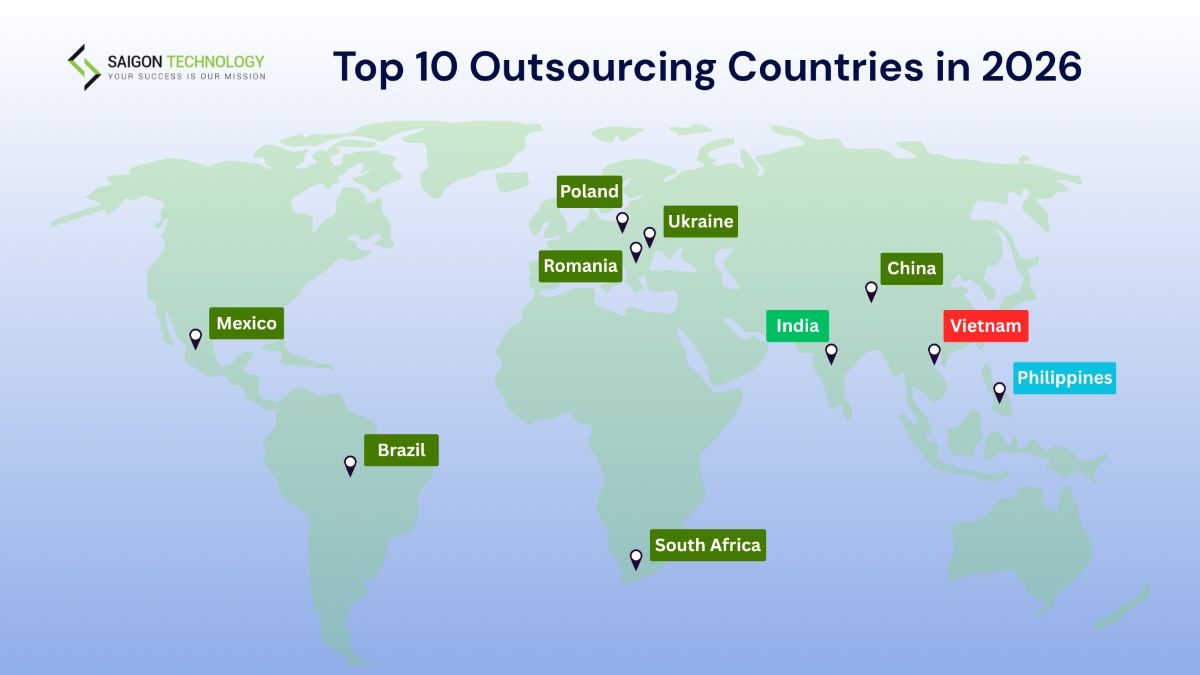
The top outsourcing countries for software development in 2026 are India, Vietnam, Poland, Ukraine, Romania, Brazil, Mexico, the Philippines, China and South Africa. Those are also, with the three exceptions this guide names, the best countries for offshore software development. Which one is right for you depends on three things: the rate you can defend to your board, the working hours you actually share, and whether the country is strong in software engineering or in business process work.
Those last two get confused constantly. A country can be excellent at customer support and thin in senior backend engineering. This guide separates them.
Key Takeaways
- India, Vietnam, Poland, Ukraine and Romania are the five destinations with real depth in software engineering. The Philippines, South Africa and China rank among the top outsourcing countries on the strength of BPO, customer support and hardware rather than software.
- Working overlap is a contract term, not a map distance. Saigon Technology publishes 10 to 12 hours of working overlap with US East and West Coast teams, and we are 12 hours from New York.
- Our published senior-led rate is $22 to $46 per hour, against a market band of $25 to $70+ per hour. For comparison, US software developers had a median wage of $135,980 a year in May 2025 (BLS).
- Retention is the number to ask for, and almost nobody publishes it. Two of India’s largest listed providers do: voluntary attrition of 13.0% at Infosys and 13.9% at Wipro for the quarter ended 30 June 2026, both filed with the US SEC.
- This guide does not publish per-country hourly bands, because no primary source for them exists. Where you see them elsewhere, ask who measured them.
How we ranked the best countries for offshore software development
Most rankings of outsourcing countries are assembled from other rankings of outsourcing countries. This one applies four filters, in order: does the country have depth in software engineering specifically, what is its cost position relative to a US in-house hire, how many working hours does it share with a US team, and what is the failure mode that actually shows up on projects there.
That first filter reorders everybody’s list, because the best offshore software development countries are not the same set as the best countries for outsourcing generally. Several of the best IT outsourcing countries rank there on the strength of call centres and back-office work, not on offshore software development depth.
Where a figure exists in a primary source, it is cited and dated. Where one does not exist, this guide says so rather than estimating. That rule removed several numbers the previous version of this page carried.
One disclosure before the list: we are an offshore provider, based in Vietnam. That shapes what we can show you. It also means our rate is ours to publish rather than ours to estimate, which is the part most comparisons in this category cannot do.
The 10 top outsourcing countries for software development, compared
|
Country
|
Cost position
|
Hours from US Eastern
|
Strongest for
|
Main constraint
|
|
India
|
Lowest
|
10.5 ahead
|
Scale, IT support, cloud migration
|
Quality varies sharply by vendor tier
|
|
Vietnam
|
Lowest
|
12 ahead
|
Product engineering, QA, AI work
|
Smaller talent pool than India
|
|
Philippines
|
Lowest
|
13 ahead
|
Customer support, BPO, back office
|
Thin in senior software engineering
|
|
Poland
|
Moderate to high
|
6 ahead
|
Fintech, security, enterprise systems
|
EU salary competition, rising cost
|
|
Mexico
|
Moderate
|
1 behind
|
Real-time nearshore collaboration
|
Costs above Asia; regional variation
|
|
Ukraine
|
Moderate
|
7 ahead
|
Product R&D, DevOps, data engineering
|
Geopolitical and infrastructure risk
|
|
Brazil
|
Moderate
|
2 ahead
|
Fintech, SaaS, nearshore product work
|
Regulatory and administrative overhead
|
|
China
|
Moderate
|
13 ahead
|
Hardware, electronics, robotics
|
IP exposure; trade and language friction
|
|
South Africa
|
Low
|
7 ahead
|
Contact centres, finance and admin
|
Small advanced-IT pool; power reliability
|
|
Romania
|
Moderate
|
7 ahead
|
Enterprise software under EU data rules
|
Limited scale for very large teams
|
Cost position is relative, not a quoted rate. Read the table as a shortlist of outsourcing countries first and a rate comparison second. See what the rate comparison leaves out for why this table carries no hourly numbers, and our offshore software development rates by country guide for the rate mechanics themselves.
The 10 countries in detail
1. India
India remains the largest offshore software development market by a wide margin, and the one most Western procurement teams already have a template for. Its depth is genuine: India added corporate capability centres at scale, reaching 2,117 global capability centres and 2.36 million people in FY2026 (Zinnov and nasscom; note that Zinnov sells GCC setup services, so read the figure with that interest in mind).
The constraint is dispersion. The same market contains world-class engineering firms and vendors who will staff your project with whoever is free. Selection matters more here than anywhere else on this list.
Retention is the one risk you can actually measure before signing. India’s two largest listed providers publish it: 13.0% voluntary attrition at Infosys and 13.9% at Wipro for the quarter ended 30 June 2026 (Infosys Form 6-K · Wipro Form 6-K). Those are the disciplined end of the market. Ask a smaller vendor for the same number.
Best for: enterprise application work, 24/7 IT support and managed services, and large cloud migration programmes.

2. Vietnam
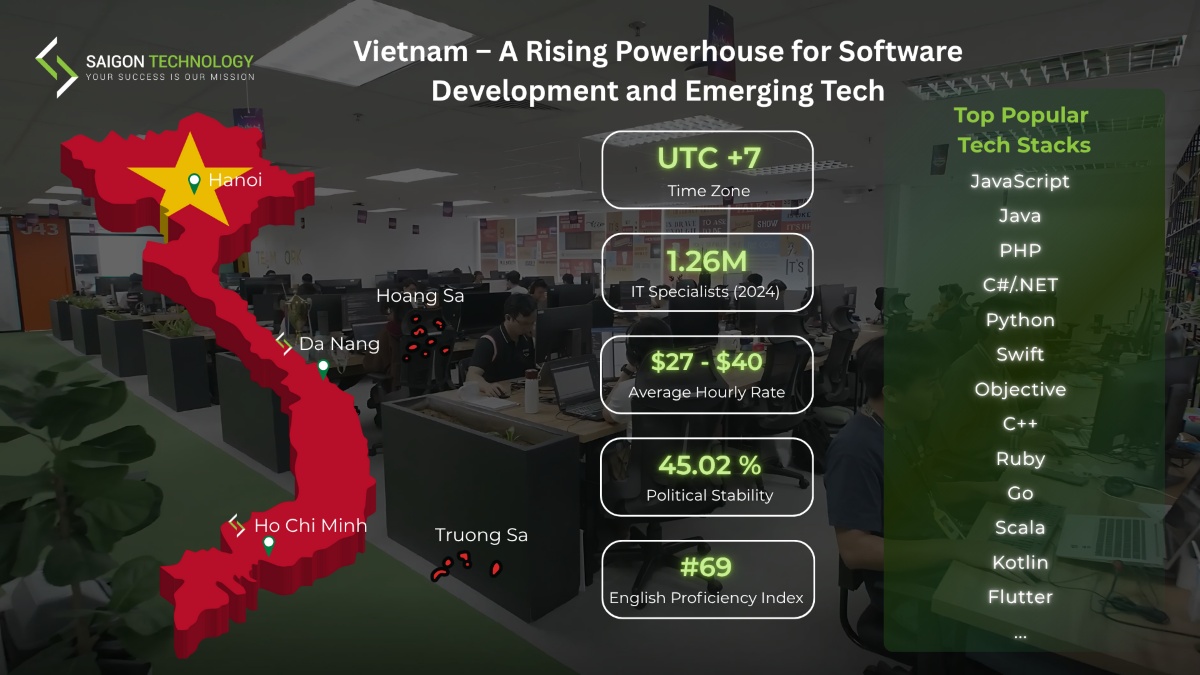
Vietnam has become the alternative most often shortlisted against India for product engineering rather than support work. Its digital technology firms earned $11.5 billion in overseas revenue in 2024, up 54% (Vietnam Ministry of Science and Technology). That figure measures foreign-market revenue, which is precisely the offshore delivery economy rather than domestic IT spend.
Scale is the honest limit. Vietnam’s ICT sector employs about 1.26 million people (same source), but a large share of that is electronics manufacturing rather than software, so treat it as a ceiling indicator and not a developer count. For a 300-person programme, India is the safer answer.
Vietnam sits 12 hours from New York. That is a real gap, and the way it gets closed is contractual rather than geographic: shifted hours written into the engagement. Ours run 10 to 12 hours of overlap with US East and West Coast teams.
Best for: web, mobile and MVP product engineering, QA and testing, and AI integration work.
3. Philippines
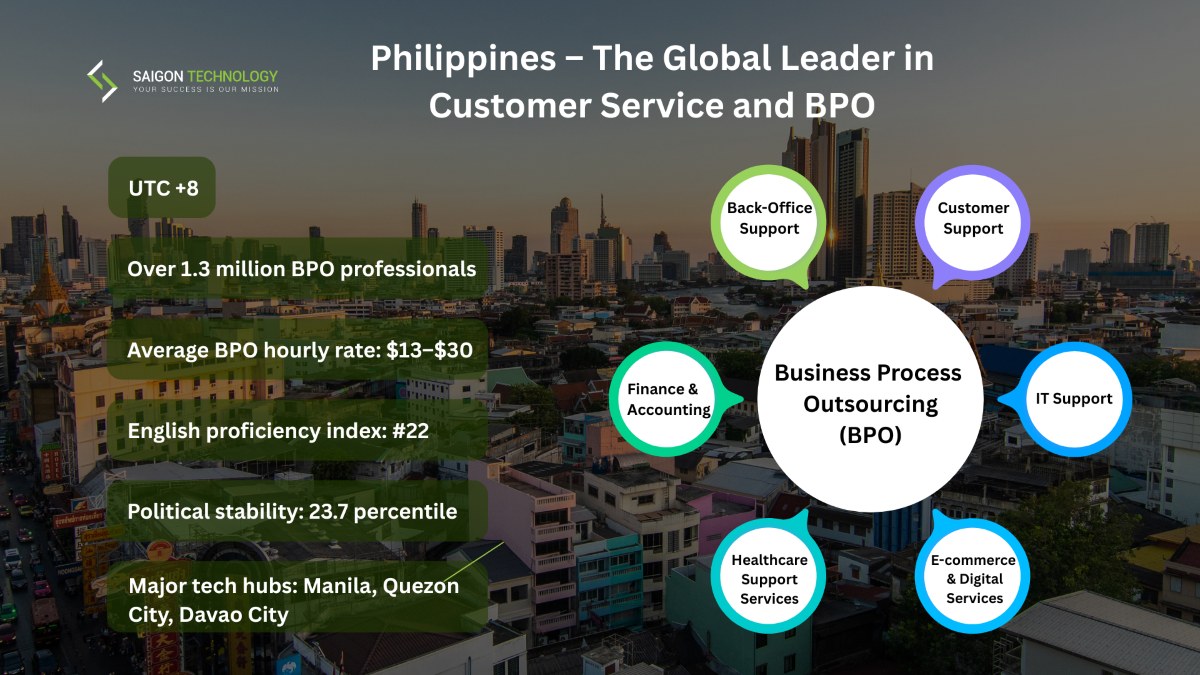
The Philippines is consistently ranked among the top software outsourcing countries, and for most buyers that ranking is misleading. Its strength is business process work: contact centres, finance and accounting, back-office operations, and customer experience across voice and chat. English fluency and cultural fit with US buyers are genuinely strong.
For senior software engineering, it is thinner than India, Vietnam or Poland. If your project is a complex platform build rather than a support function, this is usually the wrong shortlist entry.
Best for: customer support, back-office operations, multichannel customer experience.
4. Poland
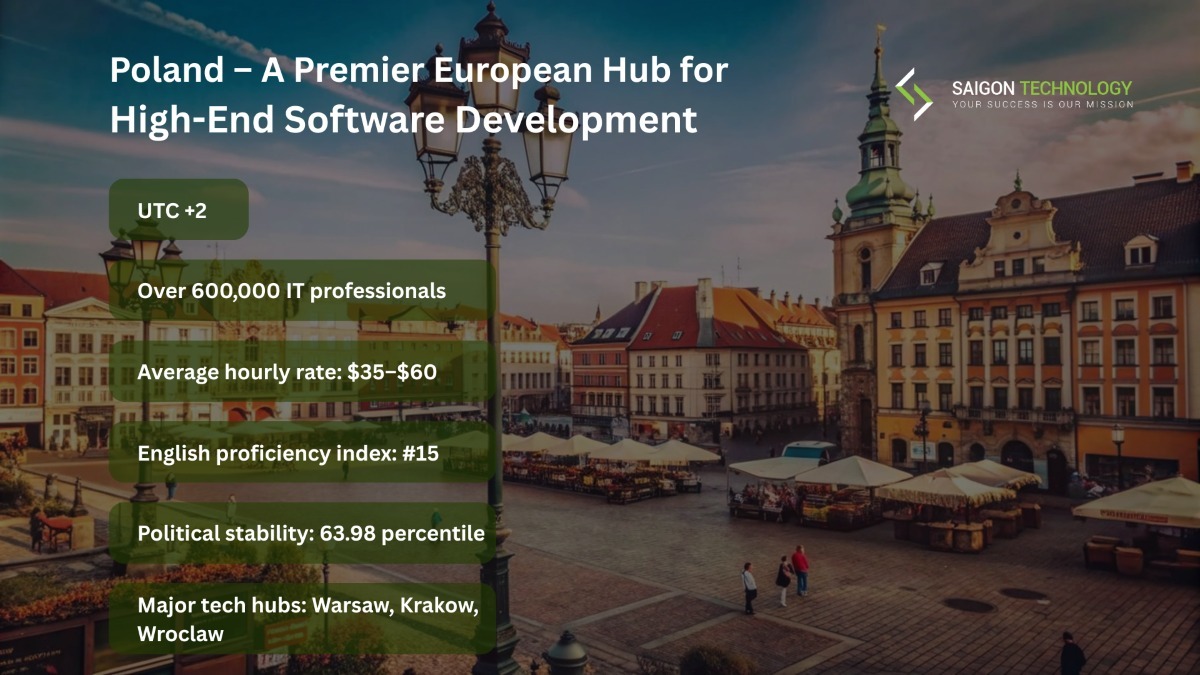
Poland is the reference point for EU-standard engineering. It suits regulated work: payment systems, banking platforms, security-critical infrastructure. It also scores well on the legal side, ranking 17th with 71.91% on the US Chamber of Commerce’s 2025 International IP Index (US Chamber), which matters when the asset you are building is the IP itself.
Cost is the trade-off. Poland prices near the top of this list, and EU-wide competition for senior engineers keeps pushing it up while lengthening time-to-hire for specialist roles.
Best for: fintech and payments, cybersecurity, large enterprise systems.
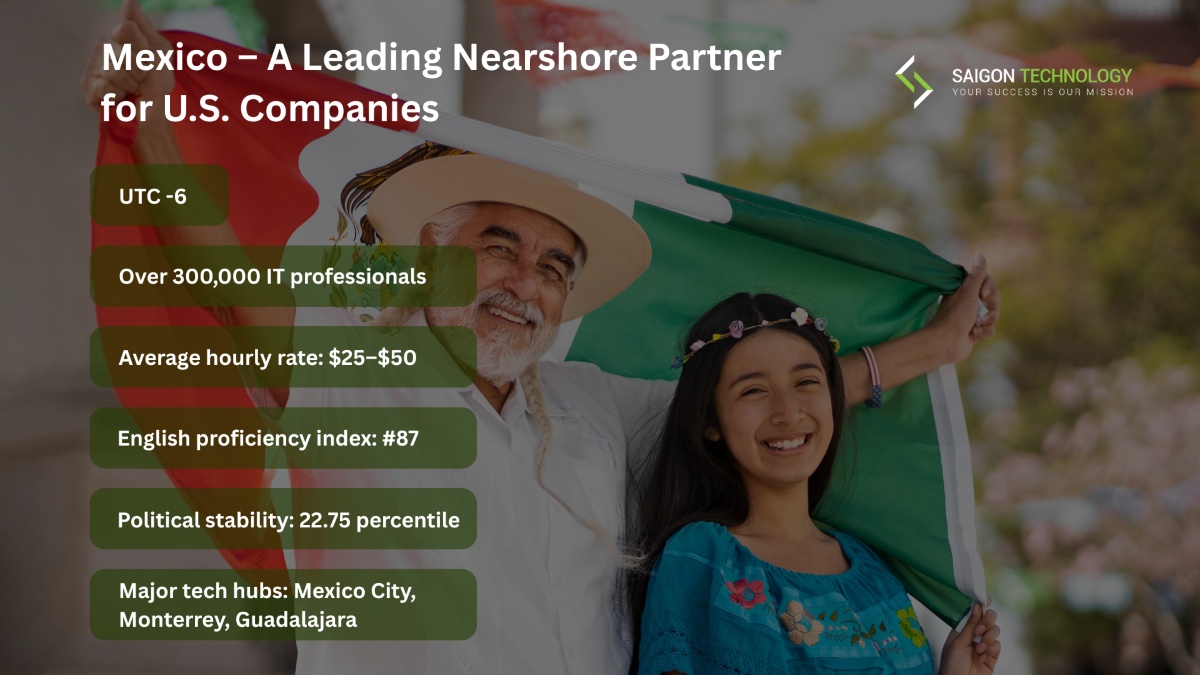
5. Mexico
Mexico is the default nearshore answer for US companies, and the reason is scheduling rather than cost. At one hour behind US Eastern, teams overlap for a full working day without anyone shifting hours. Same-day travel is realistic, which matters for kickoffs and recovery situations.
It prices above Asia. You are buying the overlap and the travel, not a lower rate, and that is a defensible trade when the work needs daily decisions.
Best for: real-time nearshore development, manufacturing and product engineering support, supply-chain operations.
6. Ukraine
Ukraine’s engineering reputation is earned, particularly in product R&D, DevOps and data work. Teams there are used to co-developing core platforms rather than taking handoff specifications, which is a different and more valuable relationship than most offshore engagements.
The risk is not technical. Geopolitical instability and infrastructure disruption are live considerations for multi-year commitments, and the standard mitigation is a provider with teams distributed across more than one country. That mitigation is worth verifying rather than accepting.
Best for: full-cycle product engineering, CI/CD and cloud architecture, machine learning and data engineering.

7. Brazil
Brazil is Latin America’s largest software market and the strongest nearshore option for US East Coast teams after Mexico. Its fintech and SaaS depth is real, built on a domestic market that produced several globally scaled payment companies.
At two hours ahead of US Eastern, the working day overlaps almost entirely. The friction is administrative rather than technical: regulatory and contracting overhead is heavier than elsewhere on this list, which is an argument for an established local provider over a new entity.
Best for: SaaS and cloud-native platforms, digital banking and payments, nearshore product work.

8. China
China belongs on a list of top outsourcing countries, but rarely on a shortlist for offshore software development. Its advantage is physical: manufacturing scale, supply chain depth, electronics and IoT hardware, and fast-moving robotics and automation work.
For software delivered to a Western buyer, three constraints stack up. IP enforcement remains a live concern for sensitive technology. Language and business-practice differences add friction. Trade and regulatory tension between China and the US introduces timeline risk that has nothing to do with your project.
Best for: hardware and electronics development, prototyping and mass production, robotics and automation R&D.

9. South Africa
South Africa is the strongest outsourcing destination in Africa and a growing choice for US and UK buyers, primarily for contact centres and back-office services. English is a primary business language, cultural alignment with Western work styles is strong, and government incentives reduce setup cost.
Its advanced IT talent pool is small relative to Asia and Eastern Europe, which limits large software programmes. Grid reliability is a real operational planning item rather than a footnote.
Best for: contact centres and customer support, finance and administrative processing, customer-facing fintech operations.

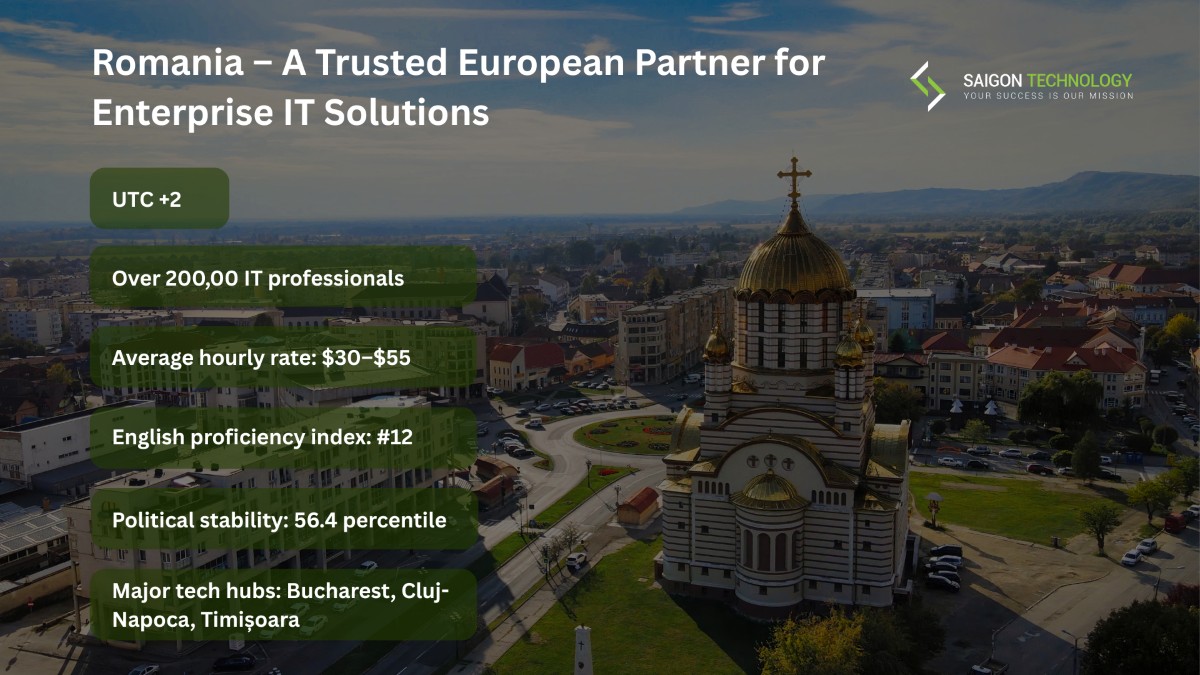
10. Romania
Romania is the quieter EU option and a good one when data protection is the binding constraint. As an EU member it operates under GDPR by default, which removes a category of argument for buyers in finance, healthcare and SaaS. Its workforce is notably multilingual, which matters for pan-European rollouts more than for US-only ones.
Scale is the limit. Romania staffs demanding projects well and very large ones with difficulty.
Best for: enterprise applications under EU compliance, IT consulting and systems integration, cloud migration.
What a country rate comparison leaves out
Most pages in this category publish a table of hourly bands by country. This one does not, and the reason is worth stating plainly: no primary source for those bands exists. They circulate between vendor blogs, each citing the last. We will not add another link to that chain.
What can be published is our own rate and a verifiable baseline to read it against. Saigon Technology’s senior-led rate is $22 to $46 per hour, against a market band of $25 to $70+ per hour. The comparison that gives it meaning is the in-house alternative: US software developers had a median wage of $135,980 a year in May 2025, and QA analysts and testers $104,300, which works out to $64.44 an hour across the combined group (US Bureau of Labor Statistics). Salaries are not billing rates, and the gap between them is where most cost models go wrong.
“The rate is the easiest number to compare and the least predictive one. What decides the three-year cost is how much work comes back for repair, and that tracks seniority and retention, not the hourly figure.” – Phuc (Cris) Tran, Program Manager, Saigon Technology
Rate-shopping across countries produces the outcome it is trying to avoid. A junior-heavy team at a lower rate generates rework, and rework is billed at the same rate as the original build.
How to choose a country for offshore software development
Cost, read as total cost rather than hourly rate
Model the hourly rate, the ramp period before people deliver independently, and the expected rework. Those three together move the three-year figure more than the rate does on its own. Ask for the ramp figure specifically. Vendors who measure it will tell you.
Working hours you actually share
Among outsourcing countries, nearshore destinations such as Mexico and Brazil overlap a US day without anyone changing schedule. Asian destinations do not, and close the gap by contracting shifted hours instead. Both work. What does not work is assuming overlap you never wrote down.
Engineering depth versus process depth
This is the filter that reorders the list. The Philippines and South Africa are excellent at process work and thin in senior software engineering. India, Vietnam, Poland, Ukraine and Romania are the reverse. Matching the country to the type of work matters more than matching it to a rate.
Data protection and IP
EU members such as Poland and Romania operate under GDPR by default, which shortens the compliance conversation. Elsewhere the protection has to come from the contract. Ask for certification evidence rather than claims: ours is ISO 9001 and ISO 27001, certified by BSI.
Retention, which almost nobody publishes
Continuity is what you are buying from a delivery partner. Ask for voluntary attrition as a number with a period attached. The Infosys and Wipro filings above give you a benchmark to hold the answer against.
Choosing your destination
There is no single best country for offshore software development, and any ranking of the best countries for outsourcing that names one is selling something. The best offshore software development countries for your project are whichever ones fit a specific combination of work type, budget, compliance requirement and how many hours a day you need your team awake at the same time.
Among the best countries for outsourcing a support function, look at the Philippines and South Africa. If it is regulated enterprise software, look at Poland and Romania. If it needs daily real-time collaboration, look at Mexico and Brazil. If it is product engineering at a defensible rate with overlap written into the contract, that is the case for Vietnam, and it is the case we would make for ourselves.
If that is the direction you are leaning, how we structure offshore engagements covers the models and what each one commits you to. When you are ready to compare shortlists properly, contact our team. We run a two-week risk-free trial, which is a cheaper way to test a country than a signed annual contract.
Frequently asked questions
Which country is best for offshore software development?
There is no universal answer, but the shortlist narrows quickly by work type. For product engineering at a low rate, Vietnam and India lead. For regulated enterprise and fintech work, Poland and Romania. For real-time nearshore collaboration with US teams, Mexico and Brazil. For customer support and back-office process work, the Philippines and South Africa. Match the country to the type of work before comparing rates. That is also the honest answer to the broader question of the best countries to outsource software development: it depends on which work you are moving.
What are the best offshore software development countries for a US company specifically?
Vietnam, India, Poland, Mexico and Brazil cover most US requirements between them. The split is by working hours: Mexico and Brazil give you a shared working day without shifted schedules, while Vietnam and India give you a lower rate and require overlap to be contracted. Poland sits between the two on both counts.
How do I check whether an offshore provider is reliable?
Ask for four things and treat vague answers as answers. Voluntary attrition as a number with a period attached. Average time from a developer joining to delivering independently. Certification evidence such as ISO 9001 and ISO 27001. And a pilot, so you test delivery rather than a sales process. Reviewing case studies tells you what a provider has built; the four questions tell you how it will go.
What are the real risks of choosing a low-cost country, and how are they managed?
The recurring ones are quality dispersion, unwritten overlap assumptions, weaker security practice, and scope creep against a low initial quote. Each has a contractual answer: a paid pilot with defined acceptance criteria, working hours written into the engagement, certification evidence plus NDAs, and deliverables defined before signing rather than after.
How much working overlap should I expect with Asia or Eastern Europe?
Eastern European teams sit six to eight hours ahead of US Eastern, which leaves a natural shared morning. Asian teams sit ten to thirteen hours ahead, so overlap is created by shifting hours rather than found on the clock. Get the specific committed hours into the contract. An unwritten overlap is the single most common source of delay in offshore engagements.
How do legal and tax requirements differ between outsourcing countries?
Materially, and in ways worth taking advice on. EU members operate under GDPR. India and the Philippines apply withholding on payments to service providers, while Vietnam offers incentives aimed at technology exporters. Contractor classification rules differ by region and misclassification carries penalties. Put compliance obligations in the contract rather than assuming them, and take local tax advice before the first invoice.


Related articles
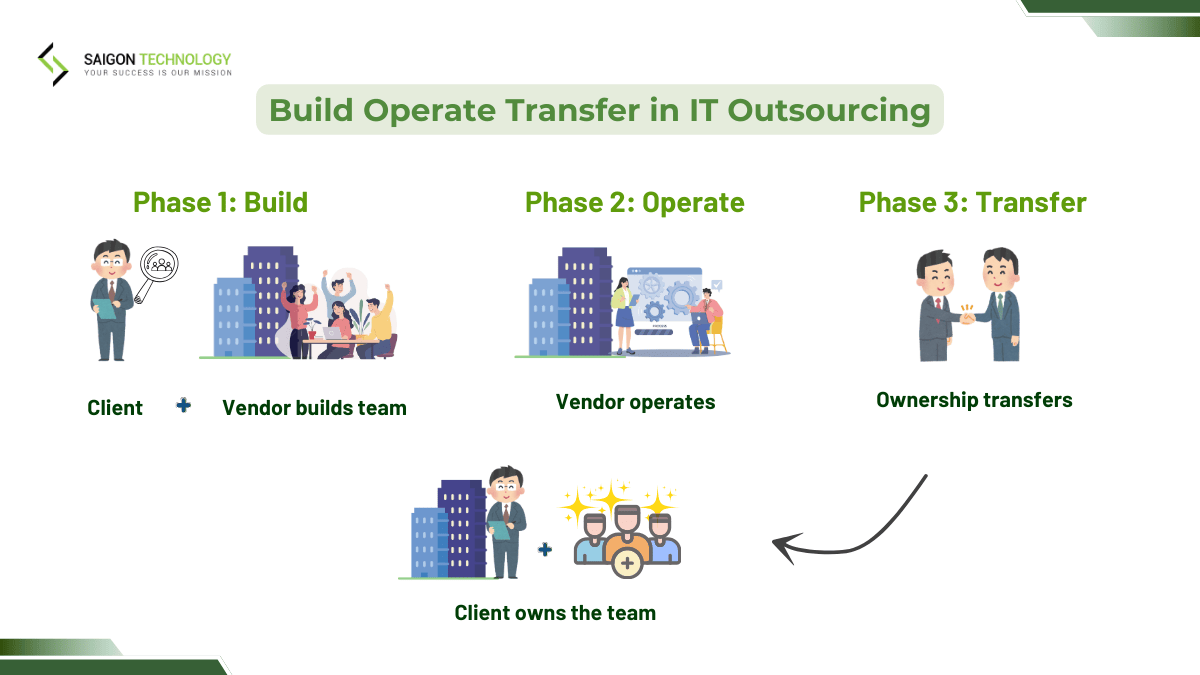
Build Operate Transfer (BOT) IT Outsourcing: Complete Guide for Global Tech Companies
 Thanh (Bruce) Pham - CEO of Saigon Technology
  03 Oct 2024
12 Key IT Outsourcing Trends 2026 for Business Growth
16 Sep 2024 
Decoding Software Outsourcing Costs and Strategies
11 Sep 2024 
Fintech Development Outsourcing: The Complete Guide for 2026
26 Sep 2024 
Choosing the Right Outsourcing Partner: Strategic Guide
26 Sep 2024 
Complete Guide to Software Testing Outsourcing 2026
05 Feb 2025 
Top 10 Software Outsourcing Challenges and How to Navigate
10 Feb 2025 
IT Outsourcing Vendor Selection Criteria You Need
14 Feb 2025 
IT Support Outsourcing: The Ultimate Guide for Businesses
26 Feb 2025 
10 Types of Outsourcing: Which One Is Right for You?
12 Mar 2025