




Outcome-Based Pricing: How It Works and What It Takes to Bill It

 Updated on Aug 07, 2026
Outcome-based pricing is a model where a vendor charges only when a defined, measurable result is achieved: a resolved support conversation, a recovered payment, a completed workflow, rather than for seats, licenses, or raw usage. AI agents made it practical, because software that finishes a task can also log proof that it finished.
The pricing logic is the easy part. The hard part is everything underneath it: the instrumentation that captures each outcome, the attribution that proves you caused it, and the audit trail a customer can argue with. This guide covers both, drawing on what our engineers have learned building metering, billing, and AI agent systems across 850+ delivered projects since 2012.
Key Takeaways
- Outcome-based pricing bills pre-defined results, not access or consumption. If the result doesn’t happen, in most models there’s no charge.
- Pure outcome pricing is rarer than the hype suggests. 37% of B2B software and AI companies now run hybrid pricing, up from 25% a year earlier (Growth Unhinged, 2026 State of B2B SaaS and AI Monetization, 230 companies, May 2026).
- The model lives or dies on outcome definition and attribution, not on the price you pick.
- Before you can bill an outcome, you need product instrumentation, a starting baseline, a customer-visible ledger, and revenue recognition workflows that survive variable revenue.
What Is Outcome-Based Pricing?
Outcome-based pricing is a value-based model in which payment is triggered by a verified business result rather than by access to software. The customer buys a measurable result. The vendor absorbs part of the performance risk, if the result doesn’t land, the invoice shrinks.
That’s the whole idea, and it’s why the model spreads fastest wherever software acts autonomously. Gartner data cited in Deloitte’s 2026 technology predictions projects that by 2030, at least 40% of enterprise SaaS spend will shift toward usage-, agent-, or outcome-based pricing (Deloitte Insights, SaaS meets AI agents, November 2025). Note what that figure actually is: three models combined, five years out. Deloitte’s own read on outcome pricing specifically is that there’s “still a long way to go” before widespread use, though some vendors are pursuing it.
What Counts as a Billable Outcome
A business result only works as a billing unit when it’s discrete, attributable, and verifiable. Common examples:
- A resolved support conversation – closed without a human touching it.
- A recovered chargeback or payment – money that came back.
- A saved cancellation – a churn event that didn’t happen.
- A qualified lead, upsell, or cross-sell – revenue motion the software created.
- A completed workflow – an order processed, a claim adjudicated, a document filed.
- A verified clinical or operational improvement – measured against a baseline.
Notice what’s missing: “improved customer satisfaction,” “better productivity.” Real customer value, but nothing you can put on an invoice without a fight.
Why Teams Are Moving to This Model
Buyers and vendors want different things from this model, and both sides get something.
What the buyer gets:
- Direct value-to-cost alignment. The invoice reflects measurable business results, so finance can tie spend to tangible business impacts instead of licence counts.
- Lower entry risk. Paying after the fact removes most of the leap of faith, which is why pilots get approved faster.
- Built-in performance incentives. When the vendor only earns on results, product and support roadmaps bend toward cost savings and throughput rather than seat expansion.
- Customer trust. Shared definitions and shared dashboards make the relationship legible. That’s the foundation of trust-based partnerships rather than annual renegotiation.
What the vendor gets:
- Pricing power. Flat subscriptions cap revenue precisely when a customer is getting the most value. Outcome pricing doesn’t.
- Revenue scalability. Grow with the customer’s results, so renewals and expansion track delivered impact instead of headcount.
- A data moat. Continuous outcome tracking builds a dataset competitors can’t buy.
The honest caveat: every one of these benefits is downstream of measurement. Get the metric wrong and the same model produces billing disputes instead of trust.
Outcome-Based vs Subscription, Usage-Based, and Value-Based Pricing
The models differ in one respect that matters more than the rest, who carries the performance risk.
|
Model
|
What you bill for
|
Who carries performance risk
|
How it’s measured
|
Fits best when
|
|
Subscription / per-seat
|
Access, per user or flat
|
Buyer
|
Licence count
|
Collaboration tools where value is diffuse
|
|
Usage-based
|
Consumption-based pricing on API calls, compute, records
|
Buyer
|
Metered usage
|
Infrastructure, where usage tracks cost
|
|
Value-based
|
Estimated worth to the buyer
|
Shared, informally
|
Judgment and negotiation
|
Enterprise deals with strong differentiation
|
|
Outcome-based
|
Verified results
|
Vendor
|
Instrumented outcome events
|
Discrete, attributable results
|
|
Hybrid
|
Platform fee plus outcomes
|
Split deliberately
|
Both
|
Almost everywhere, in practice
|
The usage/outcome distinction trips people up most. Both vary with activity, but usage bills the work performed and outcomes bill the work completed. An AI agent that holds fifty conversations and resolves nine bills fifty times under usage pricing and nine times under outcome pricing.
Value-based pricing is the older cousin. It prices to perceived worth, negotiated up front and fixed. Outcome pricing measures that worth continuously and charges accordingly, which makes it auditable in a way value-based pricing never was. For the more established options, see our breakdown of subscription, per-seat, tiered, and usage models for software products.
Four Outcome-Based Pricing Models Used in Practice
Most real agreements are a variation on four structures.
1. Per-outcome flat fee. A fixed price per verified result – the dominant shape in customer service and support automation. Fits high-volume, homogeneous outcomes. Fails when outcome difficulty varies wildly and a two-minute answer earns the same as a forty-minute investigation.
2. Percentage of value created (gain share). The vendor takes a cut of recovered or generated money. Fits recovery and revenue work where the dollar amount is unambiguous. Fails when the baseline is contested – every dollar becomes an argument about what would have happened anyway.
3. Hybrid platform fee plus outcome charge. A modest platform fee covers the floor; outcomes carry the upside. Fits almost everyone, which is why hybrids are now the most common structure in the market, 37% of surveyed B2B software and AI companies, up from 25% a year earlier (Growth Unhinged, May 2026). Fails only when the base fee grows until it’s a subscription wearing a costume.
4. Guaranteed outcome with SLA credit. The customer commits to a subscription; the vendor refunds or credits against missed targets. Fits enterprise buyers who need budget predictability. Fails when the credit is small enough to be a rounding error, at which point nobody’s incentives moved.
Two mechanisms cut across all four. Outcome caps limit exposure when outcome volumes spike unexpectedly. Credits abstract the unit so pricing logic can flex without renegotiating the contract, 29% of companies use AI credits today, and 33% plan to introduce them within 6–12 months (same survey). Both need to live in your billing logic, not in a spreadsheet someone adjusts at month end.
Companies Using Outcome-Based Pricing
Published examples are still thin, and the numbers circulating in blog posts are frequently stale or second-hand. Every figure below was checked against the vendor’s own page on August 6, 2026, where a vendor doesn’t publish a price, we describe the mechanism instead of guessing.
|
Vendor
|
What triggers the charge
|
How it’s priced
|
What is not billed
|
|
Customer confirms the issue is resolved, stops asking for help, or Fin completes a workflow, handoffs to a human included
|
$0.99 per outcome, one charge per conversation, minimum monthly commitment (e.g. 50 outcomes)
|
Repeat questions inside the same conversation
|
|
|
A chargeback is successfully recovered
|
25% of the recovered amount, no platform fee, 4× ROI guarantee; Alerts billed at $29 per deflected chargeback
|
Failed recoveries; Insights tier is free
|
|
|
A request is resolved by the AI agent without escalation to a human
|
Quote-based, not published
|
Escalations to human agents
|
|
|
The agent completes a task; routing or greeter interactions can move to consumption pricing
|
Not published; blended structures offered
|
Escalated cases, in most cases
|
Two details in that table are worth more than the prices. First, Intercom bills handoffs as outcomes while Zendesk excludes escalations entirely, two market leaders drawing the line in opposite places, on the same nominal model. Second, Zendesk’s own AI agent guidance describes resolutions as holding through a 72-hour quiet period: the conversation stays closed and the customer doesn’t reopen it. That quiet-period pattern is the single most portable idea in this table, and it belongs in your agreed-upon criteria whatever you’re billing.
If you’re building this class of system, the mechanics matter more than the market rate, see AI agent development for how the outcome-tracking layer gets built.
What It Actually Takes to Bill an Outcome
This is the part most guides skip. Every major explainer on this topic tells you to “build tracking and verification systems” and moves on. Below is what that sentence actually contains, from the perspective of the engineers who have to ship it.
1. Define the Outcome as Code
Success criteria have to exist as executable conditions, not contract prose. That means a named event, the qualifying conditions that make it count, the measurement period it’s evaluated over, and explicit exclusions. The 72-hour quiet period is a good template: resolved and still resolved three days later.
What breaks without it: two teams read the same clause differently, and the first invoice becomes a negotiation.
2. Instrument and Meter It
Product instrumentation is the foundation of reliable tracking. Outcome events need idempotent capture with dedupe keys, so a retried webhook doesn’t bill twice. They need to tolerate late, replayed, and out-of-order arrivals. And they belong in an immutable log you can replay an entire invoice from, months later.
What breaks without it: you can’t reproduce last quarter’s bill, which means you can’t defend it.
“Teams underestimate idempotency until the first duplicate invoice. On billing systems, the retry path isn’t an edge case – it’s the normal path, and every retried event is a potential double charge. We design the dedupe key before we design the schema.” – Khoa Nguyen, Deputy Director, Saigon Technology
3. Prove Attribution and Baselines
Every vendor in this market names attribution as the hard problem. Almost none publish a method. In practice you need a starting baseline measured before deployment, ideally a holdout group that keeps running the old way, and attribution rules written for the messy case where three systems touched the same result. In multi-agent systems, that messy case is the default rather than the exception.
What breaks without it: shared attribution turns into disputed metrics, and disputed metrics turn into billing fights.
4. Make It Disputable
Counterintuitive but essential: build for the argument. Customers need shared dashboards that drill from an invoice line to the individual events behind it, plus a transparent process for validating data, resolving discrepancies, and reversing a charge when a challenged outcome is overturned. Auditable tracking with no credit workflow attached is only half a system.
What breaks without it: disputes escalate to account managers and executives instead of resolving inside the product.
5. Close the Finance Loop
The last mile is where outcome-based billing meets accounting. Outcome events have to rate cleanly into invoicing, then flow into revenue recognition workflows that hold up under ASC 606 or IFRS 15, variable consideration is genuinely harder to recognize than a monthly subscription, and that’s a conversation for your auditors, not a blog post. Forecasting methods need rebuilding around volume distributions rather than renewal dates. Caps, floors, and regular reconciliations belong in code.
What breaks without it: sales closes deals finance can’t recognize, invoice, or predict.
“The pricing conversation usually happens six months before anyone asks engineering whether the events exist. By then the contract has promised a metric the product doesn’t emit. We’d rather be in the room early and say plainly which outcomes are billable today and which need instrumentation first.” – Khoa Nguyen, Deputy Director, Saigon Technology
Teams building this into a product usually need the metering layer and the application to evolve together, the pattern we follow in SaaS application development, where usage and outcome events are first-class from the first sprint rather than retrofitted.
Where the Model Breaks Down
It doesn’t fail loudly. It fails as a slow accumulation of friction.
- Metric gaming. Any metric that pays a vendor will eventually be optimized by that vendor. Bill per resolution and you may get fast closures rather than solved problems. Good contracts add quality gates alongside volume.
- Attribution and data disputes. In an environment with several systems and a human team, isolating cause is genuinely hard. Ambiguous impact is the most common reason a promising pilot never scales.
- Revenue unpredictability. Revenue now moves with the customer’s outcome volume, which is seasonal and outside your control. Pricing volatility makes board forecasting harder in both directions.
- Longer sales cycles. Procurement, finance, legal, and operations all have to agree on a metric before anything signs. Expect a pilot phase, not a signature.
- Standing instrumentation cost. The data infrastructure behind auditable outcomes isn’t a one-time build. It’s a permanent line item, higher in regulated sectors, worth factoring into SaaS development costs from the start rather than discovering it at the first invoice run.
- Poor fit for diffuse value. Where impact is shared across teams and tools, no amount of engineering rescues the model.
None of this argues against outcome pricing. It argues for hybrids, caps, and honest metric design, and for knowing which of your outcomes genuinely aren’t billable. It’s also worth understanding why AI software economics differ from traditional software before assuming a per-outcome model will hold its margin.
Outcome-Based Pricing for IT and Professional Services
Services firms field this question constantly, usually phrased as moving from time and materials to something that rewards results. It’s possible, and it’s narrower than most buyers hope.
Four things have to be true first:
- The deliverable is measurable. A defined business result with an agreed number attached, not “improved delivery velocity.”
- Attribution is clean. One vendor owns the outcome end to end. Co-delivery with the client’s own team makes causation unprovable.
- Data access is contractual. If you can’t see the system of record, you can’t evidence the outcome or run the reporting process.
- Change control is disciplined. When scope moves weekly, a fixed outcome definition stops describing the work.
Where those hold, the practical structures are a time-and-materials or fixed-price base with an outcome-linked component on top, or a high-impact outcome carved out of a larger program and priced separately with a small customer group as a pilot. Both need contract language covering partial outcomes and delayed verification, plus internal work most firms forget: compensation models and approval processes have to change too, or your delivery leads are still measured on billable hours while the company is paid on results.
Saigon Technology prices engagements on fixed-price, time-and-materials, dedicated team, staff augmentation, and BOT structures, see our engagement models for how each works. Our role in outcome-based pricing is building the systems that make outcomes billable, for clients whose own products are priced that way.
Can You Actually Bill It? A Build-Readiness Test
Most readiness checklists ask whether outcome pricing suits your strategy. This one asks whether your systems could support it on Monday.
- Can you state the outcome in one sentence a customer would sign? If it needs a paragraph and two caveats, it isn’t a billing unit yet.
- Does a single system already emit the event that proves it? If proving an outcome requires joining three databases and a CSV export, you have an instrumentation project before you have a pricing model.
- Can you establish a starting baseline the customer will accept? Baselines are negotiated before deployment or not at all, afterwards, everyone’s numbers are self-serving.
- Could you show a customer the events behind a specific invoice line today? If not, your first dispute has no resolution path.
- Can finance survive the volatility? Model your worst month with caps and floors in place. If that month breaks the plan, you need a platform fee before you need an outcome price.
Five yeses means build it. Two or three means fix the data layer first, the pricing model isn’t the blocker.
FAQs
1. What is outcome based pricing in simple terms?
You pay when the software delivers a specific result, not for access to it. If the result doesn’t happen, most agreements don’t charge. The result has to be defined and measurable in advance.
2. What’s the difference between outcome-based pricing and value-based pricing?
Value-based pricing sets a price from the buyer’s estimated worth, negotiated up front and then fixed. Outcome-based pricing measures the delivered measurable result continuously and bills against it, which makes it auditable rather than argued.
3. What does outcome-based pricing mean for AI agents?
AI agents made the model practical because autonomous software logs its own completions. Vendors bill per resolved conversation or completed task, so cost scales with work finished rather than with seats or conversations attempted.
4. How do you measure an outcome you’re billing for?
Through instrumented events with qualifying conditions, a measurement window, a pre-agreed baseline, and a customer-visible ledger. Manual reporting doesn’t survive the first dispute, the measurement has to be reproducible from raw events.
5. Can outcome-based pricing work for IT services or consulting?
Yes, where the deliverable is measurable, one vendor owns attribution, and data access is contractual. In practice most firms use a hybrid: a time-and-materials or fixed-price base with an outcome-linked component.
The Model Is Simple. The Plumbing Isn’t.
Outcome-based pricing aligns what a customer pays with what they actually got, and that alignment is real, it shortens pilots and it changes what a product team optimizes for. But the model is only as trustworthy as the events behind it. Define the outcome as code, meter it so an invoice can be replayed, agree the baseline before launch, and give the customer a ledger they can challenge. Almost everyone lands on a hybrid, and that’s a sound destination rather than a compromise.
If you’re building a product that needs to bill on results, or retrofitting metering into one that wasn’t designed for it, our engineers can scope the outcome tracking, attribution, and billing layer with you. Schedule a consultation and bring your outcome definition; we’ll tell you honestly what’s billable today and what needs instrumenting first.


Related articles
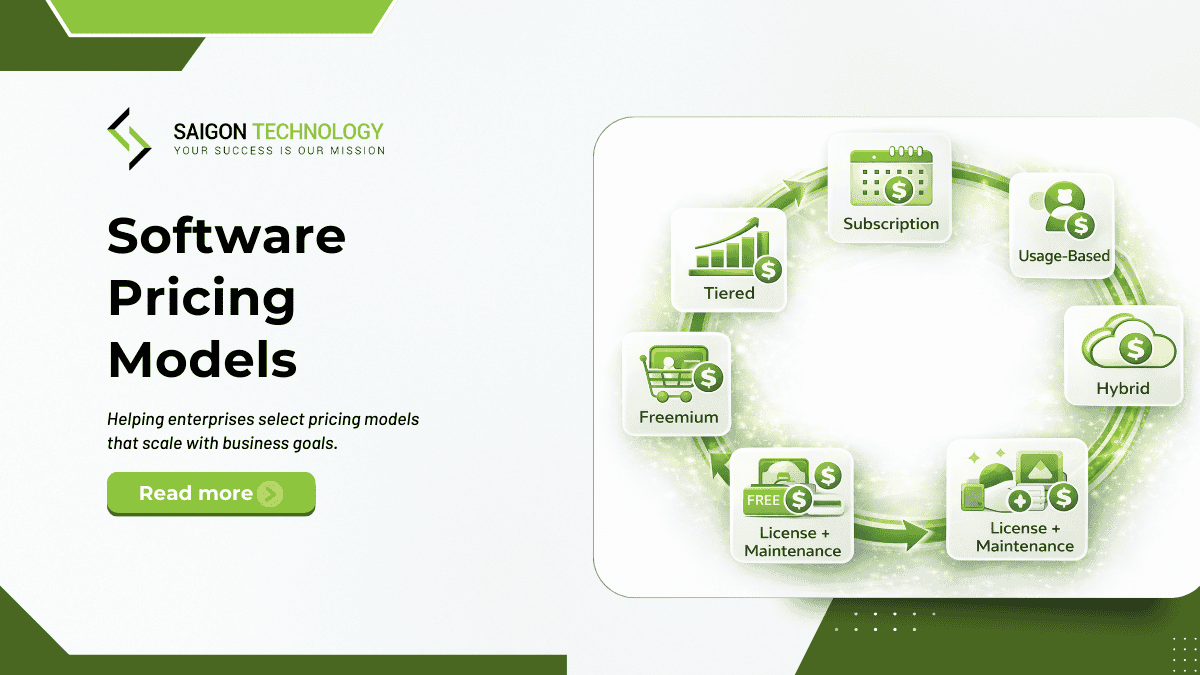
Software Pricing Models: A Complete Guide (2026)
 Khoa Nguyen - Offshore Development Consultant
  29 Jan 2026
Choosing Between Models: A Decision Framework for Tech Leaders
19 Mar 2026 
When a Dedicated Team Beats In-House Hiring
25 Mar 2026 
Staff Augmentation vs Managed Services: Which Engagement Model Fits Your Team?
06 May 2026 
Staff Augmentation vs Dedicated Team: How to Choose the Right Model (2026)
08 Jun 2026 
Staff Augmentation vs Outsourcing: A CTO’s Decision Framework
09 Jun 2026 
AI-Augmented Software Development: A Practical Guide for Engineering Leaders (2026)
08 Jul 2026