




Logistics Software Development Cost: $30K–$500K Guide

 Updated on Aug 04, 2026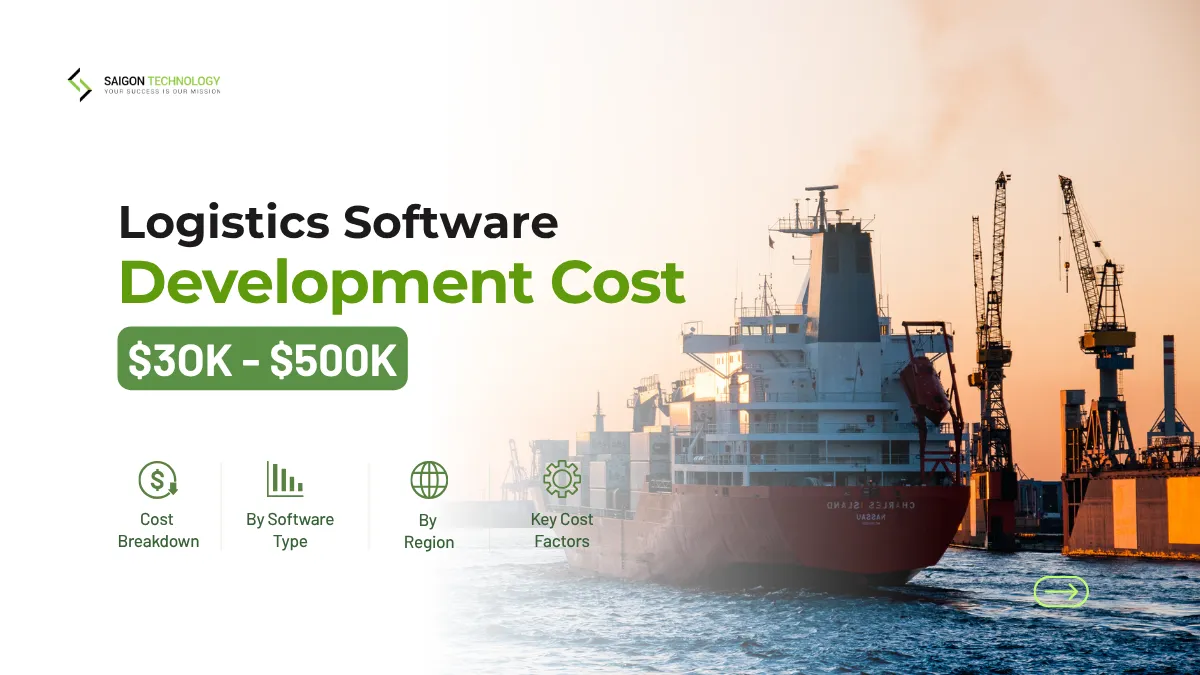
Logistics software development cost ranges from $30,000 to $500,000+ in 2026, with most enterprise projects landing between $80K and $250K. Cost is driven by software type (TMS, WMS, fleet, SCM), AI capability, integration count, and the region you build from — each explained section by section below.
This guide breaks down every cost driver: by software type, by region, by feature complexity. The numbers come from 850+ projects delivered, including transportation and logistics platforms for enterprise clients across the US, Europe, and APAC. The supply chain software market continues to grow through 2030, so budget decisions you make now compound for years.
By the end, you’ll know what your project should realistically cost, where vendors typically inflate quotes, and how to stay lean without cutting corners on engineering quality.
Key Takeaways
- Cost range: $30K to $500K+, driven by 8 key factors including scope, AI features, integrations, and team location.
- By software type: TMS costs $50K–$200K, WMS costs $80K–$300K, fleet management $40K–$180K, full supply chain platforms $100K–$500K+.
- By region: US rates run $100–$250/hour. Vietnam-based senior teams deliver comparable quality at $30–$55/hour.
- AI capabilities (route optimization, demand forecasting, predictive analytics) add 15–35% to base cost but typically pay back in 8–14 months.
- Maintenance costs 15–25% of dev cost per year ongoing. This is the most commonly underestimated line item.
What Affects Logistics Software Development Cost? (8 Key Factors)
Eight factors control logistics software development cost: scope and software type, feature complexity, integration count, AI and machine learning capability, platform choice, compliance requirements, team location and seniority, and the technology stack. Each is explained below.
1. Scope and software type
A single-purpose fleet tracking app costs a fraction of an integrated TMS plus WMS plus customer portal.
2. Feature complexity and UI/UX design
Basic CRUD costs less than AI-driven route optimization or computer vision. A custom dispatch dashboard with real-time data visualization takes more design and front-end work than standard screens.
3. Integration complexity
Every external connection adds development and testing time. ERP system integration (SAP, Oracle, Microsoft Dynamics), CRM integration (Salesforce, HubSpot), GPS, carrier APIs, payment gateways, and 3PL (Third-Party Logistics) integration each carry their own scope.
4. AI and machine learning capabilities
Route optimization, demand forecasting, predictive analytics, automated dispatch, data analytics dashboards, and NLP chatbots are the biggest cost-shifters in 2026 logistics software.
5. Platform choice
Web-only is cheapest. Adding mobile apps for drivers, dispatchers, or customers expands scope. Cross-platform frameworks like React Native and Flutter can reduce mobile app development cost by 30–40% versus building native iOS and Android separately.
6. Compliance and security
US logistics software handles DOT regulations and Hours of Service (HOS) tracking, plus GDPR for international shipments and PCI-DSS for payments. Security compliance and ongoing compliance management add non-negotiable engineering hours.
7. Team location, size, and expertise
A US-only team builds the same software at 3x–5x the cost of a Vietnam-based senior team. A five-engineer senior team often outperforms a ten-engineer mixed team. Dedicated developer cost varies widely by region and seniority.
8. Technology stack and backend scalability
The stack (.NET, Java, Node.js, Python; React, Angular, Vue) affects both upfront and long-term scaling cost. Backend scalability decisions (monolithic vs microservices, SQL vs NoSQL) set the ceiling on how cheaply you can grow.
Timeline urgency layers on top. Rush projects typically add 15–30% premium.
Logistics Software Development Cost by Type
Specify which type of system you’re building before comparing vendor quotes.
| Software Type | MVP | Mid-Tier | Enterprise | Typical Timeline |
| Transportation Management (TMS) | $50K–$80K | $80K–$140K | $140K–$200K+ | 4–10 months |
| Warehouse Management (WMS) | $80K–$120K | $120K–$200K | $200K–$300K+ | 5–12 months |
| Fleet Management | $40K–$70K | $70K–$120K | $120K–$180K+ | 4–9 months |
| Supply Chain Management (SCM) | $100K–$180K | $180K–$300K | $300K–$500K+ | 6–14 months |
| Last-Mile Delivery (with mobile apps) | $40K–$70K | $70K–$110K | $110K–$150K+ | 4–8 months |
| 3PL Platform | $80K–$140K | $140K–$220K | $220K–$350K+ | 5–12 months |
Transportation Management System (TMS)
A Transportation Management System (TMS) controls how freight moves from point A to point B: carrier selection, load planning, real-time shipment tracking, freight documentation, and carrier performance analysis. Cost climbs with multi-carrier API integrations, route optimization algorithms, and cross-region freight management.
Average TMS development cost is around $100K for mid-tier US deployments. A focused MVP may sit at $50K–$80K, while enterprise-grade systems with ERP and compliance integrations reach $140K–$200K+.
Warehouse Management System (WMS)
A Warehouse Management System (WMS) manages everything inside a warehouse: receiving, storing, picking, packing, and shipping. Most builds include an inventory management system for real-time stock tracking, yard management systems (YMS) for dock and trailer coordination, and order management systems integration for end-to-end order visibility.
Median WMS build cost sits at $150K in 2026. Cost climbs with multi-warehouse support, barcode scanning, and RFID hardware. This is why WMS typically costs more than TMS at the same tier.
Fleet Management Software
Fleet management software tracks vehicles, plans routes, monitors driver behavior, and flags maintenance needs. It connects to in-vehicle hardware for real-time data. One of the more straightforward categories: a focused MVP with tracking, routing, and basic reporting runs $40K–$70K and goes live in 4–6 months. Average fleet management software cost for a 50–200 vehicle deployment is around $85K.
For a real-world example of how these features work in production, see our fleet management platform case study covering tracking, routing, driver behavior monitoring, and maintenance workflows.
Supply Chain Management (SCM) Platform
A Supply Chain Management (SCM) platform covers procurement, inventory planning, supplier collaboration, and multi-system integration. One of the most expensive categories to build: budget typically starts at $100K and enterprise builds often exceed $300K. Most modern SCM platforms ship as cloud-based logistics software with multi-tenant architecture.
Our SCM Portal case study shows a production platform integrating SAP and ERP for PR, PO, and RFQ workflows.
Last-Mile Delivery Apps
Last-mile delivery typically involves three components: a driver mobile app, a customer tracking interface, and a dispatch admin panel. All three need to stay in sync in real time. The customer-facing side requires more UI polish than internal tools, and the mobile-heavy scope drives the overall logistics app development cost.
Cross-platform frameworks help keep the budget lean. Median logistics mobile app development cost for a single-market MVP starts at $40K–$70K. Add live ETA prediction, payment integration, proof of delivery, or multi-region support and the cost climbs accordingly.
How Much Does a Logistics Mobile App Cost? (Logistics App Development Cost Breakdown)
A standalone logistics mobile app development cost (driver-only or customer-only) typically runs $40K–$90K for a cross-platform build (React Native or Flutter). A full three-app system (driver + customer + dispatch) runs $110K–$150K+ as listed in the table above. Native iOS plus Android instead of cross-platform adds roughly 30–40% to overall logistics app development cost.
3PL Platform
A 3PL (Third-Party Logistics) platform serves your internal operations team AND the clients whose goods you handle. The dual audience is what makes it expensive: client portals, billing automation, data separation between clients, and ongoing updates as contracts evolve.

Cost by Feature Complexity
Software type sets the category. Feature complexity sets the tier within that category. Use this table to estimate the cost impact of feature decisions on any logistics software project.
Most enterprise projects span tiers: a Basic dashboard plus Mid-level integrations plus one or two Advanced features. The cleanest way to scope is to pick the tier for each feature category, then sum the estimates. A typical mid-market TMS with AI route optimization sits at “Mid-level features + 1 Advanced module,” usually $150K–$220K total.
How Advanced Technologies Reshape Cost in 2026 (AI, IoT, Blockchain)
AI capabilities used to be a $200K-plus enterprise luxury. In 2026, they’re a 15–35% premium on base cost, paying back in 8–14 months. McKinsey research suggests AI in distribution operations can reduce logistics costs by 5–20% and inventory levels by 20–30%, depending on use case and implementation maturity.
AI-driven route optimization typically adds $20K–$60K. For a fleet with $2M in annual fuel spend, a 10–25% reduction in fuel and overtime could translate into $200K–$500K in annual savings.
Demand forecasting and predictive analytics typically add $30K–$80K. Machine learning models predict load volumes from historical data and seasonal patterns. High value for 3PLs and large fleets.
Automated dispatch with data analytics dashboards typically adds $25K–$75K. Helps teams manage significantly higher shipment volume without proportional headcount growth.
Computer vision for cargo inspection typically adds $25K–$70K. Covers damage detection, package verification, and proof-of-delivery analysis.
NLP chatbots for customer service typically add $15K–$40K. Automates shipment status queries, delivery rescheduling, and basic claims intake.
IoT integration (real-time tracking, telematics, cold-chain sensors): typically $15K–$60K.
Blockchain integration (provenance tracking, smart contracts for freight payments): typically $30K–$100K. Most practical for high-value cargo and multi-party international shipments.
As an AI development services provider, we build these capabilities directly into the core product architecture. Native integration costs roughly the same upfront but cuts ongoing maintenance by 20–40%.
Logistics Software Development Cost by Region (2026 Rates)
Developer rates vary more by location than almost any other factor. The same 4,000-hour project can cost about $400K with a US team, $320K+ in Western Europe, and $140K with a Vietnam-based team at a $35/hour blended rate. The real question: does quality justify the gap?
| Region | Hourly Rate (USD) | Quality Tier | Notes |
| US/Canada | $100–$250 | High | Highest cost, deep talent pool, time zone aligned |
| Western Europe | $80–$180 | High | Strong engineering, regulatory expertise (GDPR) |
| Eastern Europe (Poland, Ukraine) | $40–$80 | High | Strong technical depth, mature outsourcing market |
| Latin America | $35–$70 | Mid-High | Time zone aligned with US, growing senior talent |
| Vietnam | $30–$55 | High (senior-first) | Best cost-quality ratio with senior engineering teams |
| India | $25–$50 | Variable | Largest pool, quality varies widely by vendor |
| Philippines | $25–$45 | Mid | Strong for support and lower-complexity work |
We work with senior engineers at $30–$49 per hour, with flexible engagement options including fixed-price, time and materials, and dedicated development team models. A mid-tier WMS project budgeted at $200K with a US team typically runs $55K–$70K with our Vietnam-based team at comparable engineering quality. We’re recognized in Vietnam Top 10 ICT Companies and ranked Best Place to Work 2025.
A cheap rate paired with junior-heavy staffing usually costs more in rework and post-launch defects. The cheapest hourly rate rarely produces the cheapest total cost of ownership.
Want a real estimate for your scope, not a generic range? Talk to our logistics software team and get a tailored quote with timeline, team composition, and phased cost breakdown — typically returned within 48 hours.
Build Custom vs Buy SaaS: The Real Cost Comparison
SaaS has a lower upfront cost. Custom software has a higher one. As explained in our build vs buy software guide, over five years, that equation often flips.
A 200-vehicle fleet on a mid-range SaaS platform costs roughly $540K over five years. That is subscription fees only, before implementation and customization.
A custom platform at $200K upfront plus annual maintenance totals around $400K over the same period. For larger fleets, custom typically costs less by year 2 or 3.
Custom wins when:
- Your dispatch rules, freight billing logic, or automated invoicing don’t fit standard SaaS workflows
- You need deep integration with legacy systems (SAP, Oracle ERP)
- You need supply chain analytics and reporting tailored to your operations
- You operate across multiple compliance regions
- You want full IP ownership with no per-user fee escalation
SaaS wins when:
- Standard use case, fleet under 50 vehicles
- Speed-to-market under 3 months matters more than long-term TCO
- You lack engineering capacity to maintain a custom platform
Hidden Costs Most Vendors Don’t Tell You
Eight cost lines that often go unmentioned until contract signing:
- Post-launch maintenance and updates (15–25% of dev cost per year). A $150K platform costs $22K–$37K annually. See our approach to software maintenance and support for typical scope.
- Cloud infrastructure and cloud server setup. AWS or Azure runs $500–$10K+ per month. Initial setup, networking, and load balancing add $5K–$20K one-time. Our cloud services team estimates infrastructure separately so it’s visible from day one.
- Third-party API fees. Google Maps Platform per 1,000 requests. Carrier APIs per shipment query. Payment gateways at 2.9% + $0.30/transaction. At scale, thousands per month.
- Security implementation and audits. Annual third-party audits and penetration testing cost $5K–$30K extra. Not optional for logistics handling sensitive shipment data.
- Compliance certifications and reviews. SOC 2: $30K–$80K. HIPAA: $10K–$50K. PCI-DSS for payment platforms: similar range. ISO/IEC 27001 is increasingly required by enterprise customers.
- Legal and licensing fees. Software license audits, terms-of-service drafting, data processing agreements. Budget $5K–$25K.
- Training and change management. Usually 5–10% of project cost, often omitted from quotes.
- Performance scaling. Infrastructure costs scale with volume, sometimes non-linearly.
How to Optimize Logistics Software Development Cost (7 Proven Strategies)
The goal is the right project at the lowest cost that doesn’t compromise quality. The right logistics software development services partner combines all seven strategies below by default.
- Start with MVP, then iterate. Cut initial cost 40–60% by phasing features. MVP development validates ROI before committing full budget.
- Modular architecture. Decoupled modules (tracking, billing, analytics, customer portal). Pay for what you need now.
- Cross-platform mobile. React Native or Flutter saves 30–40% versus native iOS and Android separately.
- Cloud-native with containerization. AWS, Azure, or GCP from day one, with IaC, CI/CD, and Docker/Kubernetes.
- Offshore senior team vs US in-house. Typical 50–65% cost saving with senior engineering. Junior-heavy offshore erases the saving through rework.
- Open-source where possible. PostgreSQL instead of Oracle. OSRM instead of commercial routing engines.
- Workflow automation inside delivery. AI-assisted code generation, automated testing, automated code review cut delivery time 15–25%.
We run 100+ offshore teams via offshore software development. Projects under budget use 3–4 of these strategies together.
Development Process and Timeline
Cost equals team rate times hours. The longer the timeline, the higher the bill.
| Phase | Duration | % of Budget |
| Discovery & Planning | 2–4 weeks | 5–10% |
| Design & Architecture | 3–6 weeks | 10–15% |
| Core Development (backend + frontend) | 16–32 weeks | 50–65% |
| Testing & QA | Parallel + 2–4 weeks final | 10–15% |
| Deployment & Training | 2–4 weeks | 5–10% |
Total timeline: 6–12 months for a mid-tier logistics platform. Core development is the largest share, split between backend development (APIs, business logic, integrations) and frontend development (dashboards, admin panels, mobile apps). Integration complexity is the biggest variable.
A dedicated project manager runs Agile/Scrum ceremonies, and DevOps tools keep the pipeline humming. Our AI-assisted workflows reduce timelines 20–30% by automating boilerplate code, test scaffolding, and code review.
ROI and Payback Period: When Does Logistics Software Pay for Itself?
Most mid-tier logistics platforms pay for themselves within 12–24 months. For operations with significant baseline inefficiency, payback can land inside 6 months.
Main savings:
- Freight cost reduction via route optimization and load planning: 5–15%
- Capacity optimization via better dispatch: 8–20% more loads per vehicle
- Logistics process automation: 60–80% reduction in admin labor hours
- Fewer delivery delays: 10–25% reduction in penalty fees
Hypothetical worked example. A mid-size 3PL with $5M annual freight spend invests $150K in a custom TMS:
- Freight cost reduction at 8%: $400,000
- Admin labor savings via automated documentation: $60,000
- Fewer delays and penalties: $40,000
- Total Year 1 benefit: $500,000 → payback in 3.6 months
Results vary with your starting point. A fleet running on spreadsheets sees larger gains than one already using basic fleet management software.
Bottom Line
Logistics software development cost in 2026 ranges from $30K (MVP) to $500K+ (enterprise SCM with AI). Most US enterprises spend $80K–$250K. A Vietnam-based senior team builds the same scope at roughly one-third the US cost. Plan 15–25% of dev cost annually for maintenance. Custom builds break even against SaaS by year 2–3 for fleets over 50 vehicles. AI features add 15–35% upfront but pay back in 8–14 months.
FAQs
How much does it cost to develop logistics software in 2026?
In 2026, logistics software development cost is $30,000 to $500,000+, with most enterprise projects between $80K and $250K. A simple MVP starts around $30K. Enterprise SCM platforms with AI can exceed $500K. The exact figure depends on software type, feature complexity, integrations, AI capabilities, and team location.
Is custom logistics software cheaper than SaaS in the long run?
Yes, custom logistics software is cheaper than SaaS in the long run, particularly for fleets larger than 50 vehicles or business horizons longer than 5 years. Custom software typically breaks even against SaaS by year 2 or 3. After that, it pays dividends through full IP ownership and zero per-user fee escalation. However, for smaller fleets or strict short-term deadlines, SaaS often wins on initial speed-to-market.
What does ongoing maintenance cost for logistics software?
Logistics software maintenance costs 15% to 25% of original development cost per year. For example, a $150K platform requires roughly $22K to $37K annually. This budget covers bug fixes, security patches, dependency updates, minor feature additions, and cloud infrastructure management. Major version upgrades are typically quoted separately.
Can I reduce logistics app development cost without sacrificing quality?
Yes — four high-leverage strategies cut logistics app development cost without sacrificing quality:
- Start with an MVP: Validate core features first and iterate, rather than building everything at once.
- Use modular architecture: Build independent modules so you only pay for what you need now.
- Use cross-platform frameworks: React Native or Flutter for mobile apps saves 30–40% versus native development.
- Hire senior-first offshore teams: This can yield a 50–65% cost reduction at comparable quality, provided you avoid the “cheapest-vendor trap” that leads to junior-heavy staffing and high rework.
How much does AI integration add to logistics software cost?
AI integration adds 15% to 35% to logistics software cost, but most capabilities pay back in 8 to 14 months through operational savings.
| AI Feature | Estimated Cost Addition |
| Route optimization | $20K – $60K |
| Demand forecasting | $30K – $80K |
| Computer vision (cargo inspection) | $25K – $70K |
| NLP chatbots (customer service) | $15K – $40K |
How much does a TMS cost to build?
Custom TMS development cost ranges from $50,000 (MVP) to $200,000+ (enterprise) in 2026. A focused MVP with carrier selection, load planning, and shipment tracking lands around $50K–$80K. Mid-tier TMS with multi-carrier API integrations runs $80K–$140K. Enterprise TMS with ERP integration and compliance modules reaches $140K–$200K+. Typical build timeline: 4 to 10 months.
How much does a WMS cost to build?
Custom WMS development cost ranges from $80,000 (MVP) to $300,000+ (enterprise) in 2026. Cost climbs with multi-warehouse support, barcode and RFID hardware integration, and yard management features. WMS typically costs more than TMS at the same tier because of the hardware-integration scope. Typical build timeline: 5 to 12 months.
Plan Your Logistics Software Budget with Real Numbers
Logistics software development cost depends on eight factors: software type, feature complexity, integrations, AI capabilities, team location, compliance requirements, timeline, and post-launch maintenance. Get all eight right and the budget becomes predictable.
Before signing any contract, verify: logistics domain experience, transparent phase-by-phase pricing, integration capability with your existing ERP/GPS/carrier stack, security certifications, and IP ownership terms. We’ve delivered long-term logistics engagements including the Merit Logistics ODC as a specialized logistics software development company, and offer a 2-week risk-free trial so you can evaluate engineers before committing.
Trusted by 350+ global clients across 850+ projects, we help logistics teams build software that fits their operations. Get a tailored estimate with timeline, team composition, and phased cost breakdown in 48 hours — talk to our logistics software team.


Related articles

Digital Transformation in Vietnam: Key Insights for Companies in 2026
 Thanh (Bruce) Pham - CEO of Saigon Technology
  09 Oct 2024
HIPAA Compliant App Development: Process & Cost Guide
05 Feb 2025 
Expert Guide on Outsourcing to Vietnam
07 Nov 2025 
Vietnam’s AI Ecosystem: Policy, Talent Pool & Market Growth
30 Mar 2026 
PCI DSS Compliance in Fintech Software Development: A 2026 Guide
03 May 2026 
How to Run a 2-Week Paid Developer Trial (and What to Watch For)
06 May 2026 
How to Run a Long-Term Offshore Engagement End-to-End: A Setup-to-Handover Playbook
12 May 2026 
ERP Software Development: A 2026 Guide for Decision-Makers
19 May 2026 
HL7 and FHIR Integration: How Healthcare APIs Actually Connect (and Where They Break)
20 May 2026