




Vietnam vs. India for Software Outsourcing: How to Choose in 2026

 Updated on Aug 22, 2026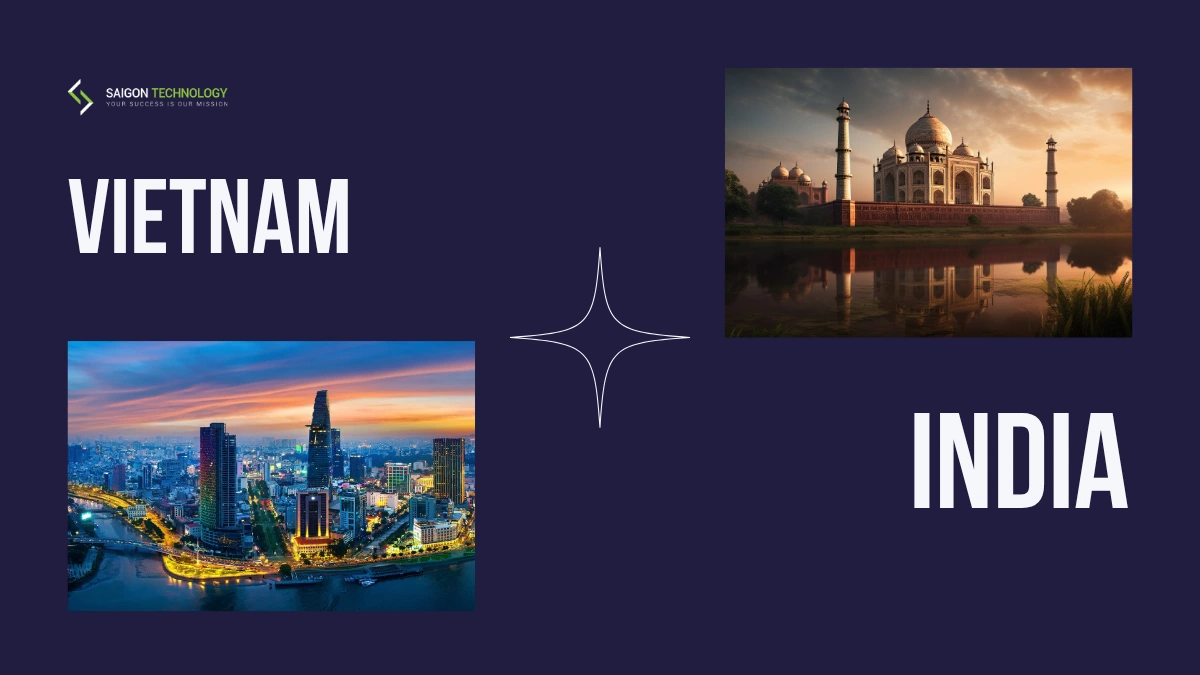
You have decided to build software with a team abroad. The open question is where.
For most companies weighing Asia, the shortlist comes down to two names:
- India – the original outsourcing giant.
- Vietnam – the fast-rising challenger.
The usual shorthand, “India for scale, Vietnam for cost”, is too crude to base a multi-year team decision on. This guide compares the two on the six factors that actually move the decision, then gives you a checklist for matching each to your own situation.
A note before the comparisons: the figures for India below are public, industry-level estimates that vary by city and specialization. The Vietnam figures come from our own work as a development partner based there. We have flagged which is which throughout.
How rates actually compare (and what drives the gap)
The two countries overlap more than the headlines suggest. The real difference is rate stability and what sits inside the rate, not a large raw-rate gap at the senior level.
India (public 2026 estimates):
- Junior engineers: $15-$25/hour
- Mid-level: $25-$40/hour
- Senior: $40-$70/hour
Vietnam (our blended vendor rate: $22-46/hour):
- Junior engineers: $18-$30/hour
- Mid-level: $22-$46/hour
- Senior: $40-$70/hour
- Tech leads: $55-$95/hour
Look closely, and the senior tiers nearly match. That is not a coincidence. Vetted senior talent is scarce in both markets, and scarcity pushes prices toward parity.
Where India keeps an edge is the junior tier and very large bench needs, where volume drives unit cost down.
The cost lever most teams underestimate is not the sticker rate at all. It is turnover. Every engineer who leaves takes context with them, and a slightly higher rate with a stable team often works out cheaper over a two-year engagement than a lower rate with churn.
For a full breakdown of what offshore engagements actually cost beyond hourly rates, see our deeper look at offshore pricing and budgeting.
Talent depth versus talent retention
India wins on raw volume and niche-skill availability. Vietnam competes on retention and team stability. Which matters more depends on the shape of your project.
India has:
- A developer population in the millions.
- A deep bench across both legacy and niche stacks.
- Decades of outsourcing infrastructure.
If you need an unusual skill or want to ramp twenty-plus engineers quickly, that depth is hard to match anywhere.
Vietnam has a smaller pool but strong modern-stack engineering and a different advantage: continuity. We were recognized on Fortune’s 100 Best Companies to Work For in Southeast Asia 2025, and low turnover means the same people stay on your product.
In practice, “scale” means two different things:
- Ramping fast, we have staffed 20 senior engineers for a US fintech lender inside three months, then kept that team running for over three years.
- Keeping the same small group on your codebase for years, we scaled one Netherlands partner from 2 to 50 engineers over a six-year build-operate-transfer partnership before a full handover.
India tends to win the first definition. Vietnam often wins the second.
English and communication fit
Both countries have plenty of English-capable talent. The practical difference is accent familiarity and working style with Western teams, and you screen for those during selection rather than assuming them by nationality.
This is the area where country-level generalizations do the most harm. Communication quality varies far more between individual teams than between India and Vietnam as a whole. Treat it as something to verify in interviews and a paid trial, not a box the country ticks for you.
That said, two honest patterns hold:
- India has a longer track record working with US enterprises at large scale, which shows in process maturity.
- Vietnam often suits teams that want closer, boutique-style collaboration.
Our developers work daily with US, EU, Australian, and Singaporean clients, who frequently point to communication as a reason the relationship worked.
Learn more: How to Run a 2-Week Paid Developer Trial
Time-zone overlap with the US, EU, and Australia
For practical purposes, the two are interchangeable here. India sits at GMT+5:30 and Vietnam at GMT+7, close enough that your overlap windows look nearly identical.
Both offer:
- Australia and Singapore: same-day, near-real-time collaboration.
- Europe: a solid afternoon overlap.
- United States: a partial window, early morning for the offshore team, evening for a US client.
The fix is the same regardless of which country you pick: agree on a three-to-four-hour overlap for standups, planning, and demos, and run everything else asynchronously.
Time zone is not a deciding factor between these two.
Learn more: Top 10 Outsourcing Countries in 2026
Quality, security, and compliance maturity
Do not judge this by country. Judge it by the specific vendor’s certifications and domain compliance. This is the factor where vendor selection matters more than geography.
Whichever country you lean toward, verify the same things:
- ISO 27001 for information security.
- A contract that transfers full IP ownership to you.
- The sector standards your product needs, HIPAA for US healthcare, PCI-DSS and KYC/AML for fintech, GDPR for EU data.
For our part, we:
- Hold ISO 9001 and ISO 27001, both certified by BSI in the UK.
- Transfer IP in full under NDA.
- Work regularly in regulated domains, one US healthcare client runs a platform managing more than 6 million medical records on a team that cut development time by 40 percent.
The honest caveat: large Indian firms carry these same certifications. Certification is table stakes in both countries, so the real question is who specifically holds it on your account and whether they have shipped in your domain before.
Stability and turnover risk
Both India and Vietnam are politically and economically stable outsourcing hubs. The variable that actually hurts projects is team-level attrition, not country risk.
- India’s largest firms can see high churn and frequent bench-shuffling, where engineers rotate across accounts.
- Boutique providers in Vietnam often offer more continuity, keeping a dedicated team on one client.
We lean on workplace recognition and low turnover as evidence of that continuity, but this varies by individual vendor far more than by country. Ask any shortlisted partner for their annual attrition rate and how long their average engineer stays on one account.
A decision framework: which to choose when
Match the destination to the project shape, not the brand name. Run your situation through this checklist:
- Choose India when you need very large headcount quickly, a specific niche or legacy skill, or a vendor with a long US-enterprise track record at significant scale.
- Choose Vietnam when you want India-level cost with closer attention, long-term team continuity, strong modern-stack and compliance work, or a build-operate-transfer path toward eventually owning your own team.
Weigh these inputs in order of what matters most to you:
- Project size
- Skill niche
- The need for continuity
- Compliance depth
- Collaboration style
- Budget tier
A team that needs forty engineers for a six-month surge should weigh differently from one building a product it will maintain for a decade.
|
Factor
|
India
|
Vietnam
|
|
Senior rates (2026 est.)
|
$40-$70/hr
|
$40-$70/hr
|
|
Junior rates (2026 est.)
|
$15-$25/hr
|
$18-$30/hr
|
|
Talent volume
|
Very large
|
Moderate, modern-stack
|
|
Team retention
|
Varies; can be high churn
|
Often high continuity
|
|
Time-zone overlap
|
Strong EU/AU, partial US
|
Strong EU/AU, partial US
|
|
Best-fit project
|
Fast large-scale ramp
|
Long-term, continuity-led
|
FAQs
1. Is Vietnam cheaper than India for senior developers?
At the senior level the two are roughly comparable, both around $40–$70/hour in 2026 estimates. India can be cheaper at the junior tier and for very large teams. Over a multi-year engagement, retention often affects total cost more than the hourly rate.
2. Which country has better English for working with a US team?
Both have strong English-capable talent, and the quality varies more by team than by country. Screen the actual people you will work with through interviews and a paid trial rather than assuming a national standard.
3. Is it harder to scale a large team in Vietnam than in India?
India has more raw volume for fast, large ramps. Vietnam suits teams that value continuity, though dedicated providers there can still staff sizable teams quickly when needed.
4. Are Vietnamese vendors as secure and compliant as Indian ones?
Certifications such as ISO 27001 exist in both countries. Verify them on your specific account, along with IP transfer terms and the sector standards your product requires.
5. Should I pick a country or a vendor first?
Vendor first. A strong, well-matched vendor in either country will outperform a weak one in the country that looks better on paper.
The bottom line
The Vietnam-versus-India choice comes down to matching the project to the place:
- India for scale and niche depth.
- Vietnam for cost-efficiency and team continuity.
And then vetting the individual vendor harder than you vet the country. Get that order right and either destination can work.


Related articles

Staff Augmentation vs Outsourcing: A CTO’s Decision Framework
 Thanh (Bruce) Pham - CEO of Saigon Technology
  09 Jun 2026
Staff Augmentation vs Dedicated Team: How to Choose the Right Model (2026)
08 Jun 2026 
Staff Augmentation vs Managed Services: Which Engagement Model Fits Your Team?
06 May 2026 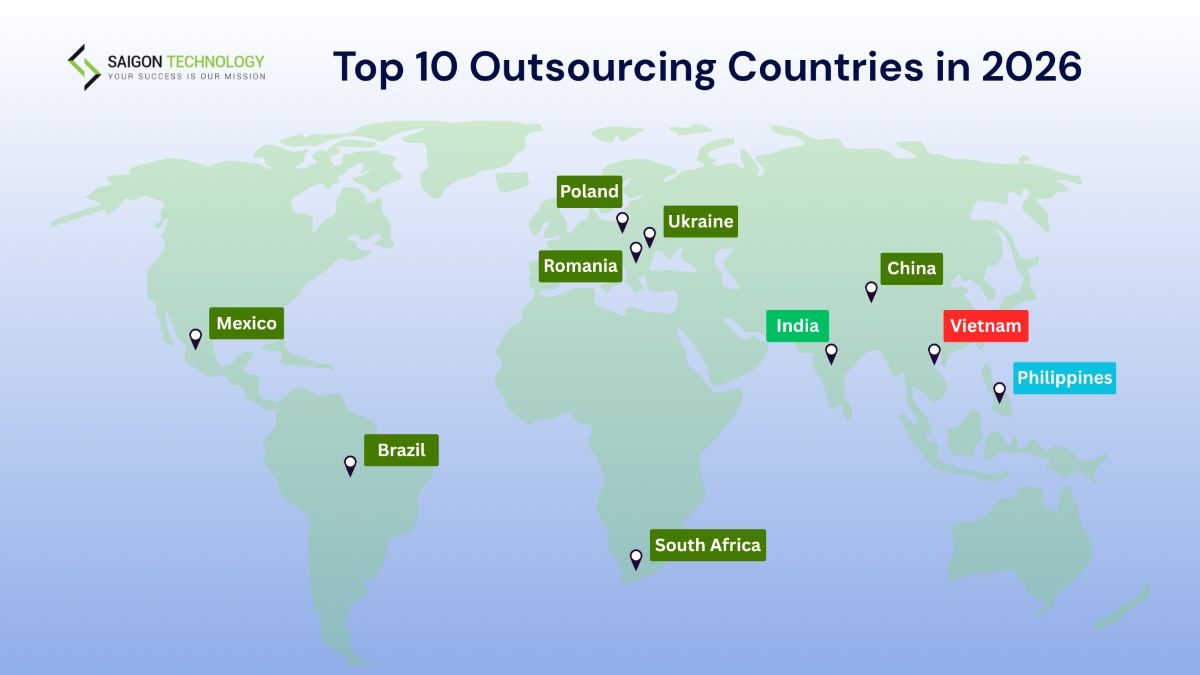
Top 10 Outsourcing Countries: The Best Countries to Outsource Software Development in 2026
29 Oct 2025 
IT Outsourcing Vendor Selection Criteria You Need
14 Feb 2025 
Top 10 Software Outsourcing Challenges and How to Navigate
10 Feb 2025 
Who Owns IP (Intellectual Property) When Outsourcing Software Development?
17 Jul 2024 
Open-source in Software Development
13 Jun 2024 
A Detailed Comparison between Software Developer and Software Engineer
12 Apr 2024