



Elderly Care & Aging-in-Place Technology: A Software Buyer’s Guide for 2026

 Updated on May 18, 2026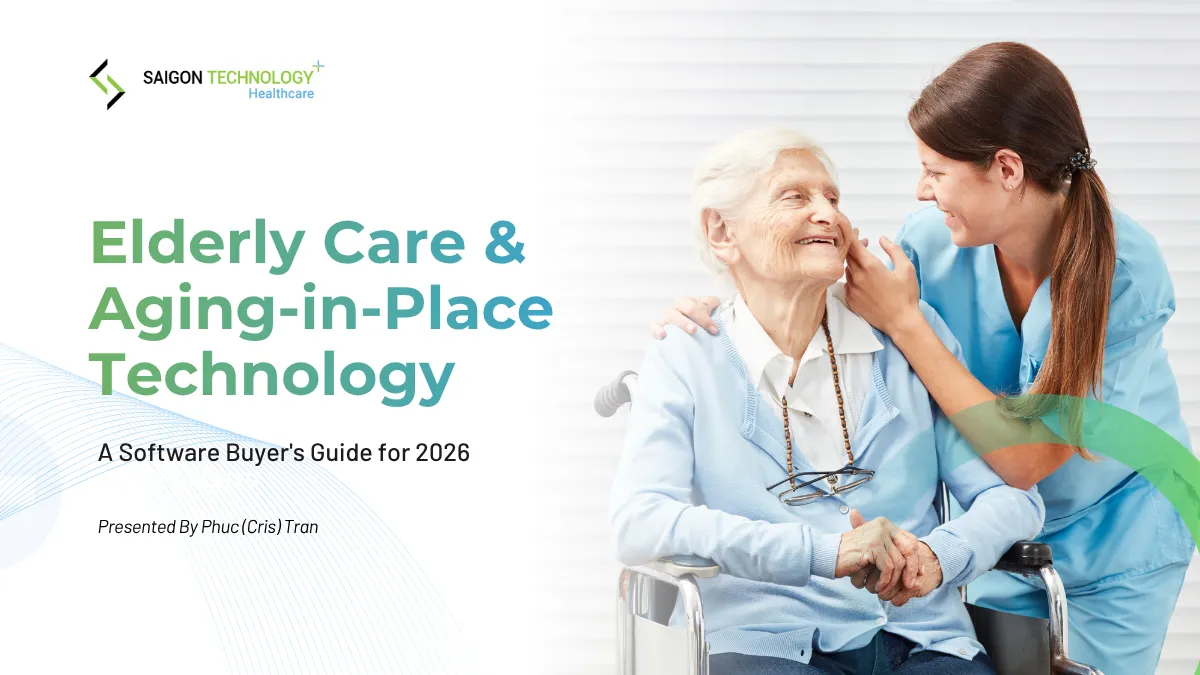
By 2030, 1 in 6 people globally will be over 60. The caregiver workforce cannot keep up.
Most eldercare software was built a decade ago. It was designed for clinicians, not seniors at home. It is fragmented, hard to use, and outdated on compliance.
This guide covers the modern aging-in-place stack. It explains what to build, what compliance to meet, and how to engineer it.
Why Aging-in-Place Is a Software Problem Now
The Demographic and Caregiver Supply Gap
77% of adults aged 50+ want to stay in their own homes (CDC). Nursing home capacity is not growing fast enough to meet that demand.
The caregiver gap makes it worse. Turnover in home health aide roles exceeds 60% annually in many US states. Families are filling the gaps without tools, training, or visibility into their loved one’s health.
Technology is not optional here. It is the infrastructure.
Shift from Facility-Based to Home-Based Care
CMS reimbursement reform has pushed care into the home. Expanded RPM billing codes and Hospital-at-Home programs now reward keeping seniors healthy at home instead of in facilities.
Home-based care needs a different tech stack. There is no nurse in the hallway. Monitoring must be passive. Alerts must reach the right person in seconds. Data must flow between the home, the care team, and the EHR without manual steps.
Where Current Eldercare Software Falls Short
Most platforms today have the same three problems:
- Data silos. Sensor data stays locked in one system and never reaches the EHR.
- Poor UX. Interfaces built for clinicians confuse seniors and families.
- Compliance debt. Many platforms predate FHIR R4 and have not caught up.
Modern platforms need to solve all three from the start.
The Aging-in-Place Technology Stack
Remote Patient Monitoring and Wearables
RPM collects continuous biometrics: heart rate, SpO2, activity, and sleep. The ingestion layer must work with multiple hardware vendors. Data should use FHIR Observation resources for EHR compatibility.
Fall Detection and IoT Sensors
Falls are the leading cause of injury death in adults 65+ (CDC). Detecting them fast is critical.
The typical sensor setup includes:
- BLE wearables for accelerometer-based fall detection
- Passive infrared sensors for room-level presence
- Zigbee or Thread mesh networks for home-wide coverage
We built a real-time elderly health monitoring system with BLE devices and ambient IoT sensors. It processes sensor events in under 2 seconds. The full platform was delivered in 6 months.
Telehealth and Virtual Care Platforms
Telehealth for seniors is more than a video call. A virtual visit works better when the doctor can see 30 days of vitals before the session starts. Context is everything.
Medication Management and Adherence
Medication non-adherence costs the US healthcare system an estimated $300 billion per year. A solid medication module covers:
- Structured schedules from prescriber data
- Push, SMS, and voice reminders
- Missed-dose escalation to family or care coordinator
- Sync with pharmacy systems via FHIR MedicationRequest
Family and Caregiver Coordination Apps
Informal caregivers provide an estimated 36 billion hours of unpaid care in the US each year. They need tools too.
Key features include shared activity feeds, secure messaging, and shift handoff documentation for paid home care workers.
AI Assistants, Voice UI, and Cognitive Support
Voice interfaces reduce the demands that touchscreens put on seniors with arthritis or low vision. A 30-second voice check-in outperforms a five-screen form every time.
EHR and FHIR Integration Layer
No platform operates in a vacuum. Seniors see multiple providers. Data must flow between all of them.
Our team delivered FHIR-compliant platforms managing 6 million+ medical records via AxiaGram. We bult full HL7 v2.x and FHIR R4 interoperability from the ground up.
Compliance and Security Non-Negotiables
HIPAA and HITECH
Compliance is a design constraint. It is not a final-stage review.
Any platform that handles PHI in the US falls under HIPAA. Vendors must sign a Business Associate Agreement (BAA). Core technical requirements:
- AES-256 encryption at rest
- TLS 1.2 or higher in transit
- Immutable audit trails for all PHI access
- Automatic session logoff
HL7 v2.x and FHIR Interoperability
FHIR R4 is the US interoperability standard. But most hospital systems still send HL7 v2 ADT messages.
Build FHIR-native internally. Add HL7 v2 parsing at the ingestion layer. Going FHIR-only will lock you out of a large part of the provider network.
GDPR and PDPA for Global Deployments
Health data is a “special category” under GDPR. Platforms serving European users need explicit consent, data portability, and right-to-erasure flows. Southeast Asian markets have similar requirements under local PDPA frameworks.
WCAG 2.1 Accessibility for Senior Users
WCAG 2.1 AA is a legal requirement for federally funded programs. For seniors, it is also a direct usability baseline. Small text and low contrast are not just accessibility failures. They cause abandonment.
Security Architecture
The baseline includes:
- Zero Trust network architecture
- Role-Based Access Control (RBAC) with consent-driven permissions
- Regular penetration testing per HIPAA guidance
- Multi-factor authentication for all clinical users
Designing for Senior Users
Accessibility-First UX
An automated audit will pass interfaces that real senior users cannot navigate.
A 44x44px touch target meets WCAG. Seniors with mild tremor still miss it in testing. The app gets one shot.
Non-negotiables:
- Minimum 16px body text
- 4.5:1 color contrast ratio
- No time-limited interactions
- Full screen reader support
Onboarding for Low Digital Literacy
One action per screen. Always-visible help text. A caregiver-assisted setup mode.
A confusing first session leads to one conclusion: this app is not for me. There is rarely a second chance.
Multi-Persona UX
The platform serves four different users. Each needs a different interface.
| Persona | Top priority |
| Senior | Simple, large text, voice options |
| Family caregiver | Activity feed, alerts |
| Professional caregiver | Shift documentation, offline mode |
| Clinician | Data density, EHR integration |
One UI trying to serve all four serves none of them well.
AI and Predictive Analytics in Eldercare
Fall Risk Prediction and Anomaly Detection
A behavioral baseline built over 2 to 4 weeks can flag changes that precede falls by hours. Reduced morning activity, altered gait, disrupted sleep: a twice-daily check-in will never catch these signals.
Computer Vision for Passive Monitoring
Camera-based monitoring needs strong privacy design. Edge processing and skeleton pose detection, instead of storing video, make it viable in home settings.
Voice and NLP for Companion Interfaces
Longitudinal voice data can surface early signs of cognitive change. This is clinical value no other channel provides.
Responsible AI in Eldercare
Any AI output that leads to a care decision needs a human in the loop. Automated diagnosis and unsupervised alert pathways are not appropriate here. That is not a limitation. It is the right design.
Build vs. Buy vs. Partner
What to Build In-House
Build only what creates your competitive advantage. For a deeper breakdown of how to make this decision, see our build vs. buy software guide.
- Clinical logic and care plan workflows
- Patient identity model
- Alert routing and escalation rules
What to License
License the solved problems. FHIR servers, video SDKs, identity management, and device connectivity platforms are all available with HIPAA BAA coverage.
Building them from scratch adds cost and delay without adding value.
When to Engage a Healthcare Software Partner
A healthcare software development partner is the right call when:
- Your team has product expertise but limited compliance engineering experience
- You need FHIR, HL7, BLE, and IoT skills from day one
- Time-to-market pressure makes building a full in-house team impractical
Engagement Models Compared
| Model | Best fit | Trade-off |
| Dedicated Team | Ongoing platform development | Requires product leadership on client side |
| ODC | Long-term, IP-sensitive builds | Higher setup time, best for 2+ year engagements |
| Fixed-Price | Well-scoped MVP only | Less flexibility, needs complete specs upfront |
| Staff Augmentation | Filling specific skill gaps | Not suitable for greenfield builds |
| BOT (Build-Operate-Transfer) | Teams wanting full ownership long-term | Higher transition cost, needs 12-18 month runway |
A Dedicated Team fits most eldercare builds best. The regulatory environment changes, device firmware updates, and clinical workflows evolve. Treating this as a one-time project leads to major rework within 12 months.
For teams planning to internalize development over time, BOT is worth considering. You get an experienced external team to build and operate the platform first, then transfer full ownership when your in-house team is ready.
Reference Architecture for an Aging-in-Place Platform
Device Layer
BLE wearables, Zigbee or Thread sensors, cellular medical devices, and a local IoT gateway for edge processing.
Ingestion and Event Streaming
Apache Kafka handles high-throughput event streaming. An MQTT broker manages IoT messages. An HL7 v2 parser and FHIR gateway normalize clinical data.
Core Services
Independent services for Patient, Care Plan, Alert, Scheduling, and Analytics. Each exposes FHIR-compliant APIs.
Web and Mobile Clients
React Native or Flutter for mobile apps. React or Next.js for clinical dashboards. Offline-first architecture using WatermelonDB keeps the app usable without connectivity.
Cloud and HIPAA-Eligible Services
AWS, Azure, and GCP all offer HIPAA-eligible services under BAA. Cloud region selection must account for data residency requirements.
How Saigon Technology Builds Eldercare Software
Our healthcare engineering practice has delivered eldercare and monitoring platforms across three continents.
Elderly Health Tracker
A real-time remote monitoring platform for elderly care homes. The system connects BLE-enabled wearables and ambient IoT sensors to a caregiver dashboard. It detects anomalies in vital signs and movement patterns, then fires alerts to family and care staff in under 2 seconds. The full platform, from discovery to production, was delivered in 6 months.
Key capabilities built: BLE device integration (Omron, Withings), real-time event streaming via Apache Kafka, FHIR-compliant data layer, offline-first mobile app for caregivers, and HIPAA-aligned audit trails.
AxiaGram
A medical records platform managing 6 million+ patient records across multiple providers. Our team built the FHIR R4 and HL7 v2.x interoperability layer, OCR pipeline for scanned documents, and semantic search across clinical image libraries.
Key capabilities built: FHIR gateway, HL7 v2 ADT parsing, AES-256 encryption at rest, role-based access control for doctors and nurses, and AWS S3 secure storage for DICOM and PDF files.
Both projects reflect the same engineering standards we bring to every eldercare platform: compliance-first architecture, device integration depth, and UX built for clinical workflows.
Planning an eldercare platform? Talk to our healthcare engineering team.
FAQs
What is aging-in-place technology?
It refers to software and devices that help older adults live safely and independently at home. This includes remote monitoring, fall detection, medication management, telehealth, and caregiver coordination tools.
Is aging-in-place software required to be HIPAA compliant?
Yes, if it handles PHI in the US. Vendors serving healthcare organizations or Medicare and Medicaid providers must sign a BAA and meet HIPAA technical safeguards.
How long does it take to build an eldercare monitoring app?
A production-ready MVP typically takes 4 to 6 months. Our Elderly Health Tracker went from discovery to production in 6 months. It covered BLE integration, IoT sensors, real-time alerts, and a caregiver dashboard.
What is the difference between RPM and aging-in-place platforms?
RPM is a clinical subset. It focuses on biometric data for CMS reimbursement. Aging-in-place platforms are broader. They cover safety, social engagement, medication, caregiver coordination, and daily living support.
How do you make an app usable for seniors?
Follow WCAG 2.1 AA as the baseline. Use large typography (16px+), high contrast (4.5:1 ratio), and voice-first options. Keep onboarding to one action per screen. Always test with real senior users, not just automated audits.
Should we use FHIR for eldercare data?
Yes, for any EHR integration. Use FHIR R4 internally. Add an HL7 v2 parsing layer at ingestion to stay compatible with legacy hospital systems.
What does it cost to build an aging-in-place platform?
An MVP with RPM, fall detection, and a caregiver dashboard typically costs $150,000 to $350,000 with an offshore team. A full platform ranges from $500,000 to $1.5M+. Contact our team for a scoped estimate.


Related articles
Cloud Computing in Healthcare: Technology Impact on the Industry
 Thanh (Bruce) Pham - CEO of Saigon Technology
  13 Jun 2024
What is the Importance of Using Cloud Computing in the Healthcare Sector?
13 Jun 2024 
EHR Software Development: A Practical Guide for Healthcare Organizations
30 Jan 2026 
Healthcare Application Testing: A Practical Multi-Market Guide (2026)
09 Feb 2026 
Mental Health App Development: A Complete Guide for 2026
11 Apr 2026 
Healthcare Data Security: Threats, Best Practices & Global Compliance Guide
22 Apr 2026