






























































-
OVERVIEW
-
SERVICES
-
MODELS
-
WHY CHOOSE US ?
-
OUR PROCESS
-
TECHNOLOGIES
-
FAQS
What Software Development Outsourcing Is, and What You Keep Control Of
Software development outsourcing is the practice of contracting an external engineering provider to design, build, test or maintain software that your company owns. You keep the product decisions, the source code and the intellectual property; the provider supplies engineering capacity, delivery process and specialist skills you would otherwise spend months recruiting.
The distinction that matters commercially is what transfers and what does not. Capacity, process and specialist skill transfer to the provider. Ownership does not. A software outsourcing company that cannot show you where your code lives, who can read it, and how you would take it back has not answered the question that determines whether the arrangement is reversible.
Saigon Technology operates as a software development outsourcing company on that basis by default. Repositories stay under your organisation, access is least-privilege and revocable, and the handover path is written into the engagement before work starts rather than negotiated at the end of it. That is also the practical difference between buying software development outsourcing services and buying a body of contracted hours: the first is defined by what you end up owning, the second only by what you spend.
Our Software Development Outsourcing ServicesÂ
A software development outsourcing company earns its place by covering the whole delivery chain rather than one slice of it: discovery, product design, build, QA, release, and the maintenance years that follow, with one accountable team across all six. Our software development outsourcing services are organised into four groups so you can buy a workstream rather than assemble one.
Engagement models. All four services run under any of the models below, and you can move between them without renegotiating the whole relationship.
| Model | What it is | Best for |
|---|---|---|
| Capacity extension | Vetted engineers join your team under your management | Named skill gaps, fastest start. See our capacity extension page |
| Product squad | A cross-functional group owns part of your roadmap | Multi-year products needing low management overhead. See our product squad page |
| Delivery center | Your own long-term engineering center in Vietnam, run by us | Large ongoing initiatives and full application ownership |
| Fixed-price | Defined scope, timeline and cost agreed upfront | Well-specified builds with stable requirements |
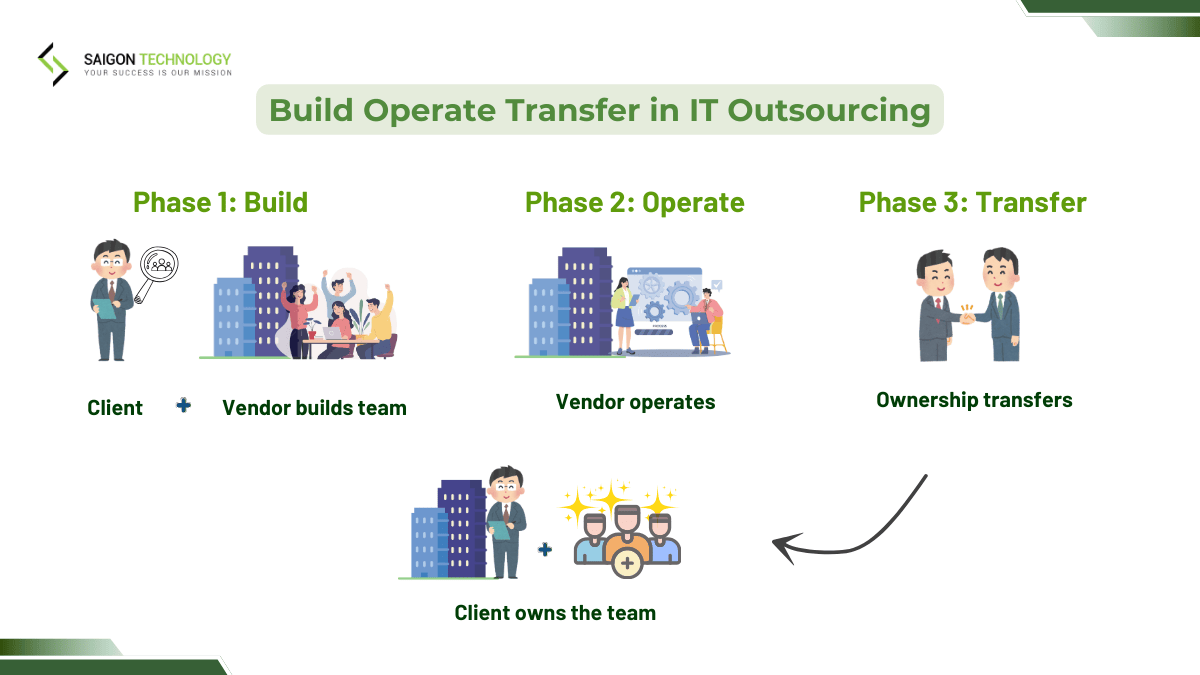
| Build-Operate-Transfer | We build and operate a team, then transfer it to you | Companies that want their own in-house team eventually |
Custom Software Development Outsourcing for New Products
Modernize and Migrate Existing Systems
Extend Your Engineering Capacity
Applied AI and Data Engineering
Case Studies: Three Engagements, Three Different Risks
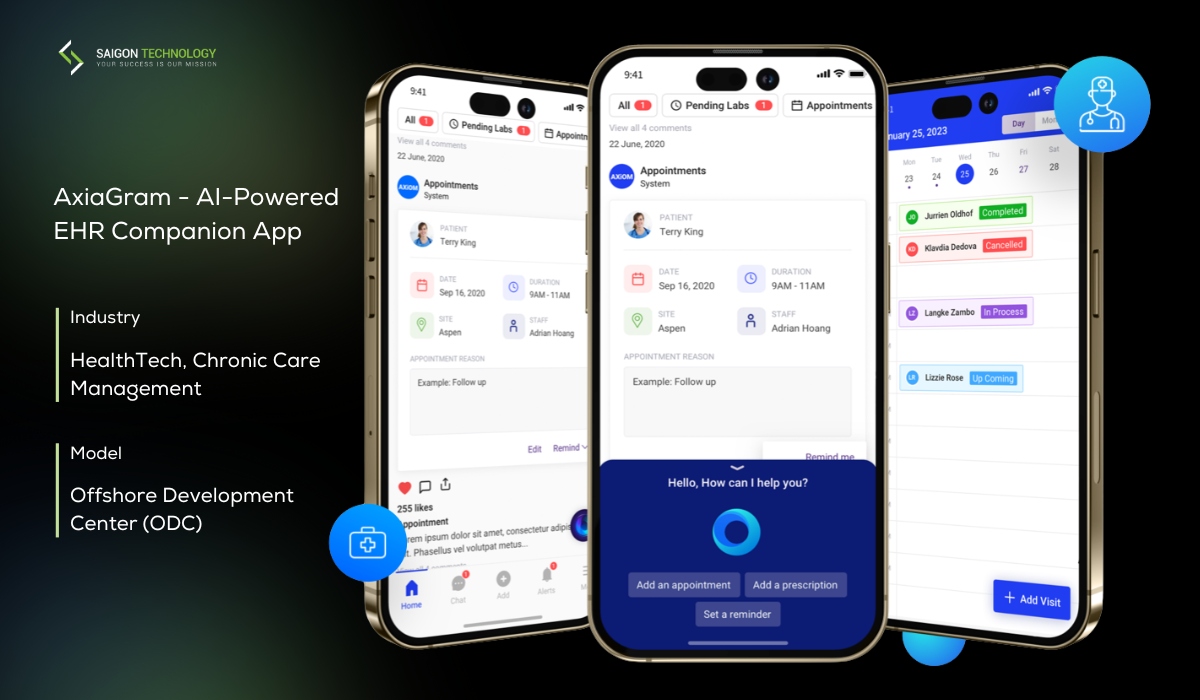
AxiaGram - AI-Powered EHR Companion (Healthcare, US)
- Challenge: US physicians needed clinical documentation and consultations inside one HIPAA-compliant workflow, integrated with hospital records over HL7 rather than re-keyed between systems.Â
- What we built: voice-driven clinical notes, secure messaging, video consultations, and HL7 integration into hospital Electronic Health Records (EHR), with encryption and access control designed for protected health information from the first sprint.Â
- Engagement: long-run delivery center, ongoing since 2021. Stack: .NET Core, Angular, Azure, voice AI, Agora/Wowza.Â
- Outcome: development time cut by 40% with no quality regressions, and 6M+ medical records handled under AES-256 encryption and HIPAA controls.Â
- Learn more | Read the full case study (PDF) →
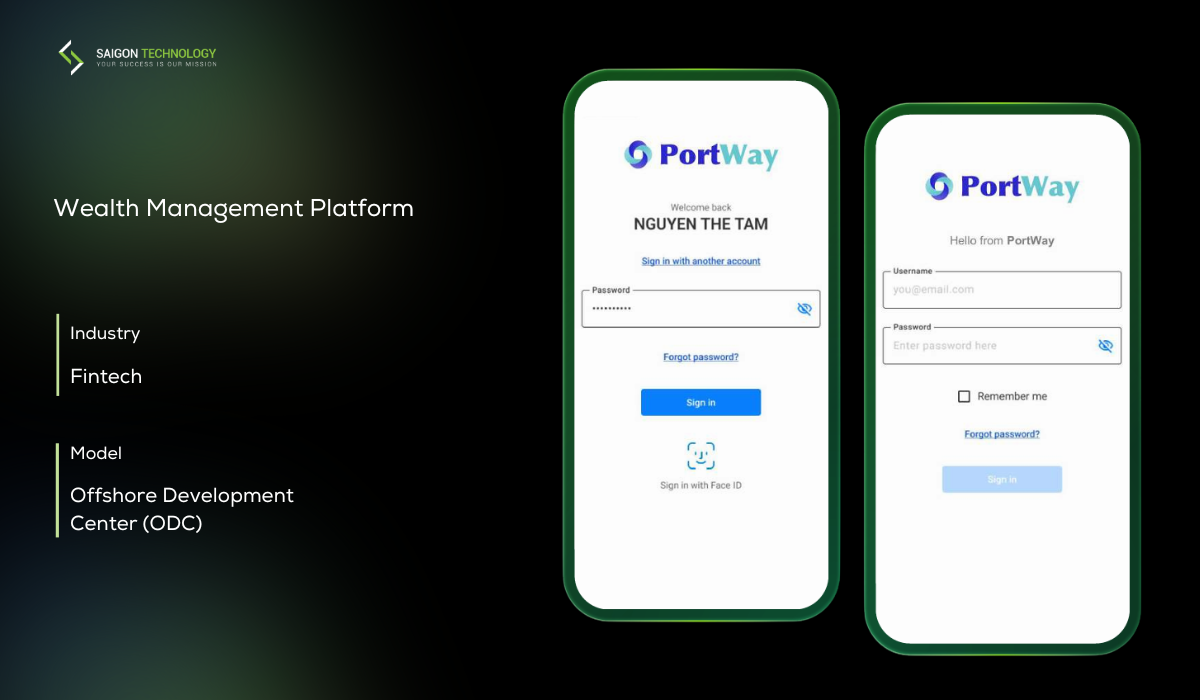
Wealth Management Application (Fintech, US)
- Challenge: wealth managers, brokers and custodians were working across separate systems for portfolio management, trading and fund operations, with reconciliation done by hand.Â
- What we built: real-time multi-asset portfolio management with tax-lot accounting and live FX rates, multi-protocol trading across FIX and REST behind a compliance rule engine, automated fund NAV calculation and fee accrual, custody covering corporate actions and proxy voting, and digital onboarding with KYC/AML automation.Â
- Engagement: delivery center, 2+ years, US market. Stack: ASP.NET Core, Azure (AKS, Functions, DAPR), Kafka, RabbitMQ, React/TypeScript, Blazor, Power BI Embedded, Azure SQL, Cosmos DB, Elasticsearch.Â
- Outcome: portfolio management, trading, fund operations, custody and broker services run on one event-sourced platform instead of separate systems. Every action is traceable end to end, so regulatory reporting and audit are generated from the same event history rather than reconciled by hand.Â
- Read the full case study (PDF) →
Build-Operate-Transfer Partnership (IT Services, Netherlands)
- Challenge: a European IT company wanted its own Vietnam engineering team, and wanted to own it outright at the end rather than stay a client indefinitely.Â
- What we built: a team assembled and operated by us over six years, then transferred in-house with knowledge handover, legal structure and operational runbooks delivered as part of the transfer rather than improvised at the exit.Â
- Engagement: BOT, started as a delivery center.Â
- Outcome: the team scaled from 2 engineers to nearly 50 over six years, then transferred to the client in full, with no delivery disruption through the handover.Â
- Read the full case study →
Send Your RFP. See Your Core Flow Running in 48 Hours.
- Clickable prototype of your core user journey, data model, and integration path
- Workflow visualization mapping your end-to-end process, from intake to reporting
- Architecture direction covering integrations, data ownership, and scale
- Technical recommendation call with our engineering team
Why Choose Saigon Technology as Your Software Development Outsourcing Company?
A good software development outsourcing company can show three things on request: a certified quality and security system, named senior engineers who stay on the account, and a documented way to hand the work back to you. Saigon Technology publishes all three, including its rate band. Â
One senior engineer with AI tooling replaces a junior-heavy pod
Our delivery model staffs fewer, more senior people and equips them with AI tooling inside the development workflow rather than alongside it. The commercial consequence is that schedule compresses faster than rate does, and rework falls because the person writing the code is the person who understood the requirement.
This matters specifically in an IT software outsourcing company engagement, where the usual failure is a large junior team producing volume that a senior reviewer then has to unpick. We frame cost per outcome rather than per hour for that reason, against a published band of $22-$46/hour.Â
Your code, your repositories, ISO 27001 controls around both
Source code lives in your own repositories from day one, not ours, under least-privilege access you can revoke without contacting us. Our secure development lifecycle is aligned to ISO 27001 and covers GDPR and PDPA, with HIPAA, HL7 or PCI DSS controls added where the sector requires them. The failure this prevents is the common one: discovering at the end of an engagement that the working history, the CI configuration and the deployment secrets all live somewhere you cannot reach.Â
A documented way to take the team in-house
Every engagement is written with an exit. Under Build-Operate-Transfer we have transferred 40+ developers into clients' own organisations, with the knowledge handover, legal structure and operational runbooks treated as deliverables rather than goodwill at the end. Lock-in is the objection buyers raise least directly and worry about most, and the answer is a path that has been executed rather than a clause that has been drafted.Â
"The transfer only works because we plan it from the first sprint. Runbooks, access and escalation paths are written for someone else to inherit, so on handover day the client's team is reading documentation we already used, not documentation we wrote for them." - Phuc (Cris) Tran, Program ManagerÂ
ISO 9001 and ISO 27001, certified by BSI (UK), plus Microsoft Gold Partner
Independently audited quality management and information security, not self-assessed. The audit trail is the point, because it is the part of a vendor claim a buyer can verify without taking our word for it.Â
14+ years, 850+ projects, 350+ clients, 400+ engineers
Where our case studies are adjacent proof rather than identical work, we say so. We would rather show verifiable adjacent work than publish a metric we cannot source, which is why some outcome figures on this page are marked as pending clearance rather than rounded into something quotable.Â
Architecture advice from day one, including when not to build
Our architects will tell you when a platform purchase beats a build, or when a phase should be cut before it reaches your roadmap. Research Labs de-risks the genuinely uncertain parts with working demonstrations first, so the decision to proceed rests on something running rather than on an estimate.Â
Two weeks, risk-free, before any commitment
A two-week risk-free trial on a real slice of your backlog, run by the engineers who would staff the engagement. You interview them first, and you judge shipped work rather than a proposal document.Â
Trusted by 350+ Clients Since 2012
Client Testimonials
Diverse Industries We Serve
Saigon Technology builds regulated and operationally complex software across healthcare, financial services, logistics, retail, manufacturing and energy, carrying the domain constraints that decide architecture in each: clinical interoperability, payment and audit controls, real-time tracking, and field connectivity.Â
When to Work With an IT Software Outsourcing Company (and When Not To)
Outsource software development when the work is real but the hire is not justified: a fixed-window roadmap, a skill you need for nine months rather than nine years, or a second workstream your core team cannot staff without stalling the first. A software development outsourcing company is a capacity and process decision before it is a cost decision.Â
Signals outsourcing is the right call
The scope has a defined end, or a defined internal owner. The skill is specialist and the local market is thin. The roadmap has a second track currently blocked behind the first. You need working capacity in weeks, and a domestic hire realistically lands in months.Â
Signals you should hire instead
The work is your core product differentiator and will be for years. Requirements are genuinely unknown and change weekly, which makes any external scope a moving target. Nobody internal has time to own the relationship. In that last case the honest answer is to wait, and we will say so.
What changed recently, and what did not
What changed is the delivery model. Senior engineers working with AI tooling now cover ground that previously took a larger junior-heavy team, which compresses schedules more than it compresses rates. What did not change is the failure mode. Engagements still fail on unclear success criteria and absent ownership, not on time zones. If a distant-time-zone delivery model is specifically what you are evaluating, our engineering hub for that model covers it in depth.Â
What a Software Outsourcing Company Changes Compared With Hiring In-House
Companies work with a software development outsourcing company for four measurable reasons: working capacity arrives in weeks rather than the months a hire takes, fixed salary cost converts to variable project cost, skills the local market does not supply become reachable, and senior internal staff stay on the product instead of on recruiting.Â
| Factor | Building in-house | With an outsourcing partner |
|---|---|---|
| Time to capacity | Months, gated by hiring and ramp-up | Weeks, with vetted engineers already available |
| Cost structure | Fixed: salaries, benefits, infrastructure, recruiting | Variable: contracted capacity sized to the roadmap |
| Scaling down | Slow and expensive | Contractual, at agreed notice |
| Talent access | Limited to your local market | A wider engineering pool, including specialist skills |
| Internal focus | Split between hiring and delivery | Senior staff stay on product and customers |
| Control | Maximum | High, if code ownership and exit are written in |
The Management Burden Moves, It Doesn't Disappear
The honest counterweight is that outsourcing moves the management burden rather than removing it. Somebody internal still has to own success criteria and make decisions. Custom software development outsourcing works when that owner exists, and fails when the arrangement is treated as a way to avoid having one.Â
The Hiring Timeline the Table Leaves Out
The second thing the table understates is time. An in-house build looks cheaper per hour once the team is running, but the months spent recruiting are months the roadmap does not move, and that cost rarely appears in the comparison. Where a capability is genuinely core and permanent, hiring still wins on a long enough horizon. Where it is neither, the arithmetic usually does not survive contact with the hiring timeline.Â
How to Outsource Software Development: Our Seven-Step Process
Define the outcome, not the feature list
We capture goals, users, constraints and what success looks like in measurable terms, then produce a feasibility assessment.Â
Agree scope, model and contract type
Scope of work, engagement model, and fixed-price versus time-and-materials, with a risk and dependency plan attached.
Assemble and kick off
You interview the named engineers before onboarding. Resourcing, budget and milestones are confirmed in writing.Â
Build in short iterations
Agile delivery with coding standards, code review on every change, and version control in your repositories.
Test continuously
Manual and automated QA and testing runs through a CI/CD pipeline with quality gates ahead of every release.Â
Deploy and hand over knowledge
Deployment into your environment, documentation, and user onboarding.Â
Maintain and support
Ongoing maintenance and support, security patching and on-demand updates.Â
Our Insights
FAQs
When should you outsource software development instead of hiring?
Outsource when the work has a defined window or a defined internal owner, when the skill is specialist and locally scarce, or when a second workstream is blocked behind your first. Hire in-house when the work is your long-term core differentiator. The test is durability of the need, not size of the budget.Â
Is outsourcing software development a dying concept?
No, but its shape has changed. The ISG Index for the quarter ending 9 July 2026 reports managed services annual contract value up 2.7% year on year while XaaS grew 65%, with managed services forecast at 2.1% growth for FY2026. Demand for contracted engineering is growing slowly rather than disappearing, while spend shifts toward platform consumption. (ISG Index, 9 July 2026)Â
How do you successfully outsource software development?
Write success criteria before you shortlist. Test one vendor with a small paid engagement rather than a long proposal process. Name an internal owner with decision authority. Insist that code, credentials and documentation live in your systems from the first commit. Our seven-step process sets this out in order.Â
Why do companies outsource software development?
Companies engage a software development outsourcing company to get working engineering capacity in weeks rather than months, to convert fixed salary cost into variable project cost, to reach specialist skills their local market does not supply, and to keep senior internal staff on product work instead of recruiting.Â
How much does it cost to outsource software development?
Saigon Technology publishes a senior-led rate band of $22-$46 per hour, and total cost depends on engagement model, contract type, seniority mix and complexity rather than rate alone. We provide a detailed budget after a scoping call. For a fuller breakdown of how outsourcing costs are structured, see our guide to software outsourcing costs.Â
What questions should you ask a software project outsourcing company?
Six questions separate operators from intermediaries when you assess a software project outsourcing company: where does the code live, may we interview the named engineers, what is the written exit path, how are scope changes priced, what is the security and IP agreement, and can we start with a small paid engagement. Ask them before rate.
What is software development outsourcing?
Software development outsourcing is contracting an external provider to design, build, test or maintain software your company owns. Scope can run from a single specialist joining your team to a full product delivered end to end. Ownership of the code and the product decisions stays with you throughout.Â