




Our Services
Software Development
Offshore & Outsourcing
Infrastructure
Custom Software Development

menu-services-icon

End-to-end software development tailored to meet all your requirements.

menu-services-icon

AI systems analyze data to help businesses make informed decisions.

menu-services-icon

Crafted custom web solutions to align with our client's business goals.

menu-services-icon

A good mobile app increases brand visibility and ease of customer interaction.

menu-services-icon

Empowers confident decision-making and unlocks real AI value with precision.

menu-services-icon

Transforming outdated systems into modern, scalable solutions.

menu-services-icon

Integrates various business processes into a unified system.

menu-services-icon

Provides real-world insights into how users interact with the product.

menu-services-icon

Accessible from anywhere with an internet connection.

menu-services-icon

Connect systems, automate workflows, and centralize data for faster growth.

menu-services-icon

Upgrade legacy systems with minimal downtime

menu-services-icon

Ensures that core application logic and business processes run smoothly.

menu-services-icon

Creates visually appealing and intuitive interfaces for seamless interactions.

menu-services-icon

Ensures the software meets standards and regulations, avoiding compliance issues.

menu-services-icon

Maintenance protects against vulnerabilities with patches and updates.

Software Development Outsourcing

menu-services-icon

Significant cost savings and access to global talent.

menu-services-icon

Get expert help with technology and industry knowledge for your project.

menu-services-icon

Stay current with industry trends to keep your project competitive.

menu-services-icon

Outsource tasks to focus on marketing, sales, and growth.

IT Services

menu-services-icon

End-to-end IT services that help businesses operate securely, efficiently, and at scale.

menu-services-icon

Speeds up updates and fixes, helping you respond faster to market demands.

menu-services-icon

Offer improved performance and reliability with faster processing and less downtime.

  • OVERVIEW
  • SERVICES
  • WHY CHOOSE US?
  • MODELS
  • TECHNOLOGIES
  • OUR PROCESS
  • FAQS

About Saigon Technology - Your Utility Software Development Partner

About Saigon Technology - Your Utility Software Development Partner
  • Saigon Technology is an ISO 9001 and ISO 27001 certified software development company with 14+ years of delivery experience across hundreds of projects. We serve global clients in the US, EU, Australia, and Singapore from three software development centers in Vietnam.
  • Our engineering teams deliver custom utility software, from billing systems and SCADA integration to customer portals and asset management platforms, using Agile methodology and DevOps practices that keep delivery transparent and on schedule.
  • With applied AI capabilities validated through our Research Labs and competitive rates, we help utility companies modernize critical infrastructure without overextending their budgets.
over 350 software developers
400+
Software Developers
Over 12 years of experience
14+
Years in Business
Over 800 Projects Successfully Delivered
850+
Projects Successfully Delivered
rating on Clutch
4.8
Star Rating on Clutch

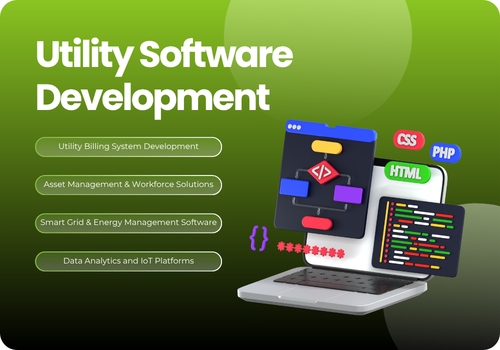
Utility Software Development Services

Saigon Technology provides energy and utilities software development services that address the core systems utility organizations depend on daily. Here's what that looks like in practice.
software development services - icon 6

Utility Billing System Development

Generic billing platforms weren't designed for the complexity of utility billing, tiered rate structures, time-of-use pricing, demand charges, and regulatory formats that change across jurisdictions. Our utility software development team builds custom billing engines for multi-commodity billing across electric, gas, water, and wastewater services.

  • Integrate directly with your meter data management (MDM) platform, eliminating manual data entry entirely
  • Apply rate changes, surcharges, and mandated disclosures automatically through compliance automation, reducing billing discrepancies and the customer complaints that follow
  • Process payments across online, in-person, and automated channels
chevron-up.svg
software development services - icon 1

Asset Management and Workforce Solutions

When asset records live in disconnected systems, maintenance challenges compound, and infrastructure reliability drops. Poles, pipes, transformers, and distribution lines demand continuous tracking, inspection, and maintenance, and scattered data makes that harder.

  • Give operations teams a single view of every asset, condition, maintenance history, and projected lifespan in one place through our asset management software
  • Let technicians receive work orders and document inspections directly from the field with mobile-first workforce modules
  • Integrate IoT sensor data to flag failures before outages occur, improving resource balancing across operations
chevron-up.svg
software development services - icon 4

Smart Grid and Energy Management Software

AMI generates massive volumes of interval data. SCADA monitors equipment in real time. Demand response programs require automated load management across thousands of endpoints. The problem is that these systems rarely talk to each other. Our energy & utilities software development services connect them into unified platforms.

  • Feed meter data into analytics for consumption analysis and demand forecasting through AMI integration
  • Replace aging SCADA interfaces with web-based dashboards accessible from any location
  • Automate load management with real-time grid monitoring, helping utilities balance supply and demand without manual intervention
chevron-up.svg
software development services - icon 9

Customer Portal and CIS Development

Your call center handles issues that self-service should resolve, because your customer information system (CIS) is disconnected from billing, field operations, and metering. We build customer portals that change this.

  • Provide direct access to usage data, payment history, billing statements, and outage reporting
  • Connect these customized solutions to your CIS, billing, and outage management platforms so that displayed information stays current and accurate
  • Extend access to smartphones through mobile apps, driving higher customer engagement, lower call volume, and improved quality and satisfaction
chevron-up.svg
software development services - icon 6

Data Analytics and IoT Platforms

Utilities generate enormous volumes of data from meters, sensors, SCADA systems, and customer interaction, but turning that data into operational decisions is where most organizations stall. Our utility software development platforms make that data actionable.

  • Aggregate multi-source data into role-specific dashboards for operations managers, finance teams, and compliance officers
  • Support capacity planning and procurement decisions with consumption forecasting models
  • Enable real-time leak detection, pressure monitoring, and pipeline inspection across water and gas networks through IoT sensor integration
  • Automate regulatory reporting and data compilation for state and federal filings, improving budget transparency and audit readiness
chevron-up.svg
software development services - icon 8

Legacy System Modernization

Running a decades-old system indefinitely creates mounting operational inefficiencies, but replacing it all at once is risky and expensive. As a utilities software development company focused on phased modernization, we take a different path.

  • Build mainframe-to-cloud migration strategies that protect your existing data and business logic while moving to scalable architectures
  • Wrap legacy systems with modern interfaces through API-first design so new applications work without touching the underlying code
  • Prioritize high-impact, low-risk modules first through our proven process, delivering early results while managing operational risk through power and utilities software development expertise
chevron-up.svg

Case Studies

Offshore Dedicated Team
HoloLens

HoloLens

This revolutionary program combined the capabilities of computer vision and mixed reality to present users with a unified and immersive augmented reality experience. Scan Environment, Measure Straight Line, Measure Area, Measure Room, Detect Text, Read Text, and Detect Objects were just some of the ways the Hololens software brought the real world to life and […]
Detail arrow-narrow-right.png
Automation and Control
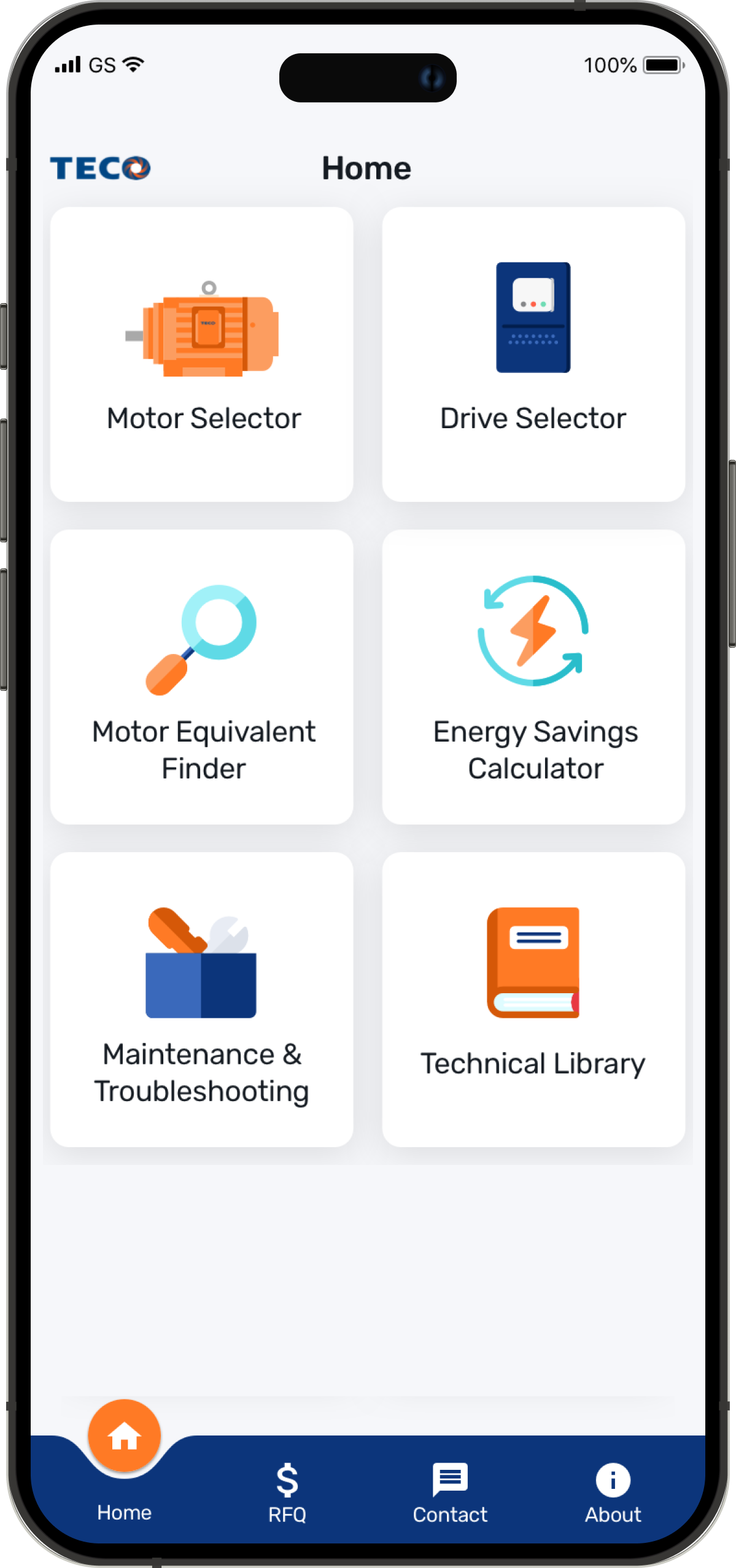
TECO APP

TECO APP

Our skilled team started the Teco App project to develop an innovative software solution that aimed to revolutionize customer engagement, in line with their vision.
Detail arrow-narrow-right.png
Mobile App
EVNT Mobile

EVNT Mobile

EVNT Mobile, a global event app, runs on iOS and Android It uses Google Maps and push notifications to highlight nightlife and events
Detail arrow-narrow-right.png

Financial
Evolution and Engine ODC

Evolution and Engine ODC

The client set up an ODC with Saigon Technology to help develop Engine and Evolution. Our ODC services delivered tailored solutions to meet their business needs.
Detail arrow-narrow-right.png

Ready to Modernize Your Utility Software?

Start with a free consultation. No commitment, no sales pitch, just a technical conversation about your current systems, your challenges, and what a realistic path forward looks like.
Discuss Your Utility Software Project
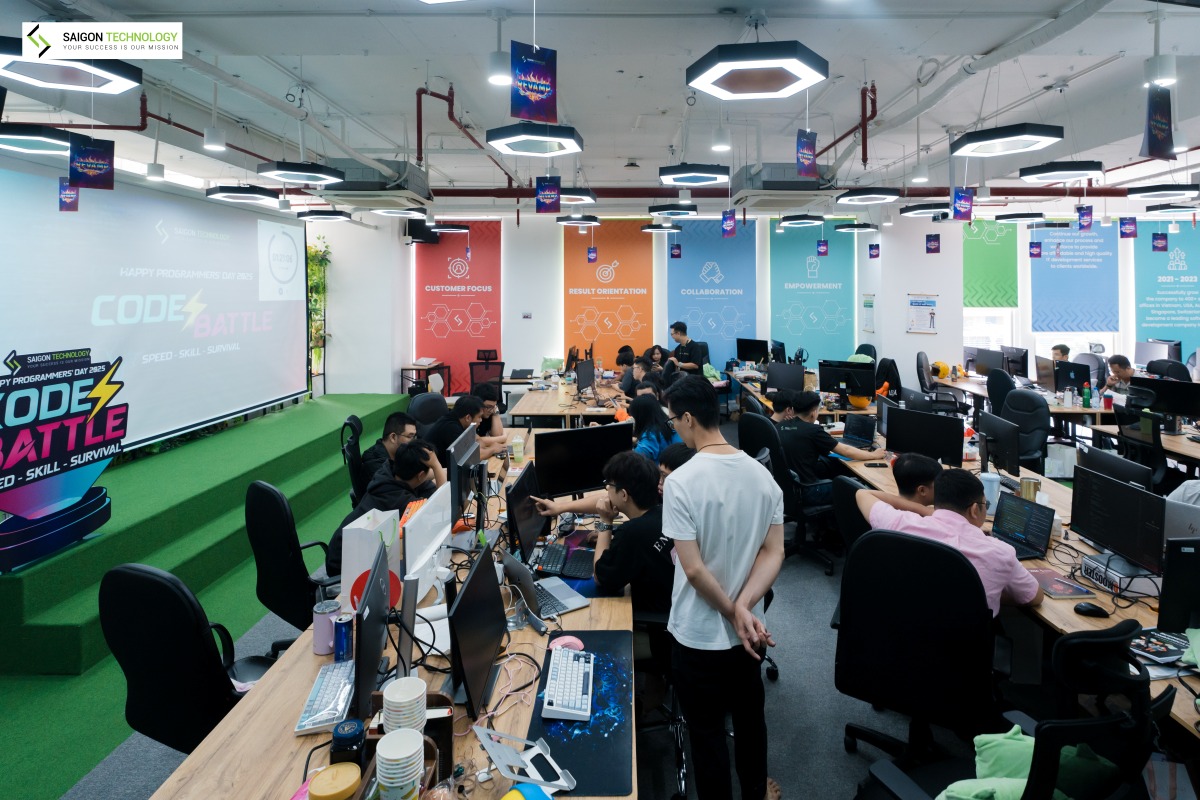
Employee at Saigon Technology 2026

What Sets Our Utility Software Development Apart

Choosing a utilities software development company is a decision that affects your operations for years. Here's why utility leaders across energy, water, gas, and telecom trust Saigon Technology with that decision.

Our teams include engineers who understand rate structures, SCADA protocols, AMI data formats, and regulatory compliance. They've built bespoke utilities software for organizations managing millions of meters and thousands of field workers. This domain knowledge means fewer requirements misunderstandings and faster delivery.

Beyond traditional development, we bring applied AI capabilities to utility challenges, from demand forecasting models to automated pipeline inspection analysis. Our approach combines proven software creation processes with emerging technologies, validated through research and real-world deployment.

We have hands-on experience integrating SCADA, GIS, AMI, CIS, ERP, and billing systems. Our consulting partners and development teams have worked with the specific platforms and data formats that utilities rely on. This design, development, and delivery expertise reduces the integration risk that derails many utility software projects.

We work with NERC CIP, EPA, and state public utility commission requirements as standard project inputs, not afterthoughts. Compliance architecture is part of every software project design, with automated audit trails, role-based access controls, and reporting modules included from the start.

With three software development centers, we offer competitive rates without compromising quality and satisfaction. Our ISO-certified development process ensures consistency across teams. This structure supports flexible engagement models, dedicated teams, project-based delivery, or staff augmentation, depending on what your project requires.

This is not our first enterprise software engagement. We've delivered across industries that demand reliability, security, and compliance. Our utilities software clients benefit from that experience, proven processes, DevOps practices, and product design and engineering capabilities that have been refined across hundreds of engagements.

Why us video preview

Our Global Clients

Partner-logo2 Partner-logo3 Partner-logo4 Partner-logo6 Partner-logo1 Partner-logo5 Partner-logo9 Partner logo

Client Testimonials

During our collaboration, Mr. Thanh and his company, Saigon Technology, have consistently demonstrated world-class leadership and execution in complex fintech projects. His ability to scale and lead high-performing engineering teams, while maintaining cost-efficiency and product quality, has been critical to our technology operations. His strategic insights and leadership enabled us to significantly improve system stability and deployment velocity.
Abe Jarrett
Senior Vice President of Software Engineering at Origence, USA
star.svg star.svg star.svg star.svg star.svg
I would recommend companies to work with Saigon Technology for their Software development or service needs. The project team is very responsible for their work and would recommend solutions in the interest of the client. The team also responds very quickly to requests, bugs, and questions. One exceptional quality of Saigon Technology was its patience with clients. There were several times when we were slow to respond or test our apps, but the project team was still very accommodating towards us
Jeremy Heng
Development Manager - Rehau Group PTE
star.svg star.svg star.svg star.svg star.svg
I have worked with Thanh (Bruce) Pham on several projects, and I admire his professionalism and his dedication to delivering high-quality work. He is responsive when answering emails and calls, as well as making sure that work always gets done on time. I am glad to be working with him and hope to continue working with him.
Mr. RJ Macasaet
Head of Partnership – DMI Global
star.svg star.svg star.svg star.svg star.svg
Its a complete piece of mind working with Saigon folks. Prompt in response and quality of work is also great. We have been associated with Saigon for a few years now and we are really happy & satisfied.
Vivek Marwaha
Senior Project Manager at DMI
star.svg star.svg star.svg star.svg star.svg

Why Utility Companies Struggle with Off-the-Shelf Software

Most utility companies run on systems built decades ago. COBOL-based mainframes, siloed databases, and rigid vendor platforms that were designed for a different era. When the pressure to modernize hits and it always does these organizations face a set of problems that generic software simply cannot solve.

Why Utility Companies Struggle with Off-the-Shelf Software

Many utilities still depend on mainframe systems from the 1990s or earlier. These systems hold critical billing, metering, and customer data, but they lack APIs and cannot communicate with modern platforms. Every attempt to add a new tool means another workaround, another data silo, and another point of failure. The cost of maintaining these systems grows every year, while their capabilities stay frozen in place.

Large platforms from SAP, Oracle, or other enterprise vendors promise end-to-end coverage. In practice, they deliver rigid workflows that require expensive consultants to customize. When your rate structures change, or your state regulator issues new reporting requirements, you're waiting months for a vendor release cycle instead of weeks for a targeted update. The platform controls your roadmap, not your business.

A water utility in California faces different reporting requirements than an electric cooperative in Texas. NERC CIP standards apply to bulk power systems. EPA mandates govern water quality data. State public utility commissions impose their own rate-setting and consumer protection rules. Off-the-shelf software treats compliance as a checkbox feature. For utilities, it's the foundation everything else builds on.

SCADA monitors your physical infrastructure. GIS maps your assets. AMI collects meter data. CIS manages customer records. Billing calculates charges. Each system was likely purchased separately, from a different vendor, at a different time. Getting these systems to share data in real time, so a field technician sees the same information as a customer service rep, requires custom integration work that no packaged solution handles well out of the box.

Your customers use apps from their bank, their telecom provider, and their insurance company that show real-time data, enable instant payments, and provide self-service options. They expect the same from their utility provider. Building a customer portal that connects to your existing billing and metering systems, while meeting accessibility and security standards, is a custom software challenge, not a plugin installation.

Engagement Models

Your engagement model should match your project's certainty and duration. We offer several options:
Fixed-Price Model

Fixed-Price Model

Works well for projects with well-defined scope, a customer portal, a reporting dashboard, or a billing integration with clear requirements.
Dedicated Development Team

Dedicated Development Team

Supports ongoing programs where requirements evolve over time, common in multi-year modernization initiatives.
Staff Augmentation

Staff Augmentation

Fills specific skill gaps when your in-house team needs additional utility-domain engineers or integration specialists.
ODC (Offshore Development Center)

ODC (Offshore Development Center)

Provides a fully managed engineering hub in Vietnam, giving you long-term capacity with operational control.
BOT (Build-Operate-Transfer)

BOT (Build-Operate-Transfer)

Lets us build and run your team, then transfer full ownership - people, IP, and processes - when you're ready.

Utility Software Development Costs Explained

One of the most common questions from utilities leaders evaluating custom software is straightforward: What does this cost? Here's an honest breakdown based on our project experience.

Typical project investment ranges

Billing system integrations and focused modules typically fall in the 150K to 500K range, depending on the number of rate structures, payment integrations, and regulatory requirements involved.

Full platform builds, enterprise CIS replacement, comprehensive asset management systems, or multi-system integration projects range from 500K to 2M or more. These numbers reflect the complexity of utility operations, not arbitrary pricing.

chevron-up.svg

What affects cost

Several factors drive project cost data in utility engagements. System complexity is the primary driver; a billing engine supporting three rate structures costs less than one supporting thirty.

The number of integrations matters: connecting to one MDM platform is different from integrating SCADA, GIS, AMI, and CIS simultaneously. Regulatory requirements add compliance automation, audit trails, and security features.

Data migration scope, moving decades of historical billing and customer data, can represent a significant portion of the project effort.

chevron-up.svg

Timeline expectations

Focused modules (a customer portal, a reporting dashboard, a billing integration) typically take 3 to 6 months from kickoff to deployment. Enterprise platform builds, full CIS replacement, comprehensive legacy modernization, or multi-system integration program runs 12 to 18 months.

Phased approaches deliver working software at regular intervals throughout these timelines, so you're not waiting a year to see results.

chevron-up.svg

Our Tech Stack

How Utility Software Development Projects Work

Utility software projects involve regulated data, critical infrastructure, and multiple system integrations. Rushing into development without proper planning leads to costly rework. Our proven process is designed to manage that complexity.
Software Development Process - Step 1

Discovery and Requirements

We start by mapping your existing systems, data flows, and integration points. This includes reviewing your SCADA, GIS, AMI, CIS, and billing platforms. We document regulatory requirements, identify compliance gaps, and define the scope of work. Our co-located team works alongside your domain experts during this phase, not from a generic requirements template.

Software Development Process - Step 2

Architecture and Planning

Based on discovery findings, we define the technology stack, integration architecture, and phased delivery plan. Compliance frameworks (NERC CIP, EPA, PUC requirements) are baked into the architecture — not bolted on later. This phase produces a software project design that your technical and business stakeholders both review before development begins.

Software Development Process - Step 5

Iterative Development

We use Agile sprints with utility domain engineers embedded in the development team. Burndown charts and sprint reviews keep progress visible. Each sprint delivers working software that your team can test against real operational scenarios. This is not generic agile; it's development informed by how utilities actually operate.

Software Development Process - Step 4

Integration and Testing

End-to-end testing validates data flows across SCADA, billing, CIS, GIS, and any other connected systems. We test for edge cases specific to utility operations: rate changes mid-billing cycle, meter data gaps, failover scenarios, and cybersecurity penetration testing. Compliance validation runs in parallel with functional testing.

Software Development Process - Step 8

Deployment and Support

Phased rollout minimizes operational risk. We don't flip a switch on a Friday afternoon. Deployment happens in stages, by region, by system module, or by customer segment, with rollback plans in place. Post-launch support includes monitoring, incident response, and ongoing maintenance through a consultation model that fits your needs.

Our Insights

FAQs

Utility software development is the process of building custom software solutions specifically for energy, water, gas, and telecom companies. It covers billing systems, asset management platforms, customer portals, SCADA integration, smart grid management, and regulatory compliance tools, all designed around the operational requirements unique to utility organizations.

Custom utility software typically costs between 150K and 2M+,  depending on project scope. A focused billing integration might fall in the 150K - 500K range, while a full platform build with multiple system integrations can exceed $1M. Key cost factors include system complexity, number of integrations, regulatory requirements, and data migration scope.

A utility billing system with standard rate structures, payment integration, and regulatory compliance typically takes 4 to 8 months. Complex implementations supporting multiple commodities, dozens of rate structures, and extensive MDM integration can take 9 to 14 months. Phased delivery approaches produce working billing modules within the first 3 to 4 months.

It depends on your requirements. Off-the-shelf platforms like SAP IS-U or Oracle Utilities offer faster deployment but limited customization and ongoing license costs. Custom-built solutions require more upfront investment but provide full control over features, integrations, and compliance automation. Most utilities benefit from a hybrid approach, using commercial platforms where they fit and custom development where they don't.

We build integration layers using API-first architecture and protocol adapters specific to each system. For SCADA, this means DNP3 or Modbus communication interfaces. For GIS, we use standard geospatial APIs and data formats. For AMI, CIM-based data exchange protocols handle meter data flows. Each integration is tested end-to-end with your production systems before deployment.

Utility software must address NERC CIP standards for cybersecurity (bulk power systems), EPA regulations for water quality and environmental reporting, state public utility commission (PUC) requirements for rate-setting and consumer protection, and data privacy regulations. Compliance requirements vary by utility type, jurisdiction, and service territory, which is precisely why custom solutions outperform generic platforms in regulated environments.

Utility management software refers to off-the-shelf platforms (Oracle Utilities, SAP IS-U, Itron) designed for broad industry use. Custom utility software is built specifically for your organization's infrastructure, regulatory environment, and operational workflows. Custom solutions integrate with your exact system landscape and adapt to your specific rate structures, compliance requirements, and customer service model, without the constraints of a vendor's product roadmap.

Don't Let Legacy Systems Slow You Down

Your competitors are modernizing. Stop patching legacy systems, start building what's next.
Contact Message Box
Back2Top