

































































• OVERVIEW
  • SERVICES
  • MODELS
  • WHY CHOOSE US ?
  • OUR PROCESS
  • TECHNOLOGIES
  • FAQS

Dedicated Development Team with AI Capabilities: Quality Delivery, Optimized Costs

Saigon Technology builds teams for companies that need consistent delivery and clear governance, not just extra hands. Screening focuses on practical engineering ability alongside English communication and problem-solving, so your dedicated software development team can collaborate smoothly across the US, AU, EU, and Singapore time zones.

If your roadmap includes AI-enabled features, that discipline matters more, not less. AI work changes shape as soon as real users, real data, and real edge cases arrive. A stable team with applied AI capability helps you move quickly without gambling on quality: iterative development stays under control, rework drops, and you avoid throwaway prototypes that never reach production.

You get a team that supports modern product engineering, DevOps, and ongoing improvement while staying cost-effective compared with building the same capacity locally. Explore Our Talent.

Across 14 years, Saigon Technology has delivered 85+ dedicated teams. That number matters more than a headcount figure, because a team that stays together is the only version of this model that pays back. The first month of any engagement is spent buying context; every month after that is spent using it. Churn resets the meter.

"The engagements that go wrong are almost never the ones where the code was weak. They are the ones where nobody agreed who decides what, and by when. We settle that in week one, before the first sprint, because it is far cheaper to argue about ownership on a whiteboard than in a release." - Phuc (Cris) Tran, Program Manager, Saigon Technology

Contributors
Phuc Tran - Program Manager
Meet Phuc (Cris) Tran
Program Manager leading teams of 60+ engineers and budgets exceeding $3.9M across 90+ projects
Book an Appointment More Details
Phong Le - AI Tech Lead
Meet Phong Le
AI Tech Lead with 10+ years building production AI applications, intelligent agents, and enterprise data pipelines
Book an Appointment More Details
over 400 software developers
400+
Software Developers
Over 14 years of experience
14+
Years in Business
Over 850 Projects Successfully Delivered
850+
Projects Successfully Delivered
rating on Clutch
4.8
Star Rating on Clutch

Dedicated Development Team Services: Engagement & Pricing Options

If you are evaluating dedicated development team services, the first filter is usually whether the shape of the engagement fits how your product actually moves. The three models below differ in who holds the roadmap, not in who writes the code.
software development services - icon 7

Monthly dedicated team

A monthly dedicated software development team gives you predictable capacity and steady momentum. You get a stable set of roles (engineering, QA, DevOps, team leads, and optional PM support) who stay with your product long enough to understand your domain and reduce rework.

This model suits long-term collaboration, iterative development, and structured timelines where scope evolves but delivery cadence has to stay consistent.

Choose this when you have a roadmap rather than a project, one internal owner who can set priorities, and work that will still exist in twelve months. It is the wrong choice when the scope is genuinely fixed and finite, because you would be paying for continuity you will not use.

chevron-up.svg
software development services - icon 9

POD / squad model

A POD or squad is a cross-functional dedicated software team organized around one product stream, such as onboarding, billing, integrations, or analytics. You get clear roles and responsibilities, faster decision loops, and progress tracking tied to outcomes rather than individual tasks.

It works well for scale-ups running several streams in parallel while keeping shared standards for architecture, QA, and reporting.

Choose this when you can draw a boundary around one product area and name the outcome it owns. It breaks down when two PODs share a codebase without agreed module boundaries, so settle ownership before the second squad starts, not after the first merge conflict.

chevron-up.svg
software development services - icon 3

Hybrid

Hybrid combines a stable core team with short-term specialist support when you need it: AI and ML experts, performance work, security hardening, or modernization and migration phases. You keep a consistent delivery engine while flexing capacity for high-impact bursts.

This improves long-term cost efficiency because you avoid permanently staffing roles you only need for a few sprints.

Choose this when your roadmap has a predictable base plus occasional spikes that demand a skill your core team should not have to carry year-round.

For how these compare with other engagement structures, including build-operate-transfer, see our engagement models. Saigon Technology has transferred 40+ developers into client-owned entities through BOT arrangements, so the exit path is a real option rather than a brochure line.

chevron-up.svg

Proof of Delivery

If you want to buy a dedicated software development team with confidence, look for proof that matches your reality: long-term collaboration, security, and outcomes someone can check.

Two of the three ran past the two-year mark. That is the signal worth reading: a dedicated software development team is judged on what it looks like in year three, not in sprint three.

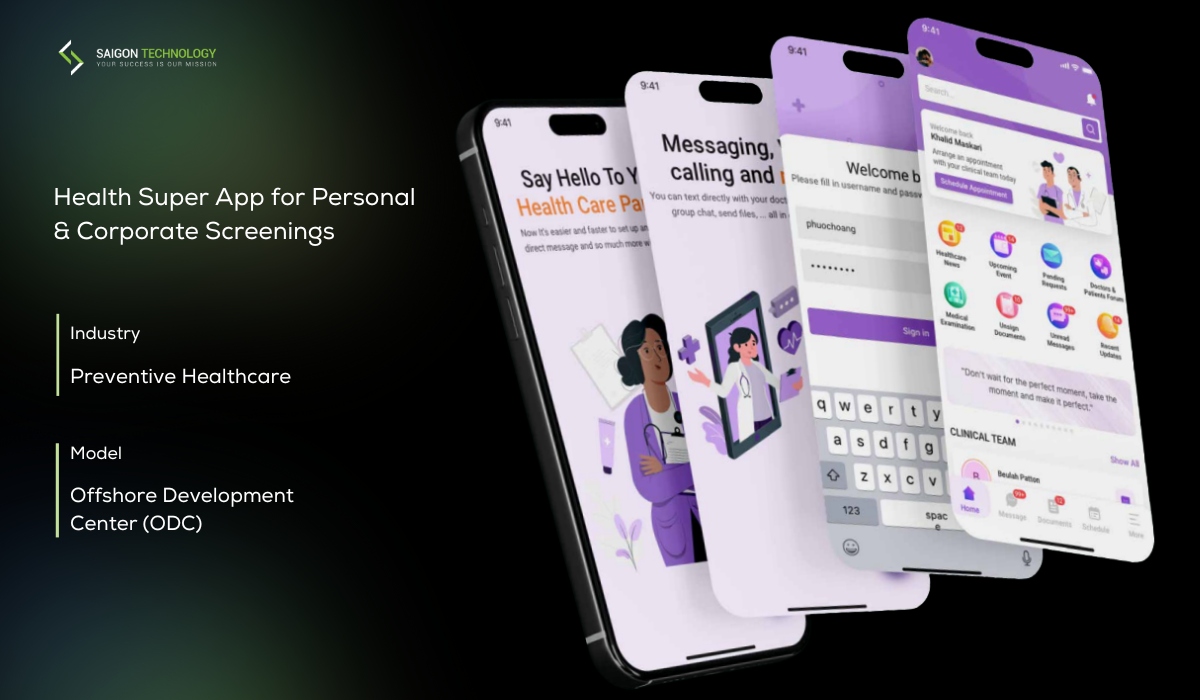
Health Super App for Personal & Corporate Screenings

Health Super App for Personal & Corporate Screenings

  • Client snapshot (industry + region): Preventive healthcare provider using the solution across clinics and corporate programs in Southeast Asia, with privacy obligations including Singapore PDPA. 
  • Overview project: A mobile platform for personal and corporate users to book screenings, manage results, and schedule follow-ups across in-clinic, executive, and home-based options. 
  • Team model & composition: ODC-style long-term team with mobile, backend, and QA roles, supported by project management practices and structured timelines. 
  • Scope & deliverables: Corporate booking with company codes and custom surveys, personal screening flows with optional tests, QR-based check-in, digital consent and lifestyle surveys, follow-up bookings, plus appointment editing, cancellation, and rescheduling. The team also implemented dynamic pricing and refund logic tied to screening changes. 
  • Process & governance: Agile practices with iterative development, sprint demos, and progress tracking through milestone reporting. 
  • Tech stack: React Native, Node.js, Firebase, PostgreSQL; QR codes, PDF report generation, Stripe payment integration. 
  • Outcomes: Monthly usage at scale, faster paperless check-in, centralized records, and improved engagement through dashboards and trend tracking. Security included AES-256 encryption for records and auditability through Stripe. 
  • Read the full case study (PDF) →
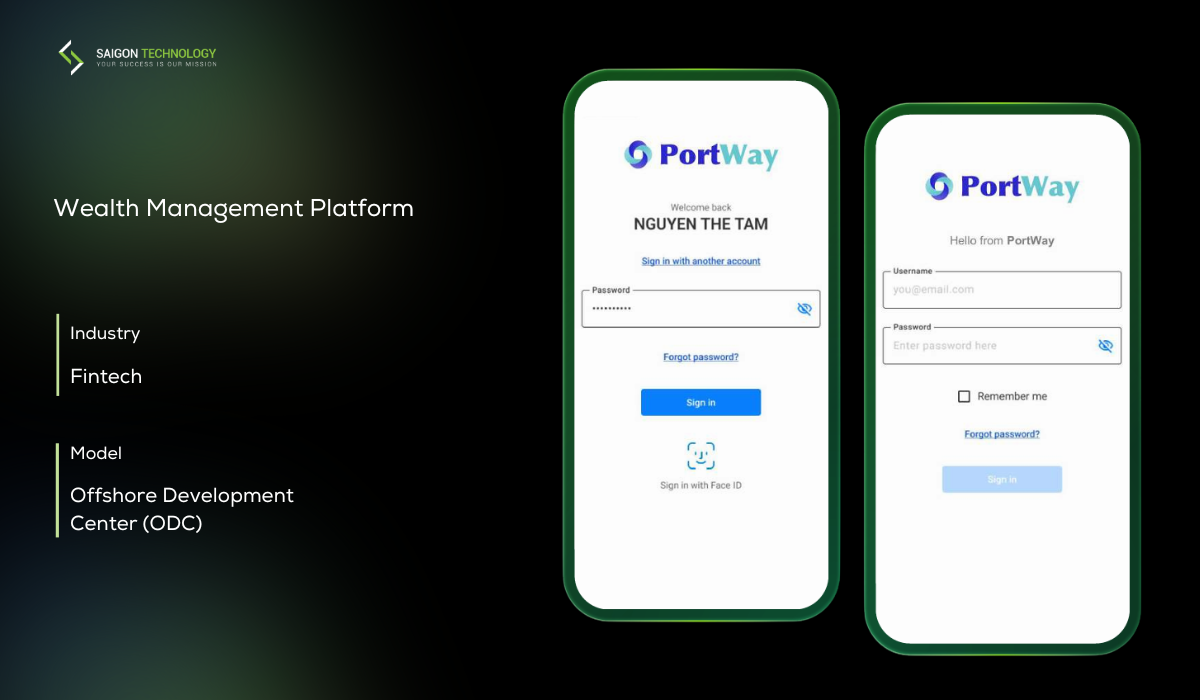
Wealth Management Platform

Wealth Management Application

  • Client snapshot (industry + region): US fintech platform for wealth managers, brokers, and custodians operating under strict compliance expectations and audit requirements. 
  • Overview project: A financial services technology platform covering portfolio management, trading, fund operations, broker management, custodian services, and client services, designed for low-latency trade flows and transparent audit trails. 
  • Team model & composition: ODC engagement over 2+ years with a dedicated software team including platform experts, team leads, QA, and DevOps support for continuous delivery and release stability. 
  • Scope & deliverables: Real-time portfolio management, multi-protocol order and execution workflows, automated fund NAV calculations with compliance monitoring, broker operations with order tracking and commission handling, custodian workflows for corporate actions and proxy voting, and secure onboarding with KYC/AML automation and event-driven audit trails. 
  • Process & governance: Governance cadence with structured reporting, change request handling, and documentation suitable for regulated operations. 
  • Tech stack: Azure-based microservices and event-driven architecture, real-time communication, and enterprise-grade monitoring. 
  • Outcomes: Faster operational visibility, improved traceability through event history, and more reliable execution and reporting across broker and custodian workflows. 
  • Read the full case study (PDF) →
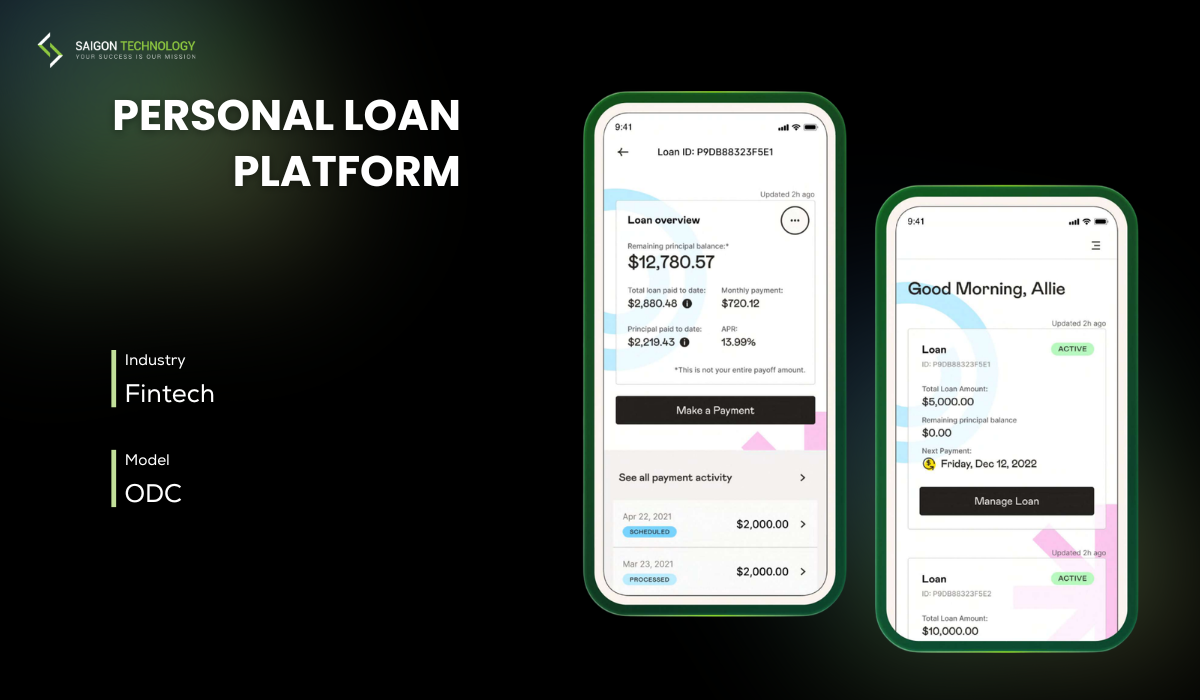
Personal Loans Application

Cost Module / Loan Management Solution

  • Client snapshot (industry + region): US fintech lender needing a secure, auditable loan lifecycle platform with real-time fraud detection and compliant data handling. 
  • Overview project: A loan management solution supporting onboarding and identity verification through underwriting, disbursement, repayment tracking, fraud detection, and collections management. 
  • Team model & composition: ODC engagement over 3+ years with backend and frontend engineers, QA, DevOps engineers, and domain experts for lending workflows and third-party integrations. 
  • Scope & deliverables: KYC document recognition, identity and income verification, employment verification integrations, real-time fraud detection, bank account verification, loan servicing workflows, and AI-assisted underwriting and credit risk decisioning. The system included fallback strategies for third-party failures and clean data normalization for verification quality. 
  • Process & governance: Continuous collaboration with structured release governance, audit trail discipline, and support and maintenance to stabilize production operations. 
  • Tech stack: Cloud-native AWS setup with secure secrets management, message brokers, and API documentation practices. 
  • Outcomes: Faster underwriting decisions, stronger fraud controls through unified scoring, reduced manual verification effort, and improved compliance posture via OAuth-based authentication and end-to-end auditability. 
  • Learn more | Read the full case study (PDF) →

Send Your Roadmap. Meet Your Dedicated Team in 48 Hours.

An AI-accelerated path from your roadmap to a staffed dedicated software development team, assembled by our engineers rather than a sales team.
  • Proposed team matched to your roadmap
  • Role-by-role skills and seniority map
  • Engagement direction covering ownership, process, and scale
  • Technical strategy call with our engineering team
Fee live demo - Saigon Technology

Why Choose Saigon Technology?

The cheapest risk control available to you is a short, bounded trial before any long-term commitment. Not a discovery phase, and not a paid proof of concept that ends in a bigger proposal. A real trial has three properties: a fixed end date, one contained objective, and a genuine option to walk away without penalty.

Saigon Technology runs a two-week risk-free trial before any long-term commitment. Judge it on code quality, communication, review responsiveness, and how the team handles an ambiguous requirement. Deliberately do not judge it on raw velocity, because velocity in week one measures familiarity with your codebase, not capability. 

The usual version of this purchase runs the wrong way round: you evaluate a company, review an anonymised team profile, sign, and meet the people three sprints later. Every assessment step you run becomes theatre when it is run against a proposal instead of against the humans who will write your code.

Here you review the CVs and interview the engineers who would actually be assigned to you, before anything is signed, and you can decline an individual without renegotiating the engagement. Ask any provider whether that is standard. The answer tells you how they staff.

Saigon Technology works under ISO 9001 and ISO 27001 aligned practices, certified by BSI, UK, with the certificate numbers published and checkable. That matters most where the deliverable touches regulated data: quality management, security controls, environment separation, audit trails, and documentation a compliance reviewer can follow. Two of the three programmes above run in fintech, where an unauditable release is a bigger problem than a late one. When any provider tells you it is "ISO certified", ask which standard, which certification body, and when it was last audited. An unnamed certifier is not a certificate. 

Continuity is the thing you are actually buying from this model, which makes retention a technical argument rather than a cultural one. Churn breaks the thing you already shipped: the engineer who understood why a workaround exists leaves, the workaround gets "cleaned up", and a bug returns that was fixed eighteen months ago. Saigon Technology has delivered 85+ dedicated teams and was ranked #10 in the Medium category of Southeast Asia Best Workplaces™ in Technology 2026. The award is worth exactly one thing here: it is evidence about the variable your roadmap depends on. 

Microsoft Gold Partner status, 14+ years in operation, 850+ projects delivered for 350+ clients, across three development centers. 

Shipping AI-enabled features needs production-minded engineering, DevOps, and QA that protect releases, not experimentation. Teams here build, ship, monitor, and iterate with clear ownership and documentation. 

Overlap decides whether code review is same-day or next-day, and next-day review quietly halves throughput on anything needing two passes. Saigon Technology runs 10 to 12 hours of overlap with US East and West Coast schedules. Ask for the number in hours and get it into the working agreement. 

If your scope is genuinely fixed and finite, a fixed-price project is the cheaper instrument. If nobody internally can own priorities day to day, no engagement model fixes that. We would rather say so before the contract than after. 

Why choose Saigon Technology 2026

Trusted by Global Clients

Partner-logo2 Partner-logo3 Partner-logo4 Partner-logo6 Partner-logo1 Partner-logo5 Partner-logo9 Partner logo

What Our Clients Say

Over the past year, collaborating with Saigon Technology Solution company, we have brought high-quality financial software solutions. STS helps us meet the strict requirements of the IT market with software engineers, software testers, and internal system control. And all of these are evidence that we have chosen a good software outsourcing partner.
Mr. Corbin van Amelsvoort
Director at Topicus Vietnam
star.svg star.svg star.svg star.svg star.svg
As the Owner and Director of ISMS Global, Australia, I understand perfectly how challenging it is to find a support team of skilled and professional developers to help grow a system. A few years ago, I found Saigon Technology Software (STS), led by Mr. Thanh Pham (CEO), and I have never looked back. STS has single-handedly taken ISMS camp management software from a concept on a napkin to an international product used by major companies around the world. If you are looking for a trusted partner to help you, then you should be talking to Thanh Pham.
Mr. Paul Upson
Director of ISMS Global, Australia
star.svg star.svg star.svg star.svg star.svg
Being a client of Thanh’s, from the beginning, I have been very impressed with Thanh’s professionalism and exceptional customer service. Thanh and his team have always provided me with high-quality work at a very reasonable cost and always within the given time frame. I have no hesitation in recommending Thanh.
Mr. Matt Niemeyer
Managing Director APAC – ISMS Global
star.svg star.svg star.svg star.svg star.svg
During our collaboration, Mr. Thanh and his company, Saigon Technology, have consistently demonstrated world-class leadership and execution in complex fintech projects. His ability to scale and lead high-performing engineering teams, while maintaining cost-efficiency and product quality, has been critical to our technology operations. His strategic insights and leadership enabled us to significantly improve system stability and deployment velocity.
Abe Jarrett
Senior Vice President of Software Engineering at Origence, USA
star.svg star.svg star.svg star.svg star.svg
Saigon Technology provided the expert advice and technical development needed for our platform. I truly appreciate their professionalism and ongoing support.
Jason Soo
CEO - Loan City
star.svg star.svg star.svg star.svg star.svg
We value Saigon Technology’s strong support in managing the engagement from an internal delivery perspective. They were able to maintain team performance across a relatively large team, provide additional resources when required, and work collaboratively with us on matters such as gap time, discount proposals, and improvements to the working process. Their flexibility and consistent management support contributed positively to the overall partnership.
Sri Vijayasarathy
CTO of Axiagram, USA
star.svg star.svg star.svg star.svg star.svg

Build Your Team: Roles, Seniority, and Team Composition

If your plan is to build a dedicated software development team, start by designing it around delivery risk rather than around a headcount budget. The right mix of roles reduces rework and makes progress tracking easier, and the wrong mix shows up as a queue in front of one person. 

Typical roles we can assemble

  • Product Manager / BA 
  • Tech Lead / Architect 
  • Frontend / Backend / Mobile engineers 
  • QA (manual + automation) 
  • DevOps / Cloud 
  • UI/UX 
  • Data and AI roles when needed 
chevron-up.svg

Common team setups (examples)

  • Startup MVP squad: 1 Tech Lead, 2 engineers (full-stack, or a frontend and backend split), 1 QA, part-time UI/UX. Built for one contained objective and a hard date. 
  • Scale-up feature team: 1 Lead, 3 to 6 engineers across web and mobile, QA automation, DevOps engineer. Built to hold a roadmap while the product keeps shipping. 
  • Enterprise modernization team: architect plus platform experts, migration specialists, QA, DevOps, and governance-friendly reporting. Built for work where the risk sits in the cutover, not in the feature. 
chevron-up.svg

Seniority bands

Three bands, and the distinction is about what each one owns rather than years served. 

Mid engineers own well-defined tickets end to end, including tests, and raise ambiguity rather than guessing at it. Senior engineers own a feature area: they break down vague requirements, make trade-off calls inside their area, and review other people's work. Lead engineers own the system's shape, which means architecture decisions, the definition of done, and the technical conversation with your side. 

A common and expensive mistake is buying seniority uniformly. An all-senior team is slower than it looks, because senior engineers spend their time on work a mid-level engineer should be doing, and the lead has nobody to delegate to. The reverse also fails: a team with no lead produces code that works and an architecture nobody chose. Most stable versions of a dedicated software development team sit at roughly one lead to three or four engineers, with QA and DevOps sized to release frequency rather than to team size. 

chevron-up.svg

What You Gain When You Hire a Dedicated Development Team

When businesses hire a dedicated development team, they are usually buying outcomes rather than headcount. These are the gains that show up in delivery data, especially in cross-border work. 

A dedicated software development team ships faster because capacity stays consistent sprint to sprint. Less ramp-up and fewer handovers mean more time building, testing, and releasing, with fewer reset weeks caused by lost context. The gain compounds: a team in its sixth month estimates more accurately than the same team in its first, because it has been wrong before in your codebase and remembers where. 

When you buy a dedicated software development team, the same engineers learn your business logic, your edge cases, and your stakeholders. That continuity reduces rework, improves estimation, and keeps milestones stable as the product grows. It also changes what a bug report costs you, because the person reading it has probably seen the code path before. 

With dedicated development team services you adjust composition as priorities change. Add QA automation, a DevOps engineer, or a domain expert for a release push, then scale back without restarting a recruitment campaign. Scaling is contractual rather than a hiring cycle, which is the difference between a quarter and a fortnight. 

Need platform experts, AI and ML engineers, or niche skills for one phase? A dedicated software team lets you bring targeted skills in quickly without running separate hiring cycles across regions and time zones, and without carrying that salary once the phase closes. 

Going through a delivery partner removes recruiting overhead, onboarding cost, and a large part of the management load. The saved time usually converts into earlier releases. It also removes a risk that is easy to forget: a failed direct hire costs you the search twice, plus the months in between. 

Stable capacity makes progress tracking easier and reporting more credible with your own stakeholders. A team that stays together delivers more predictable velocity, clearer documentation, and smoother scope-change handling. Predictability is usually what the board is asking for when it asks about delivery. 

How To Launch Your Dedicated Software Team

When buyers bring in a dedicated software development team, the fear is rarely code quality. It is ramp-up, misalignment, and unclear ownership. The sequence below exists to remove those three.
Software Development Process

Discovery & scope alignment (project goals, requirements, success metrics)

We start with a working session to align on goals and requirements, key stakeholders, and success metrics. You leave with a clearer roadmap view, a draft milestone plan, and a shared definition of done. If you have an RFP, we can translate it into a delivery-ready scope and work breakdown structure. 

Software Development Process

Team design and role mapping (team composition, responsibilities, workflow alignment)

Next we design the team around your delivery risks. We map roles, define responsibilities, and set workflow alignment across product, engineering, and QA. This is where reporting, progress tracking, and communication lanes get confirmed, so decisions do not bottleneck on one calendar. 

Software Development Process

Candidate screening & interviews (you meet shortlists, you approve the team)

You review shortlisted candidates and interview the people who would join your dedicated software development team. This step protects delivery quality and trust, because you validate technical depth and communication fit before onboarding starts rather than after. 

Software Development Process

Terms of contract discussion (scope, timeline, budget, IP, NDAs, SLAs)

Before kickoff we align on delivery methodology, scope boundaries, resource allocation, and cost transparency. We confirm IP assignment, NDAs, and SLAs so procurement, compliance, and legal have clarity early, which matters most for US and EU buyers with strict governance requirements. 

Software Development Process

Onboarding and tool setup (GitHub, Jira, Slack, access, environments)

  • We set up environments, access controls, and delivery tooling (GitHub or GitLab, Jira, Slack or Teams). 
  • We confirm documentation standards, knowledge-sharing rhythm, and security practices such as least-privilege access and environment separation, so the team can start shipping safely. 
Software Development Process

Sprint kickoff & governance cadence (milestones, reporting, change requests)

Delivery begins with sprint planning, demos, and retrospectives under an agreed governance cadence. Milestones are tracked through reporting you chose (velocity, release progress, quality metrics), with a change request flow that keeps scope changes visible across regions. We agree early on what you provide (access, backlog, stakeholders) and how success is measured at 30, 60, and 90 days.

Engineering Capabilities & Stack

Our Insights

FAQs

Yes, and you should insist on it with any provider. You review shortlisted CVs and run your own interviews with the specific engineers who would join your dedicated software development team, before anything is signed. You can decline an individual without renegotiating the engagement. A two-week risk-free trial follows, so the commitment decision comes after you have seen the team work on your codebase rather than before. 

Start speed depends on role complexity and how quickly your side can schedule interviews. The sequence is discovery and scope alignment, team design and role mapping, candidate screening and your interviews, contract terms, onboarding and tool setup, then sprint kickoff with a governance cadence. Niche roles such as platform architects or AI engineers take longer to shortlist than mid-level full-stack engineers, and interview scheduling on the client side is usually the longest single step. 

IP in work produced for you is assigned to you, and that belongs in the contract from day one rather than in a conversation. Saigon Technology works under ISO 9001 and ISO 27001 aligned practices certified by BSI, UK, and supports NDA, MSA, and DPA readiness, role-based access control, secure SDLC practices, environment separation, and audit trails. Compliance expectations are aligned by region for US, EU, AU, and Singapore buyers. 

Saigon Technology runs 10 to 12 hours of overlap with US East and West Coast schedules, which is what makes same-day code review possible rather than a courtesy. Ask any provider for that number in hours per time zone and get it into the working agreement, because next-day review quietly halves throughput on any task needing two passes. Tooling commonly includes Jira, Slack or Teams, and GitHub or GitLab. 

Scope changes happen on most roadmaps, so the engagement is built to absorb them. Changes run through sprint planning and backlog prioritization with transparent tradeoffs on cost, timeline, and resource allocation. Because the same engineers stay with your product, a change of direction does not also mean a loss of context, which is the part that usually turns a scope change into a schedule slip. 

Continuity is the thing you are actually buying, so settle how replacement works before you sign. Saigon Technology has delivered 85+ offshore dedicated teams, and the practices that protect continuity are documentation standards agreed at onboarding, more than one engineer familiar with each critical area, and a handover period rather than a swap. Ask for the attrition figure and the period it covers. A number you cannot check is worth nothing. 

A dedicated development team is a long-term, allocated group of engineers plus QA, DevOps, and optional PM or BA support that works only on your product or program. It is built for predictable capacity, continuity, and domain knowledge retention, which is what separates it from project-based outsourcing, where a vendor delivers a fixed scope to a spec and then leaves.

Ready to Build Your Dedicated Software Development Team?

Send your roadmap. Our engineers, not a sales team, map a dedicated software development team to it within 48 hours: the exact roles and seniority you need. Interview your shortlist, run the two-week trial, then decide. Rates run $22 to $46 per hour, with US, EU, AU, and Singapore overlap.

    Contact Message Box

    Schedule a Demo with Our Industry Experts

    Book a free 30-minute call

    • See case studies aligned with your requirements
    • Validate our industry experience
    • Confirm technical fit for your project
    Schedule a Demo

      Your RFP, reviewed by experts in 48 hours

      AI-accelerated path from brief to working prototype. Engineers, not sales.
      • Clickable prototype of your core user flow
      • Workflow visualization mapping the full system
      • Architecture direction covering stack, integrations, and scale
      • Technical recommendation call with our engineering team
      Free Demo Campaign