




Software Pricing Models: A Complete Guide (2026)

 Updated on Jul 13, 2026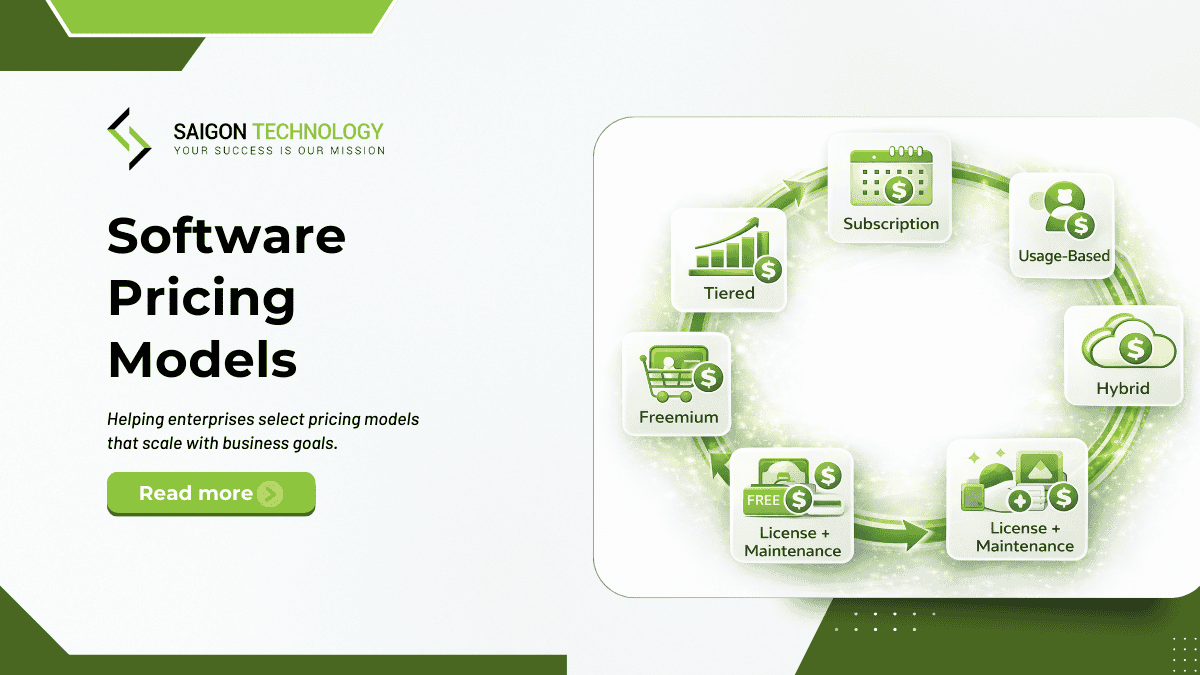
Choosing a software pricing model is more than setting a price tag. It is a strategic move that affects revenue, churn, and growth. In 2026, leading companies treat it as something that evolves with market trends and the broader competitive landscape.
Key Takeaways
- Pricing is a growth lever, not just a number.
- The best software pricing models evolve with customer needs and market changes.
- Clear packaging, billing, and value metrics reduce churn and improve expansion revenue.
This Saigon Technology guide explains the most common software pricing models, when to use each one, and how to adapt pricing as your business scales.
What Is a Software Pricing Model?
A software pricing model is the structure a software company uses to determine how customers are charged for using its product. It defines what customers pay for, such as time, users, usage, features, or value. It also defines how billing is packaged, including plans, tiers, add-ons, and upgrades.
It’s often confused with related concepts:
- Pricing strategy: The logic behind your prices. It includes cost-based pricing, value-based pricing, and competition-based pricing. It should focus on customer perceived value while also considering costs and competitors.
- Product packaging: how features, entitlements, and limits are grouped into pricing tiers
- Software billing models: how charges are invoiced (monthly, annual, prepaid credits, pay-per-use options)
In practice, software pricing models evolve as companies grow. Early-stage startups usually keep things simple to lower the barrier to entry and gain momentum. In contrast, enterprise-level companies often shift toward complex, hybrid models and dynamic pricing.
Types of Software Pricing Models: Pros, Cons, and Examples
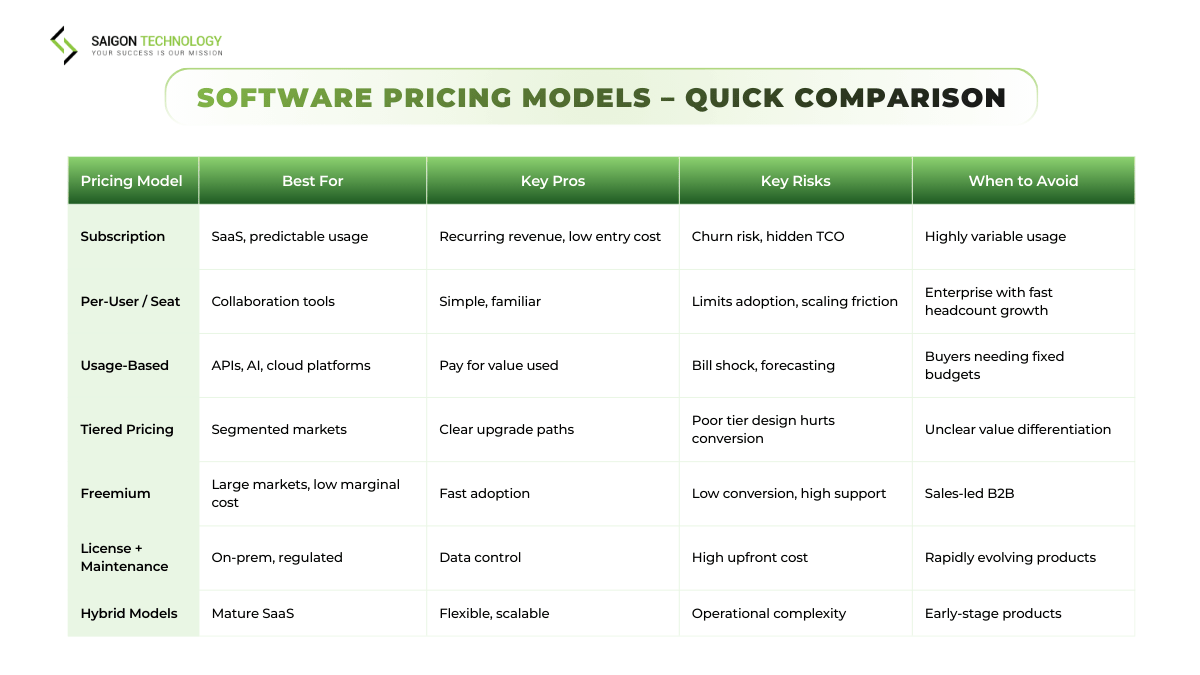
This section explains common pricing models for SaaS and enterprise software. We’ll look at the pros, cons, and when to use each one.
Subscription Pricing Model (Monthly / Annual)
In a subscription model, customers pay a regular fee (monthly or yearly) to keep using the software
Best for:
- SaaS products
- Predictable usage patterns
- Businesses prioritizing recurring revenue
Pros:
- Forecastable recurring revenue and cash flow
- Lower upfront costs for buyers
- Strong alignment with long-term customer relationships
Cons:
- Requires ongoing value delivery to prevent customer churn
- Can hide the total cost of ownership (TCO) and create hidden costs if usage grows unexpectedly
Most software today starts with a subscription. To help companies grow, they often mix it with other options, like charging more for extra features or for how much you actually use. By doing this, the plan stays flexible and scales along with the customer’s needs.
Per-User / Per-Seat Section
In this model, customers pay based on the number of individual users (per-user pricing). While it is the industry standard for simplicity, it carries significant strategic risks.
Common pitfalls:
- Hinders growth: Charging per head stops teams from inviting colleagues. As a result, the software becomes less useful and loses its value.
- Slows expansion: Every new hire triggers a budget debate. Consequently, growing your service within the company becomes slow and difficult.
- Security risks: Users often share logins to save money. This means you lose revenue while the client loses data security.
Enterprise objections: Procurement teams often resist this model because costs become unpredictable as their headcount grows.
Hybrid fixes: To mitigate these risks, consider these strategic adjustments:
- Volume discounts
- User caps
- Bundled seats with feature-based entitlements
Usage-Based Section
This model charges customers only for what they actually use, based on real usage patterns. Common examples include API calls, data storage, or AI compute power.
Why it’s growing:
- API-driven platforms
- AI tools
- Cloud infrastructure and cloud migration challenges
Challenges:
- Revenue forecasting is harder
- Customers fear bill shock
- Requires strong usage data, usage insights, and billing automation
When not to use it: If customers struggle to predict usage or require stable monthly costs.
Tiered Pricing
Tiered packages feature or limit into clear tiers (often “good / better / best”).
Best practices:
- Most customers choose the middle plan, so premium options should reinforce their value, not confuse or pressure buyers.
- Limit your pricing tiers to 3–4. If you offer too many choices, customers become overwhelmed and won’t buy.
Common mistakes:
- Unclear upgrade paths between tiers
- Putting the wrong features in the wrong tier leads to lost revenue.
This model works best when it aligns with customer segmentation and the value customers receive.
Freemium Pricing Model
Freemium offers a free tier with limited functionality, then charges for the full experience.
Works best when
- Marginal costs are low
- The product has strong viral or network effects
- Easily identify when a free user is ready to upgrade based on their activity
Risks
- Free users still require support, increasing costs without corresponding revenue
- If the free tier offers too much value, users have little reason to upgrade
Freemium pricing should be paired with strong usage data, feature usage tracking, and clear upgrade paths.
One-Time License + Maintenance
This traditional licensing model involves upfront license fees plus recurring maintenance fees.
Still relevant for:
- On-premise software deployed within a customer’s own infrastructure
- Regulated industries (Healthcare, Fintech,..) that must enforce strict data control
- Government agencies that prefer one-time budget approvals over ongoing subscription costs
In short, perpetual licensing is declining, yet it remains a critical licensing model. This is because high-security sectors still demand the total data control that only this model provides.
Hybrid Software Pricing Models
Hybrid pricing combines many models, such as:
- Base subscription + usage-based: A fixed monthly fee plus charges for actual usage
- Platform fee + per-user: A flat fee to access the software plus a cost for every added user.
- License fee + support and maintenance: A one-time purchase fee plus recurring costs for support.
Most mature SaaS companies adopt hybrid models to balance predictable revenue, scalability, and customer value.
How to Choose the Right Software Pricing Model
Choosing among software licensing pricing models should be a structured decision, not a gut feeling. To succeed, you must test these five critical factors:
- Target Customer: Is it an SMB or an Enterprise? Consider their budget layers and who actually signs the check.
- Buying Behavior: Do they rank predictability (fixed costs) or flexibility (pay-as-you-go)?
- Value Metric Alignment: What do customers actually value most? Is it the number of users, the volume of data, or specific premium features?
- Sales Motion: Is your product self-serve (simple plans) or sales-led (custom, complex contracts)?
- Margin Structure: Does your plan structure cover infrastructure, onboarding, and ongoing SaaS development costs?
This framework ensures your pricing aligns with real customer value and product differentiation. It moves away from internal assumptions. By doing this, you reduce sales friction and maximize long-term growth.
Software Pricing Models by Business Type
B2B vs B2C Software
B2B Buyers: They focus on transparency and budget alignment. You must provide clear contracts and invoices that meet procurement rules.
B2C Buyers: They prioritize simplicity. As a result, B2C pricing often uses “charm pricing” ($9.99) and flat-rate bundles to drive fast conversions.
SaaS Startups vs Enterprise Software
Early-Stage SaaS: Focuses on traction. Pricing is usually simple. Many use flat-rate pricing to encourage as many users as possible to provide feedback.
Enterprise Software: Focuses on scalability. So, these models focus on license enforcement, entitlement management, and predictable recurring revenue.
As a product matures, its approach must evolve. In short, most successful companies eventually shift from simple flat-rate models to more complex hybrid pricing.
Custom Software Development Pricing Models
For service-based businesses, pricing differs significantly from SaaS due to the software development cost.
Common software development pricing models include:
- Fixed price: Best for projects with a well-defined scope. A clear software development contract is critical to ensure scope alignment, cost predictability, and delivery success.
- Time & materials: Offers the greatest flexibility. But it requires a high level of trust as the final cost is not fixed.
- Dedicated team: Suitable for long-term development. Clients pay for a stable team and ongoing capacity.
- Offshore software: A long-term model where an offshore team works as an extension of the client’s organization.
Underpricing custom work is a common mistake. Understanding regional rate benchmarks and offshore development pricing helps set realistic budgets. When hidden complexity is not factored in, teams end up doing more work for less profit, which hurts delivery quality.
Global Pricing Considerations: Currency, Taxes, and Regional Expectations
Global buyers demand clarity, but “transparency” means different things in different regions. To build trust, your pricing must align with local tax requirements and billing practices.
| Market | Currency & Tax Considerations | Typical Buyer Expectation |
| United States | Prices usually shown before tax; sales tax handled separately | Predictable spend, flexible scaling, and clear contract terms |
| United Kingdom | VAT 20% must be clearly stated on invoices | Total contract transparency for procurement approval |
| EU | VAT applies and varies by country (typically 19%–27%); correct VAT handling is required | Total contract transparency and VAT compliance |
| Australia | GST 10% is commonly included in displayed prices | “No-surprise” pricing at checkout |
| Singapore | GST 9% applies with strict invoicing requirements | Clean invoices and accurate GST handling to build trust |
| Japan | Consumption tax 10% applies; formal invoicing standards | Localized billing and compliance with strict norms. |
| South Korea | VAT 10% with corporate invoicing requirements | Structured enterprise-grade invoicing |
| Taiwan | VAT 5% applies with local documentation expectations | Transparent billing and compliant tax documentation |
| Hong Kong | No VAT/GST, but strong financial governance | Clean pricing, clear contracts |
Localization builds trust. B2B buyers prefer vendors who correctly handle local taxes, currency, and billing requirements.
Ignoring regional requirements creates friction and delays deals. Thus, software licensing pricing models should be designed to meet local expectations from the start.
Common Software Pricing Mistakes to Avoid
Strong software pricing models are built on pricing experiments, including A/B tests. They also rely on continuous research and validation, not guesses. Avoid these growth-killers:
- Blind Copying: Pricing like your competitors without understanding your own unique value.
- Hidden Pricing: Hiding prices behind “Contact Sales” when users want a quick and simple price.
- Option Overload: Offering too many tiers, which leads to decision paralysis.
- Dead-End Paths: Creating unclear upgrade paths that stop users from spending more.
- Data Blindness: Ignoring real customer usage when making pricing changes.
Successful pricing requires continuous experimentation, grounded in real usage data and customer feedback.
Final Thoughts: There Is No “Perfect” Software Pricing Model
There is no universal winner among software pricing models.
The best pricing model:
- Evolve as your product, and customers grow
- Clearly reflect the value customers receive
- Adapt to changing market dynamics and competitive pressure
Instead of copying competitors, strong monetization is built around your own market, product value, and growth goals.
For teams building custom software or scaling SaaS globally, getting pricing right early matters. Contact us to explore a pricing approach tailored to your business.
FAQs
1. What is the most common SaaS pricing model?
The most common SaaS pricing model is subscription-based pricing, billed monthly or annually. It provides predictable costs for customers and recurring revenue for businesses.
2. Is usage-based pricing better than subscription?
Neither model is better for every product. Subscription pricing suits predictable usage, while usage-based pricing works when customers pay based on how much they use.
3. How do software companies price for enterprise clients?
Enterprise pricing is usually custom and contract-based. It often includes a platform fee plus usage, seats, or features. Buyers expect clear contracts, volume discounts, and predictable long-term costs.
4. What pricing model works best for custom software development?
Common models include fixed price, time and materials, and dedicated team. Fixed pricing works best for clearly defined scopes. Time and materials or dedicated teams offer more flexibility for long-term work.


Related articles

8 Basic Software Development Models and Methodologies You Should Know
 Thanh (Bruce) Pham - CEO of Saigon Technology
  12 Jun 2024
ODC vs Other Engagement Models: How to Set Up Your Own ODC
25 Nov 2024 
Fixed Price Software Development (2026): Comparison With Time and Material
03 Oct 2024 
Offshore Software Development: An In-Depth Strategic Guide (2026)
10 Oct 2025 
Software Development Contracts: Controlling Cost, Change, and Risk (2026)
14 Jan 2026