




Build vs Buy Software: How to Make the Right Decision for Your Business

 Updated on Mar 26, 2026
Build vs buy software is a strategic decision where businesses choose between developing custom software tailored to their specific needs (“building”) or purchasing existing SaaS solutions (“buying”). While often framed as a simple cost comparison, this choice directly shapes a company’s ability to innovate, scale, and compete.
A poor build vs buy decision can increase total costs by 2 to 5 times over a 3-to-5-year period, making it one of the most consequential technology choices a leadership team will make.
Why the Build vs Buy Question Keeps Coming Up
The build vs buy software decision resurfaces more frequently today because the economics of software keep shifting. Several forces are driving this:
- More off-the-shelf options than ever. With over 30,000 SaaS products available globally, the “buy” option is more viable today than even five years ago.
- Bespoke development costs continue to rise. Senior developer salaries in the US now average $150K-$180K, making in-house software builds significantly more expensive.
- AI and low-code are lowering the build barrier. Smaller teams can now create solutions that previously required a 10-person engineering team — though this doesn’t eliminate complexity as businesses scale.
At its core, the choice comes down to this: building gives you a tailored solution designed around your exact workflows, while buying gives you faster, more predictable deployment with lower upfront investment.
Yet the decision is rarely one-and-done. Research shows that 66% of software projects exceed their original budget, often because development and integration challenges are underestimated from the start. And as businesses grow, off-the-shelf tools frequently create integration bottlenecks — forcing teams to revisit their build vs buy decision more than once throughout the company’s lifecycle.
When Should You Buy Software Instead of Building?
1. The Problem Is Common and Well-Understood and Widely Solved
Buying software makes more sense when the problem you’re solving is already standardized. For needs like CRM, accounting, project management, or HR, vendors have invested years refining their solutions with input from thousands of customers. If your requirements match 80% or more of what a mature product offers, buying typically wins for speed and reliability.
2. Speed to Market Is the Priority
When a solution needs to go-live in weeks rather than months, ready-made tools are the practical choice. They come up with documentation, onboarding support, and battle-tested stability — making them ideal when time-to-value is the deciding factor.
3. Maintenance and Security Aren’t Your Core Competencies
In the build vs buy software pros and cons, operational overhead is often underestimated. With a purchased solution, the vendor handles updates, uptime, and compliance. This reduces risk significantly, especially for industries that must meet standards like SOC 2, HIPAA, or GDPR.
4. Budget Is Fixed and Predictable
SaaS pricing is easier to forecast, making buying the safer choice when budgets are tight and executive stakeholders need cost certainty. Bespoke development, by contrast, carries more financial variability — particularly if scope changes mid-project.
When Should You Build Software?
1. The Software Is Your Competitive Advantage
Building makes sense when the software directly creates differentiation. If it defines how you operate, deliver value, or serve customers — like a proprietary algorithm, a unique fulfillment workflow, or a specialized data platform — custom application development gives you the control and uniqueness that off-the-shelf tools simply cannot match.
2. Off-the-Shelf Products Force Workarounds
When teams spend more time adapting to a tool than actually using it, the initial “80% fit” becomes a daily burden. Growing inefficiencies — manual data transfers, clunky workarounds, or duplicate entries — often signal that it’s time to build a solution designed around your processes, not someone else’s.
3. You Need Full Control Over Data and Architecture
Organizations with strict security, compliance, or integration requirements often find vendor solutions too restrictive. Building your own software ensures full ownership of data, architecture, and infrastructure decisions, which is especially critical for enterprise software in regulated industries like finance, healthcare, and government.
4. Long-Term Cost Favors Building
Although SaaS solutions appear more affordable initially, costs can grow 3–5x as you add seats, storage, or API calls. Organizations scaling beyond 50–100 users often find that custom delivers a lower total cost of ownership over a 5-year horizon.
Build vs Buy Software: Pros and Cons at a Glance
| Factor | Build Software | Buy (Saas/Off-the-Shelf Software) |
| Upfront cost | Higher ($50K–$500K+, depending on scope) | Lower (monthly/annual subscription) |
| Time to deploy | Can be around 3 months or more than 12 months | Days to weeks |
| Customization | Full control over features and workflows | Limited to vendor’s feature set and configuration |
| Maintenance | Your team’s responsibility (or outsourced) | Vendor-managed updates, patches, and uptime |
| Scalability | An architect to fit your exact growth path | Depends on vendor’s infrastructure and pricing tiers |
| Competitive advantage | High (unique IP tailored to your business) | Low (competitors can use the same tool) |
| Data control | Full ownership and on-premise options | Vendor-dependent; data portability varies |
| Long-term TCO (5 years) | Potentially lower at scale | Grows with usage, seats, and add-ons |
| Vendor lock-in risk | Low (you own the code) | Higher (migration can be costly) |
| Speed of updates | Depends on your team’s capacity | Vendor ships updates automatically |
This comparison provides a starting point, but the right choice still depends on your specific context. The framework below walks through how to make that assessment systematically.
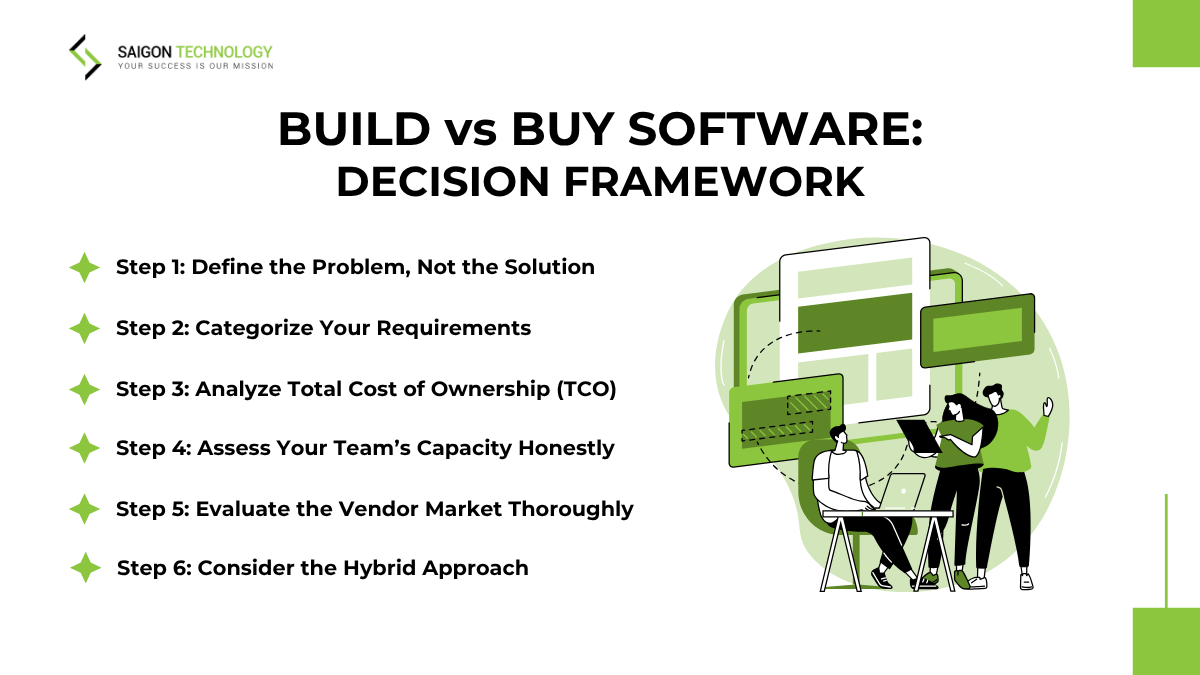
How to Decide Between Building or Buying Software: A 6-Step Framework
A structured build vs buy software decision framework helps teams move past gut feelings and make decisions grounded in strategy, cost, and execution reality.
Step 1: Define the Problem, Not the Solution
Start by clarifying the business outcome you’re trying to achieve, not the tool you think you need. Many teams jump into comparing software or planning development sprints without fully understanding the problem, which leads to misaligned decisions later. Write down the specific workflow, bottleneck, or capability gap you’re trying to address before evaluating any option.
Step 2: Categorize Your Requirements
Break your needs into three groups: must-have, differentiating, and nice-to-have. If most of your requirements are standard and widely available in existing products, buying is usually the better path. But if differentiating features dominate the ones that set your business apart, building becomes more justifiable.
Step 3: Analyze Total Cost of Ownership (TCO)
Look beyond the upfront price tag. A proper build vs buy analysis includes integration costs, training, ongoing maintenance, and potential migration expenses. For building, factor in engineering salaries, QA, DevOps, and long-term support. For buying, account for subscription growth over 3–5 years, per-seat pricing increases, and the cost of vendor lock-in if you need to switch later.
In our experience, integration costs alone can add 30–40% to what companies originally budget for a SaaS implementation, a figure that’s frequently overlooked in early-stage evaluations.
Step 4: Assess Your Team’s Capacity Honestly
Building software requires more than developers. It involves product management, QA, DevOps, security, and long-term maintenance. If your engineering team is already at 80%+ capacity on core product work, building a new internal tool will either stall existing priorities or deliver a half-finished solution. Be realistic about what your team can take on without sacrificing quality elsewhere.
Step 5: Evaluate the Vendor Market Thoroughly
When leaning toward buying, go beyond feature comparison matrices. Review case studies from companies similar to yours, speak with existing customers (not just references the vendor provides), and assess flexibility in contracts, APIs, and data portability. A strong vendor evaluation is one of the most overlooked steps in the build vs buy software decision.
Step 6: Consider the Hybrid Approach: Build vs Buy vs Partner
The decision isn’t always binary. In many cases, the most effective option is a hybrid: buying a core platform while building custom layers on top or partnering with a development firm to accelerate delivery while retaining ownership of the code. This build vs buy vs partner approach is increasingly common among mid-size companies that want custom capabilities without building an entire engineering department.
Common Build vs Buy Decision Mistakes to Avoid
Underestimating the true cost of building. Development is only part of the effort. Ongoing maintenance, updates, bug fixes, and scaling often account for 60–80% of the total lifetime cost. What seems like a one-time investment turns into a long-term commitment that many teams aren’t prepared for.
Overestimating how unique your requirements are. Many teams assume they need a fully custom solution when in reality, most of their needs are already covered by existing tools. This leads to unnecessary complexity, longer timelines, and delayed delivery: solving problems that didn’t need custom engineering.
Ignoring the cost of switching later. Vendor lock-in is widely discussed, but custom-built systems create their own form of lock-in through technical debt, internal dependencies, and gradual loss of documentation as original developers move on. In both cases, changing direction becomes expensive and disruptive.
Letting internal bias drive the decision. The build vs buy software decision is sometimes driven by who’s in the room — a CTO pushing to build because it’s more interesting, or procurement pushing to buy because it’s easier to justify. Without a structured framework, decisions often reflect preferences instead of business priorities.
Treating it as a one-time decision. The build vs buy landscape evolves quickly. What made sense to build three years ago may now be better served by a mature SaaS product — and vice versa. Companies that revisit this decision annually, rather than treating it as permanent, consistently make better technology investments.
We’ve seen companies commit to a 12-month custom build only to realize at month 8 that a $200/month SaaS tool covers 90% of their needs. The sunk cost keeps them building, and the final product delivered late still requires ongoing maintenance that their team wasn’t staffed for. A structured framework prevents this.
Build vs Buy in the Age of AI and Low-Code
The build vs buy software decision is shifting as AI and low-code tools reshape how software gets created.
AI coding assistants are accelerating custom builds. Research from GitHub found that developers using Copilot completed tasks up to 55% faster, making custom builds more accessible to smaller teams. At the same time, SaaS vendors are rapidly embedding AI features into their products — narrowing the gap between custom vs. off-the-shelf software in terms of capability.
Low-code platforms sit in the middle of the build vs buy analysis
They enable faster development without full engineering effort, making them practical for:
- Internal tools and admin dashboards
- Simple workflows and process automation
- MVPs and proof-of-concept applications
However, as requirements grow in complexity, these platforms can introduce limitations, performance constraints, and hidden technical debt, pushing teams back toward either full bespoke development or more robust off-the-shelf solutions.
The real question has evolved
The decision is no longer just “build or buy software.” Today, teams face three paths:
- Build with AI assistance — use AI coding tools to accelerate software development
- Adopt an AI-native SaaS product — buy solutions with built-in AI capabilities
- Combine both in a hybrid approach — balance speed with long-term scalability
Frequently Asked Questions
1. Is it cheaper to build or buy software?
It depends on scale and timeline. Buying software is typically less expensive upfront, with predictable monthly or annual costs. Building requires a larger initial investment but can deliver lower total cost of ownership over 3–5 years, especially for organizations with high user counts or complex workflows. The key is calculating TCO — including integration, training, maintenance, and scaling costs — rather than comparing sticker prices alone.
2. What is a build vs buy analysis?
A build vs buy analysis is a structured evaluation that compares developing custom against purchasing an existing solution. It weighs factors like cost, speed to deployment, flexibility, maintenance burden, and strategic fit. A thorough analysis prevents teams from making decisions based on assumptions or internal bias, and instead grounds the choice in measurable business criteria.
3. How do you calculate the total cost of ownership (TCO) for software?
TCO includes all costs over the software’s expected lifecycle: development or subscription fees, integration and migration, team training, ongoing maintenance and support, and eventual replacement or upgrade. A strong build vs buy framework also factors in opportunity cost — like the engineering hours spent maintaining an internal tool instead of building your core product.
4. When should a startup build vs buy?
Startups should typically buy to move faster and conserve limited resources. Off-the-shelf tools let small teams focus on what makes their product unique rather than reinventing solved problems. Building makes sense when the software itself is the startup’s core product or when it creates a meaningful competitive advantage that available tools can’t provide.
5. What is the build vs buy vs partner approach?
This approach adds a third option: partnering with a software development company instead of building everything in-house or relying entirely on purchased software. It offers a balance between speed, cost, and control — letting businesses own their code and architecture while accessing experienced development teams without the overhead of hiring full-time engineers. This model is especially effective for companies that need custom solutions but lack the internal capacity to build and maintain them.
Making Your Build vs Buy Decision
The build vs buy software decision isn’t a one-time choice — it’s a recurring strategic evaluation. As technology evolves, costs shift, and new solutions emerge, what made sense a year ago may no longer be the right option today.
By applying a structured build vs buy framework — defining the problem clearly, categorizing requirements, analyzing true TCO, and honestly assessing your team’s capacity — you can make confident decisions based on evidence rather than assumptions.
If your build vs buy analysis points toward custom development, or if you’re considering the hybrid “partner” approach, talk to our team at Saigon Technology about scoping your project. We’ve helped businesses across the US, Europe, Australia, and Singapore navigate this decision and deliver custom projects that fit their exact needs.


Related articles

When a Dedicated Team Beats In-House Hiring
 Khoa Nguyen - Offshore Development Consultant
  25 Mar 2026
Choosing Between Models: A Decision Framework for Tech Leaders
19 Mar 2026 
Dedicated Team Pricing in 2026: What Buyers in the US, EU, Australia, and Singapore Actually Budget
13 Mar 2026 
No-Code vs Purpose-Built Software: A Decision Framework for Startup Founders
12 Mar 2026 ![Software RFP Template: Free Guide + Download [2026]](https://saigontechnology.com/wp-content/uploads/software-rfp-template.png "Software RFP Template: Free Guide + Download [2026]")
Software RFP Template: Free Guide + Download [2026]
10 Mar 2026 
Cross Functional Team Roles and Responsibilities: A Practical Guide
09 Mar 2026 
Software Pricing Models: A Complete Guide (2026)
29 Jan 2026 
Software Development Contracts: Controlling Cost, Change, and Risk (2026)
14 Jan 2026 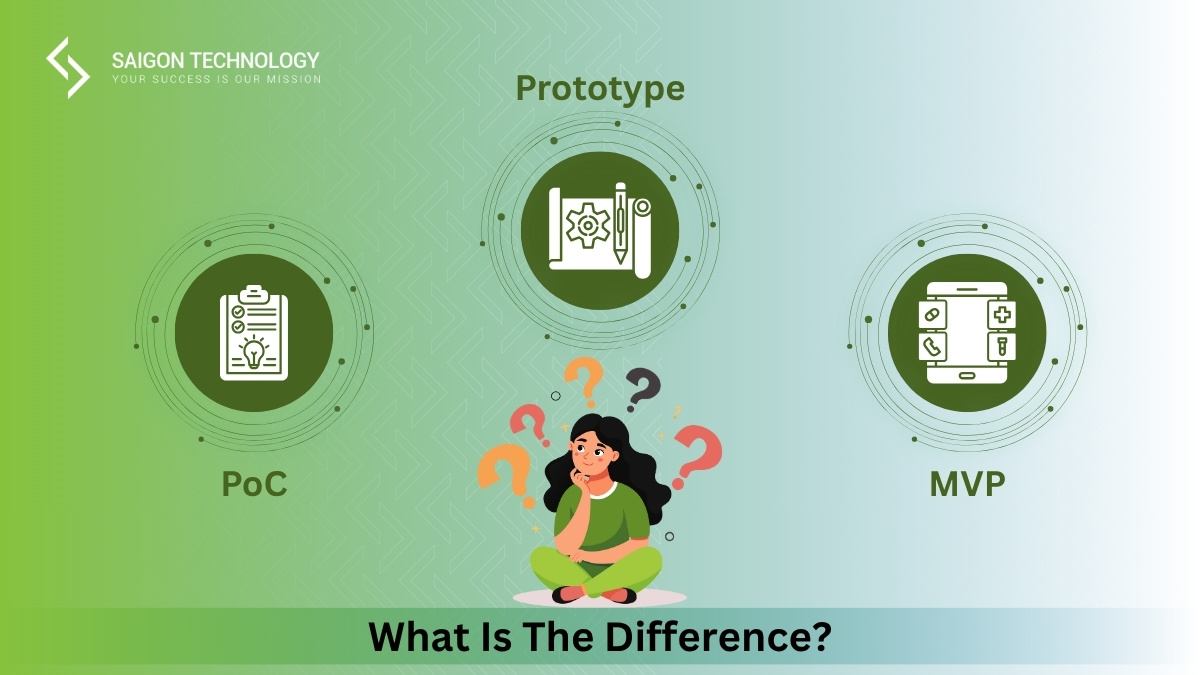
PoC vs Prototype vs MVP: What Is The Difference?
08 Nov 2025